
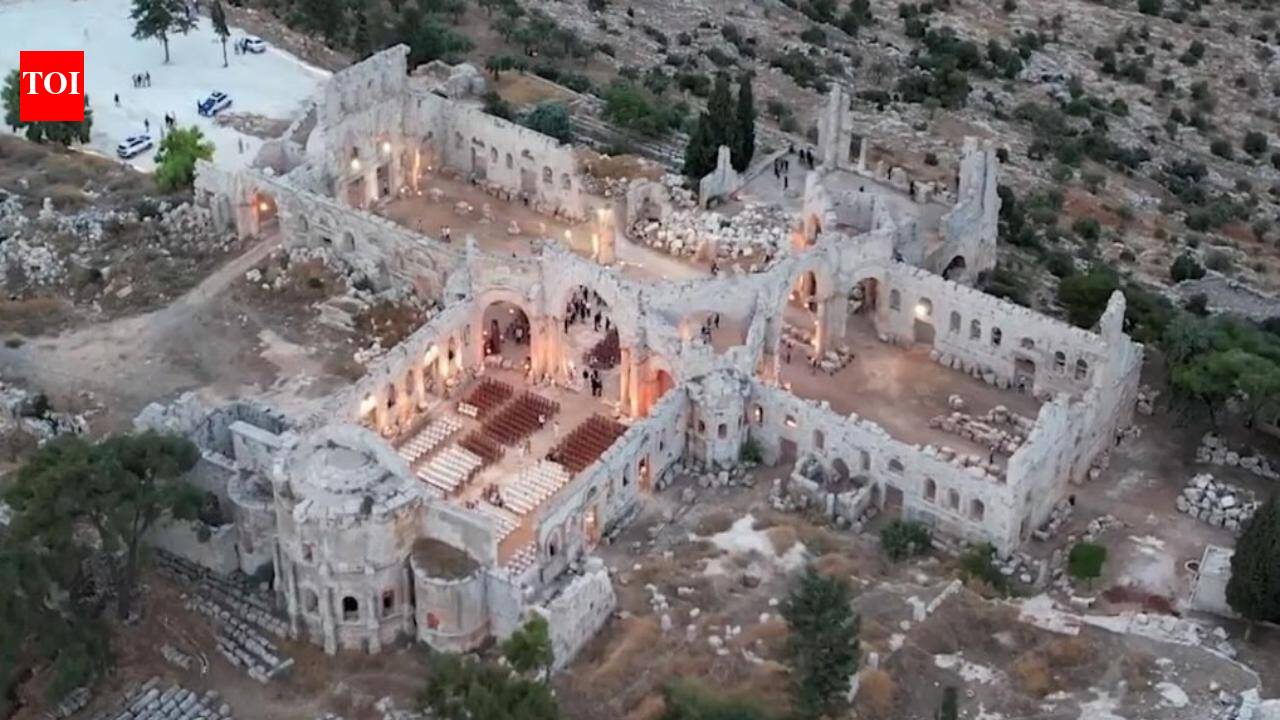
Saint Simeon Church reopens ((via SWNS)An outstanding piece of early Christian history has reopened to visitors in northern Syria. It will offer a fresh opportunity to explore an ancient religious complex that has survived natural calamities like earthquakes, wars and centuries of changes. The Deir Samaan Citadel, associated with Saint Simeon the Stylite and also known as Qalaat Semaan, welcomed visitors again on September 28, 2026 after massive restoration work.Situated in the countryside of Aleppo, the historic site is as old as the fifth century. Its monumental church, monastery, baptistery and processional route once formed an important destination for Christian pilgrims. Today, the complex is part of the Ancient Villages of Northern Syria, a collection of archaeological sites recognised on UNESCO’s World Heritage List in 2011.It’s a significant step in efforts to protect Syria’s cultural heritage.Why is this ancient church complex special?Church complex (via SWNS)The story of the complex starts with Saint Simeon the Stylite, who was a Christian ascetic. He became famous for spending decades living on top of a pillar. As per historical records published by Syria’s Directorate-General of Antiquities and Museums, Simeon was born around 386 AD.He gradually raised his pillar to a height of approximately 18 metres, attracting followers and visitors who came to hear him preach. After his death in 459 AD, the location became home to his religious teachings and ascetic life.Between 476 and 490 AD, during the reign of Byzantine Emperor Zeno, an enormous church complex was built around the pillar. The design featured four basilicas arranged around an octagonal central space. It was a monumental architectural wonder. The complex subsequently expanded to accommodate a baptistery, monastery and accommodation for visitors. It was a massive structure for its time.From a pilgrimage destination to a fortified citadelOver the years and centuries, the place experiences extreme natural disasters and war and changing regimes.Earthquakes between 526 and 528 AD damaged the site. As per official reports, the church's wooden dome above the octagonal section collapsed and was never replaced.Later in the 10th century, Byzantine forces fortified the hill and turned the complex into a stronghold. This military phase gave rise to the name Qalaat Semaan, or the Citadel of Simeon. The fortress subsequently changed hands during regional conflicts and gradually lost its military importance. But later it fell into disuse.What restoration work was carried out?According to Syria's state news agency, SANA, the restoration work included repairing visitor routes and facilities, rehabilitating the main square and reinforcing sections considered structurally vulnerable. Officials also reported work to return the Column of Saint Simeon to its location.An important heritage siteVisitors (via SWNS)Despite its historical importance, the Saint Simeon complex has suffered considerable damage in recent decades all because of the conflict in Syria. It placed archaeological sites across the country at risk from military activity, looting and neglect. According to the site's official historical timeline, the surviving column associated with Saint Simeon was damaged in an airstrike in 2016.The February 2023 earthquake caused further destruction, bringing down the entrance arch and columns of the western section's narthex. These incidents added to the damage accumulated over many centuries.A report prepared by Syria's Directorate-General of Antiquities and Museums for UNESCO in 2026 described serious structural vulnerabilities at Qalaat Semaan, including damage to the church and baptistery. The reopening is therefore an important step towards the site's recovery.Can visitors explore the complex again?Saint Simeon ChurchThe September 2026 reopening has restored public access to the historic complex, allowing visitors, researchers and people interested in archaeology to reconnect with the site. Deir Samaan's reopening is also part of a broader effort to revive tourism in Aleppo province.For now, the return of visitors to the Saint Simeon complex represents a meaningful moment for one of the region's most distinctive historical landmarks.
Syria reopens 1,600-year-old Byzantine church complex after restoration
Full Article
Original Source
Read the full article at Timesofindia →KhanList aggregates and links to publicly available news content. We do not host full articles from third-party sources. Always verify important information with original sources.