
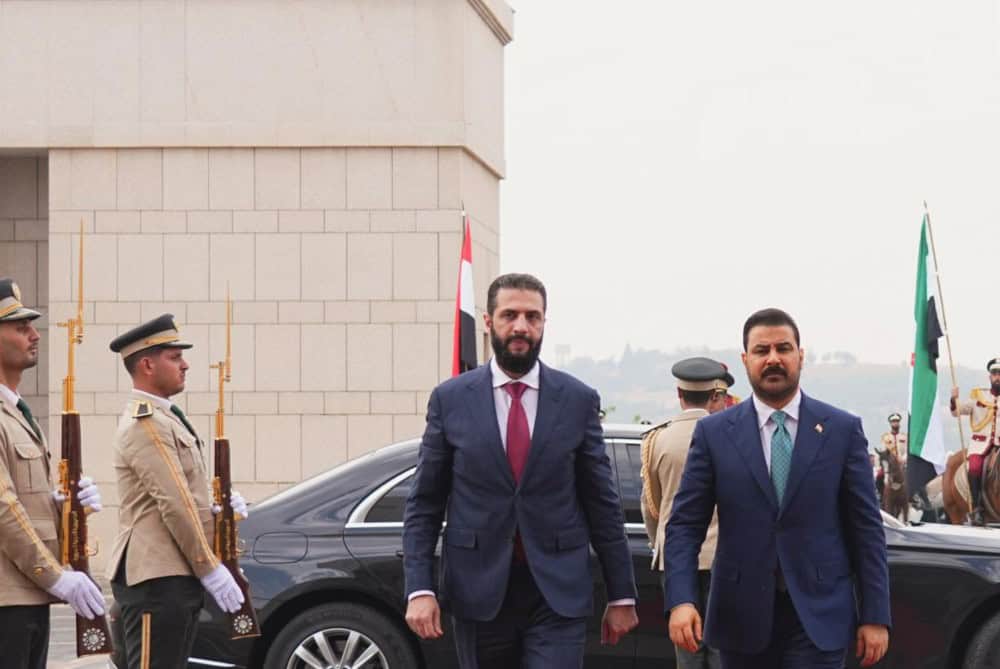
Syrian President Ahmed al Sharaa welcomed Iraqi Prime Minister Ali al Zaidi to Damascus on October 28, marking Zaidi’s first trip to Syria. Sharaa described the meeting as a historic opportunity for the countries to improve ties. This visit took place as Syria continues to face security challenges. Clashes in northern Syria occurred with a French jihadist group on October 28. Separately, Syrian authorities reported that seven civilians were killed in Jordanian airstrikes targeting what Jordan described as Islamic State positions in southern Syria. Sharaa hosted Zaidi at the People’s Palace in Damascus on October 28 for the historic visit. The Syrian Arab News Agency (SANA) said the two held “talks aimed at strengthening bilateral relations and addressing regional developments,” including focusing on trade. “President al-Sharaa said the two countries had an opportunity to regain greater control over regional decision-making and build strong states capable of protecting their interests while pursuing development and prosperity,” SANA reported. Sharaa is a controversial figure in Iraq, particularly among Shiite political factions and Iran-backed militias, because of his history as an Al Qaeda leader and his participation in the insurgency that followed the US invasion of Iraq in 2003. The US designated him a global terrorist in 2013 because of his ties to Al Qaeda in Iraq, but revoked the designation in November 2025, nearly a year after the collapse of the Assad regime and Sharaa’s rise to power in Syria. Zaidi’s visit to Damascus is designed to reset ties. The Iraqi prime minister spoke positively about the prospects for Syria-Iraq relations and described Iraqis and Syrians as “one people in two countries.” The Zaidi visit comes as Iraq is seeking to expand its energy exports via Syria. The countries are seeking to revive a pipeline from Iraq to Syria that could have the capacity of 2 million barrels per day, according to the Iraqi Prime Minister’s Office. Zaidi also traveled to the historic Ummayad Mosque in Damascus and the Shiite Sayyida Zainab shrine. The diplomatic engagement took place as Syria continues to face security crises in its northern and southern regions. In southern Syria, the October 26 Jordanian airstrikes that reportedly killed seven civilians strained relations between Damascus and Amman. Following the strikes, Syria and Jordan reaffirmed their close ties and agreed to establish a joint security committee to investigate the incident and address its repercussions. In northern Syria, there were clashes around a camp housing French foreign fighters in Idlib province. The fighters belong to a group of men who traveled to Syria with their families during the Syrian civil war. Rudaw Media Network noted that “Dakar-born French national, Omar Omsen — known also as Omar Diaby — is considered to be the group’s leader, recruiting extremists from France to Syria through online propaganda videos.” It added that a commander in the group, Abu Ayman al Faransi, was killed while traveling in a car on October 28. The New Region noted that the “French jihadist was killed on Wednesday during clashes with Syrian security forces near a camp housing French jihadists in the northwestern Idlib province, state media reported, adding that a civilian was also injured.” The report added that Idlib province’s internal security command said a patrol had seen a group leaving the “French camp.” This violated a local agreement, and a clash occurred. The confrontation illustrates the continued challenge Syria faces in trying to rein in foreign fighters who remained in the country after the fall of the Assad regime. Some of them have been integrated into the new Syrian security forces. However, others have sought to maintain their independence and continue to pose problems for the government. This is part of a larger challenge Syria faces as it continues to try to reconcile problems from the civil war era. For instance, Kurds who were returning to an area near Tel Abyad in northern Syria were attacked by local civilians on October 26. “Syrians displaced by years of conflict must be able to return home safely and voluntarily, free from violence and intimidation,” a spokesperson for the US State Department told Rudaw. Meanwhile, on October 29, 229 displaced families departed camps in northern Idlib to return to their hometowns across five Syrian provinces. Reporting from Israel, Seth J. Frantzman is an adjunct fellow at FDD and a contributor to FDD’s Long War Journal. He is the senior Middle East correspondent and analyst at The Jerusalem Post, and author of The October 7 War: Israel’s Battle for Security in Gaza (2024).
Syria hosts Iraqi PM for visit amid security challenges in north and south
Full Article
Original Source
Read the full article at Fdd →KhanList aggregates and links to publicly available news content. We do not host full articles from third-party sources. Always verify important information with original sources.