
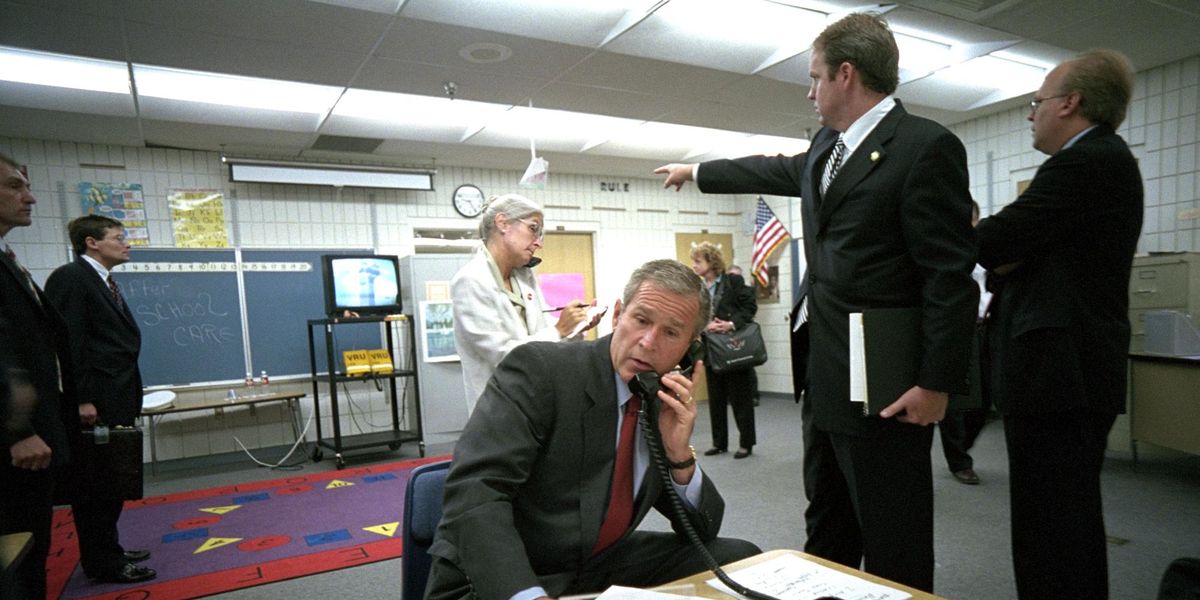
While it is somewhat cliche to say that the “whole world changed” after the Sept. 11, 2001, attacks on the United States, it does not detract from the reality of the statement. In numerous tangible ways, the culture, security, and politics of the nation were never the same after al-Qaida hijackers in passenger planes left nearly 3,000 people dead in smoldering ruins across lower Manhattan, the Pentagon, and a field in Shanksville, Pennsylvania. For many of us who lived through it all, a quarter century has passed in a blink, while at the same time the pre-9/11 Washington era paradoxically seems so far away, and perhaps softened a bit by wistfulness and nostalgia. Conversely, the “post” era is pockmarked by wars, and an expansion of the national security state that was unimaginable a generation ago. Those born too early to witness the events of that day know nothing other than the current atmosphere of hyper-securitization and political polarization. It wouldn’t be an exaggeration to say 9/11 and the “Global War on Terror” that followed are somewhere at the root of these woes.RS asked nearly two dozen foreign and national security experts — journalists, scholars, activists — what they miss most about the America that existed before the attacks on September 11, 2001. Their answers range from the personal to the philosophical, but all emphasize the sense of lament, for innocence and opportunities lost.###Andrew Bacevich; Linda Bilmes; Christopher Coyne; Carolyn Eisenberg; John Feffer; Chas Freeman; Jacob Heilbrunn; William Hartung; Stephen Kinzer; Peter Kuznick; Lora Lumpe; Catherine Lutz; Scott McConnell; Jefferson Morley; Paul Pillar; Peter Van Buren; Katrina vanden Heuvel; Jim Webb###Andrew Bacevich, co-founder of the Quincy Institute, author of “After the Apocalypse: America's Role in a World Transformed” I miss the "post-Cold War Era." During that brief interval between the Fall of the Berlin Wall and 9/11, it was still possible to believe that the United States might somehow salvage the ideals that informed the founding of the Republic. This was an illusion, of course, as events since have definitively demonstrated.Linda Bilmes, Harvard Kennedy School, author of “The Three Trillion Dollar War”On September 11, 2001, President George W. Bush was reading “The Pet Goat” to a group of elementary school children in Sarasota, Florida. At that exact moment, 50 million Americans watched live footage of airplanes being flown into the twin towers in Manhattan. The attacks killed 2973 civilians and wounded some 6000 others. Television and cable stations broadcast the aftermath for 93 continuous hours, the longest coverage for any event in U.S. history. The juxtaposition of this serene book-reading with the carnage unfolding in New York City epitomized a loss of innocence in America. There had not been a foreign attack on U.S. soil since Pearl Harbor in 1941. The 9/11 attacks had a profound impact on the American psyche. My childhood had taken place in a country that felt safe. I knew instantly that my three young sons would grow up in an atmosphere of uncertainty, facing a more dangerous world. I miss the era in which the U.S. felt gentler, and less vulnerable.Christopher Coyne, George Mason University, author of “Tyranny Comes Home: The Domestic Fate of U.S. Militarism”Violence has long been a part of the U.S. government’s foreign policy. But something shifted in the wake of September 11. The “war on terror” normalized repugnant practices of controlling and harming people. Torture, kill lists, drone strikes, global surveillance, and the militarization of police became routine government functions. Even when made public, there was little shame — real or feigned — associated with these actions. The killing of Abdulrahman al-Awlaki, a 16-year-old American, in a drone strike in Yemen, and the airstrikes on civilian wedding parties in Afghanistan, Iraq, and Yemen are but a few examples.Shame regarding U.S. foreign policies that violated laws and basic moral precepts was in short supply prior to 9/11.Carolyn Eisenberg, Historian, Hofstra UniversityOn this day, I especially miss a former student Peter Vega — a New York City fireman — who had joined the department because he wanted "to save people." He had served in the first Iraq War and wanted to do something helpful for humanity. On September 11, his firetruck crossed the Brooklyn Bridge, and Peter entered the tower — where he died trying to save people. His was a voice for peace.John Feffer, author and director of Foreign Policy In Focus at the Institute for Policy StudiesBefore 9/11, “democracy promotion” had not been successfully co-opted by neoconservatives as part of their campaign to topple the foreign governments they disliked and establish America-friendly regimes.I came of political age in the human rights movements in Eastern Europe and the former Soviet Union. I was part of progressive movements on both sides of the Atlantic that quite deliberately promoted democracy. We did so only in solidarity with pro-democracy movements, and the democratic principles we embraced were homegrown, not manufactured in DC thinktanks. We promoted democracy against not only authoritarian regimes of the right but also neo-Stalinist tendencies on the left.Vestiges of those movements can still be found in efforts to oppose Putinism, Trumpism, LePenism, and “campist” movements on the left. What is missing is the belief, in the 1980s and 1990s, that we were part of a historic transformation. Osama bin Laden and the neoconservatives destroyed that illusion.Chas Freeman, former U.S. diplomat, U.S. Ambassador to Saudi ArabiaI miss the Constitution, the Bill of Rights, and the rule of law. These were the things that made the United States great. They have been steadily eroded to create a warfare state in which the executive exercises unbridled power, the legislature defers to the executive, and the courts are politicized.I also miss the interagency policy process in Washington. It has been replaced with ignorant, strategically illiterate decision making that produces forever wars — misadventures with no clear or fixed objectives, dishonest reports on their progress, and no war termination strategies.I miss diplomacy, which is MIA (possibly KIA) in foreign relations that rely exclusively on coercion, including military measures. I miss civility, tolerance, and friendship despite political differences, as well as governance guided by empiricism rather than a priori reasoning and ideological presuppositions. I miss the unflagging aspirations for self-improvement of the country I loved and served for three decades.Jacob Heilbrunn, editor of the National Interest, author of “They Knew They Were Right: the Rise of the Neocons”Once upon a time you could stroll to Dupont Circle or Farragut Square in Washington and frequent an establishment that carried not only newspapers from around the globe but also magazines. It was known as a newsstand. To visit it was to receive a shot of mental adrenaline, a bracing stimulant for what PG Wodehouse referred to as the old pineapple. There, arrayed in serried row after row, was a veritable cornucopia of magazines, from left to right, each promising their very own special induction into the world of ideas. The web, by contrast, cannot spin as enchanting a net to enfold its visitors. In the post-9/11 world, time has sped up and attention spans dwindled. If, like me, you are something of a dawdler, or even a luftmensch, then the vanished era of the newsstand was bliss indeed.William Hartung, co-author of "The Trillion Dollar War Machine"American foreign policy has always included a heavy dose of war and military intervention. But after 9/11 and the passage of the PATRIOT Act, during what was then called the Global War on Terror (GWOT), the urge to intervene accelerated, sparking a period of intensive war making — either through boots on the ground or drone strikes and special forces deployments — in Afghanistan, Iraq, Pakistan, Yemen, and Somalia. The Costs of War Project at Brown University estimates that America’s post-9/11 wars have cost over $8 trillion, and over 4.5 million lives have been lost directly or indirectly on all sides, including a large cohort of civilians. In addition, hundreds of thousands of veterans of those conflicts have suffered severe physical or psychological injuries.Unfortunately, presidents and the majority of the Congress have still not learned from these disastrous examples, as the current war on Iran makes clear.Stephen Kinzer, author of "Overthrow: America's Century of Regime Change from Hawaii to Iraq"Americans used to admire themselves for creating a country that was a force for good in the world. That self-image has been largely shattered. The reality of American power did not change after 9/11, but our fantasy faded. We were rampaging around the world long before 2001. The difference is that today, it is no longer possible to ignore this fact.Denial is an important psychological tool. It allows us to reject unpleasant truths and shield ourselves from guilt and anxiety. Until 9/11, many Americans happily followed what Freud called the “ostrich policy.” That is no longer possible. The nature of American behavior has not fundamentally changed — it just seems that way. What has really changed is that today, our leaders no longer try to hide what they do. The last quarter-century has seen the veil drop from the face of American power. The denial option is no longer available.Peter Kuznick, American University, co-author (with Oliver Stone), “The Untold History of the United States”What I miss most about pre-9/11 America is that nuclear war felt remote — that it had been relegated to the dustbin of history. While neither peace nor the promised post-Cold War "peace dividend" ever actually arrived, the fear of nuclear war that had been so pronounced in the early-to-mid 1980s had largely abated. Nuclear activism, which had been so visible on campuses and beyond, had effectively disappeared. Even Russia and China seemed remote threats. Vladimir Putin was the first foreign leader to offer support after 9/11. Now the threat of nuclear war looms large with the U.S. and Israel losing in Iran, Russia bogged down in Ukraine, and tensions high across Asia. Talk of nuclear war is more pervasive than it's been in decades and a school of nuclear planners has emerged who, according to the Bulletin of the Atomic Scientists, believe that a nuclear war can be fought and won.What I miss most about pre-9/11 America is that it existed at all.Lora Lumpe, CEO of the Quincy InstituteI miss my innocence. I had thought terrorism was not really a threat to the United States. Even after Oklahoma City, the first World Trade Center attack, and the U.S. embassy bombings in Africa, I believed that terrorism was the next in a series of trumped up, post-Cold War threats that the national security establishment conjured to fill the threat gap and keep the money flowing. The war on drugs had not worked, “instability” and humanitarian intervention had not worked. Engagement and enlargement was the best the Clinton administration could do, and the national security budget was flagging. Realizing on 9/12 that I was wrong to have dismissed a real threat and understanding that the response was going to be profoundly bad left me temporarily depressed, but it also made me want to grab life. My daughter was born a tidy 10 months after the attack. She grew up in Washington, DC, blocks from the Capitol and then later a little further out. She went to high school near the State Department. Every day of her childhood – during all of the U.S. military and economic twists and turns that blithely impacted or wrecked lives abroad – I wished that I could once again be dismissive of the very real threat she faced. Catherine Lutz, co-founder of the Costs of War Project, Brown UniversityI miss the America of the 1990s. We hoped that the end of the nuclear-tipped Cold War between the Soviet Union and the United States would mean the transfer of America’s wealth and work to more productive and humane fields of endeavor, at home and abroad. I miss that decade for the opportunity it gave us to begin to imagine what an America at peace could accomplish, how many military bases could be turned into economic opportunity zones, how many military jet and nuclear weapon dollars could be transferred to healthcare, education, home construction, and science. But the military budget dipped a tepid 18% and began to grow again in the last years of the Clinton administration, and to then mushroom to what were once unimaginable levels with the militarism, Islamophobia, federal budget distortions, and other ills that the U.S. government response to 9/11 helped foster. And I miss my WWII and Korean War veteran father who mercifully died a few months before 9/11. He was spared the horror of that day — and of the U.S. response in the years since.Scott McConnell, co-founder of The American Conservative magazine Watching a movie from 1995 (for instance, “Party Girl” filmed in NYC, in the last pre-9/11 moments and before the internet commenced its doleful takeover), brings to mind Talleyrand’s “douceur de vivre” phrase about life before the French Revolution, roughly translated: "Anyone who has not lived in the years around 1789 does not know the sweetness of life."I worked for Pat Buchanan’s 2000 campaign; Pat was brilliant, accessible, terrifyingly prescient. We worked together on a speech about U.S. sanctions on Iraq, all the children they killed, the sheer hatred of America they (and our Israel policies more broadly) were generating throughout the Mideast, and the resulting dangers to us. The speech was delivered at a respectable Washington venue. Alongside Pat’s other warnings against our quest for global hegemony, it was sedulously ignored by the mainstream press, the only press that mattered to most voters at the time. In our post-9/11 social media age, there is less douceur de vivre, but I don’t miss the passing of the unchallenged America-promoting democracy-can-do-no-wrong narrative.Jefferson Morley, editor of “JFK Facts” and author of “The Ghost: The Secret Life of CIA Spymaster James Jesus Angleton” The ten years from 1991 to 2001 were a time when you could something you cannot do now: imagine an America at peace with the world without a cell phone in hand. The Cold War was over, though the habit of conflict persisted in an incipient war on terrorism which after 9/11 became another global conflict in which America cast itself disastrously as moral savior. Now the warfare state is the norm inside the surveillance culture. Thinking our way out of this bind begins with remembering when there was an alternative.Paul Pillar, Georgetown University, author of “Intelligence and U.S. Foreign Policy: Iraq, 9/11, and Misguided Reform”Although I miss some of the same pre-9/11 liberties that many fellow citizens do, I will identify a subject related to my work on counterterrorism in the 1990s as a public official and author. I was deputy chief of the Counterterrorist Center at CIA and subsequently wrote a book about counterterrorism and its relation to U.S. foreign policy. I miss well-reasoned discourse about terrorism and how to combat it — discourse that 9/11 badly distorted and emotionalized. The widespread tendency to treat America’s terrorism problem as if it suddenly began in September 2001 overlooks numerous lessons from the past about the variety of perpetrators and their motivations, terrorist techniques not just imagined but used, and the pros and cons of counterterrorist measures. I have missed being able to apply these lessons, calmly and rationally, and to put terrorism into proper perspective without being dismissed as insufficiently committed to a national crusade.Peter Van Buren, former State Department foreign service, author of “We Meant Well. How I Helped Lose the Battle for the Hearts and Minds of the Iraqi People”There is surveillance in my condo’s hallways. The city's facial-recognition cameras are on every corner, tied to license-plate readers, tied to our digital lives. Vast databases assure us no detail — no one — is too small to monitor.I learn to follow orders at the airport. After becoming an Iraq War whistleblower, I was placed on the SSSS list and sent to secondary screening every time I flew. I never knew who put me there or why. The agents searching me didn’t know either. They were following orders. An algorithm tagged me for something I had no idea I’d done.People once said, “If you have nothing to hide, you have nothing to fear.” Older people still joke about it. My kids don’t know the joke. They grew up assuming this way of life is simply part of life.That’s what we’ve lost, and what I miss most about pre-9/11 America.Katrina vanden Heuvel, publisher of The Nation magazineWhat do I miss about America pre-9/11? No Department of Homeland Security, no ICE, no Patriot Act, no AI. Advocating for peace didn’t seem as tough. We spent more time living, less on our smartphones and social media platforms. There was more time to think, read, converse about news and ideas. Public life was not mediated by toxic, isolating algorithms. I miss Christopher Hitchens as a Nation columnist, pre-Iraq War. Donald Trump was a bankrupt realtor, not the fictitious mogul of “The Apprentice,” nor the president.Jim Webb, former U.S. Senator and Secretary of the NavyWhat do I miss about pre-9/11 America? Real leadership. I served in the Reagan administration for four years as an assistant secretary of defense and secretary of the Navy. Of the presidents in office during my years in government, none surpassed Reagan’s inspirational leadership and experience. When he died on June 5, 2004, nearly three years after 9/11, more than 200,000 ordinary citizens visited his casket at the Reagan Library and at the Capitol Rotunda to pay their respects. The heightened security on Capitol Hill reflected the new normal. But the lines never slowed, often at a rate of 5,000 visits an hour. Setting aside political differences, something truly rare today, people came almost close enough to touch the leader who convinced us that we could be honorable and good. There was no provocation in the lines. For a moment, 9/11 and the Iraq invasion that Washington politicians used to justify it were far away, while America recalled an era fading fast into the mist of history. Watching the line, I thought of novelist Gore Vidal’s words: “you never really know when you’re happy; you can only know when you were happy.” Reagan may or may not have known. But we knew.
Symposium: What I miss most about pre-9/11 America
Full Article
Original Source
Read the full article at Responsiblestatecraft →KhanList aggregates and links to publicly available news content. We do not host full articles from third-party sources. Always verify important information with original sources.