
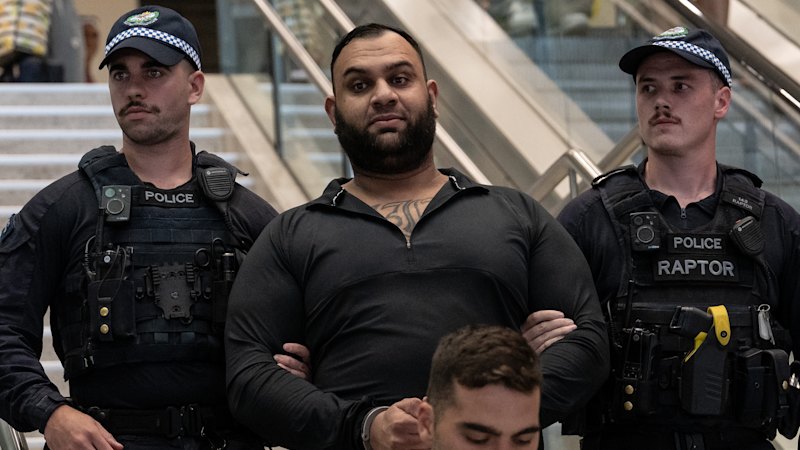
October 21, 2026 — 7:40pmAustralian Federal Police officers encouraged Turkish authorities to deport wanted underworld fugitive Masood Zakaria weeks before local authorities arrested the alleged fugitive at a seaside villa, a court has heard.The crime figure’s removal from the country a year later is now the subject of an unprecedented legal saga sparked by allegations he was illegally deported in what his lawyers say was a “kidnapping” facilitated by AFP officials.NSW Police had issued a warrant for Zakaria’s arrest over an alleged plot to murder a gangland rival.Police MediaZakaria this week launched a highly anticipated challenge in the NSW Supreme Court to have murder charges against him thrown out, arguing that his return to Australia was unlawful and constituted an abuse of process.His lawyers allege the AFP facilitated his removal from Turkey in December 2023 while he was awaiting the outcome of an appeal against his deportation and are seeking to have proceedings against him, including murder charges, permanently stayed.In an email sent in late 2022 and read in court on Wednesday, then-AFP detective sergeant Scott Murphy told NSW Police investigators – whom he called “Zakaria chasers” – that the agency would engage with the Turkish National Police to have Zakaria, an alleged high-ranking member of Sydney’s Alameddine crime family, “blacklisted” and removed from the country because his activities meant he posed too high a risk to continue residing there.Murphy, who was based in the AFP’s Ankara command, proposed five options to have Zakaria removed from Turkey, four of which involved his deportation.Masood Zakaria was brought back from Turkey in December 2023.Wolter PeetersAt the time of the email, NSW Police had been exploring the possibility of extraditing Zakaria from Turkey, with which Australia does not have an extradition treaty. Police have previously alleged that Zakaria fled Australia on a fishing boat after becoming aware a warrant had been issued for his arrest.A month later, in January 2023, Turkish organised crime investigators arrested Zakaria alongside other Australians and foreign nationals accused of committing crimes in their home countries.In another email previously tendered to court, an AFP officer told NSW Police counterparts that Australian authorities needed to “value add to the table” for Turkey to deport Zakaria to Australia, or risk him being sent to another country.A raft of offences Zakaria has been charged with, including the murders of father and son Toufik Hamze, 64, and Salim Hamze, 18, and a conspiracy to murder gangland rival Ibrahem Hamze at the height of an underworld feud in 2021, will not be prosecuted if his application is successful. Trials for those offences were last year vacated after Zakaria’s lawyers levelled kidnapping allegations at the AFP.Zakaria’s legal team says the AFP spent more than $1 million to bring him back to Australia in an Airbus A319,similar to the one in this file picture.Zakaria , 31, was returned to Australia after the AFP, his lawyers say, chartered an Airbus A319 for more than $1 million. He is being held in Goulburn Supermax.“The AFP normally investigates sham payments, but here it’s engaged in one for its own benefit,” Zakaria’s barrister, Murugan Thangaraj, SC, said during his opening address to the court on Monday.A team of six ex-military contractors working for Hart International, a multinational security and risk management firm, flew to Australia with Zakaria after he was escorted onto a plane by heavily armed Turkish law enforcement officials.Under cross-examination, Hart International Australia’s chief executive said the company’s personnel did not restrain passengers, before being shown images appearing to show Zakaria wearing plastic restraints around his wrists.‘I didn’t understand what [the AFP] were seeking to do’: NSW Police Detective Chief Inspector Glyn Baker at court on Wednesday.Sam MooyHart International has been engaged by the AFP for more than 25 years, the executive said, and had returned passengers to Australia in similar circumstances to Zakaria on several occasions. Zakaria’s application has cast doubt on the prosecutions of several of those individuals, who cannot legally be identified.The chief executive, who cannot be legally identified, avoided awaiting media on Tuesday after two NSW Police officers helped her leave via a back exit of Sydney’s historic King Street Courts complex.The executive made a successful eleventh-hour bid to suppress her name and image after arguing that media scrutiny of them would worsen mental health conditions caused by backlash over her role in a botched attempt by current affairs program 60 Minutes to recover two Australian children from Beirut in 2016.Nine, the publisher of this masthead and broadcaster of 60 Minutes, engaged the executive, a former journalist who was working for Hart International, to contain the fallout of the scandal.The team leader on board the flight that returned Zakaria to Australia, Nathan Heckel, was communicating with the AFP and providing regular updates to one of its senior organised crime investigators involved in Zakaria’s return to Australia, according to messages read in court.The executive was unaware Heckel was communicating with the AFP during the operation, she told the court. Zakaria’s lawyers have been unable to contact Heckel, who the executive said was doing security work in Baghdad.NSW Police sent Zakaria’s passport, which was being held at a Sydney police station, to Turkey after a request from the AFP, which said it intended to provide the document to Turkish immigration authorities to “facilitate his eventual deportation”. The passport was handed by Turkish authorities to the Hart International team on board Zakaria’s returning flight, the court heard.Several NSW Police officers raised concerns that Zakaria may be able to flee Turkey if in possession of his Australian passport, the court heard.“I didn’t understand what they were seeking to do,” Detective Chief Inspector Glyn Baker said of the AFP’s intention to have Zakaria deported.Zakaria’s lawyers have cross-examined some of NSW Police’s most senior organised crime investigators, and have subpoenaed AFP Commissioner Krissy Barrett and her predecessor, Reece Kershaw, to give evidence in court.The AFP maintains its actions were lawful. The hearing before Justice Edward Muston continues.Start the day with a summary of the day’s most important and interesting stories, analysis and insights. Sign up for our Morning Edition newsletter.More:CrimeOrganised crimeCourtsTurkeyCourtsPoliceAFPFrom our partners
Sydney underworld kingpin ‘blacklisted’ before alleged kidnapping, court told
Full Article
Original Source
Read the full article at Smh →KhanList aggregates and links to publicly available news content. We do not host full articles from third-party sources. Always verify important information with original sources.