
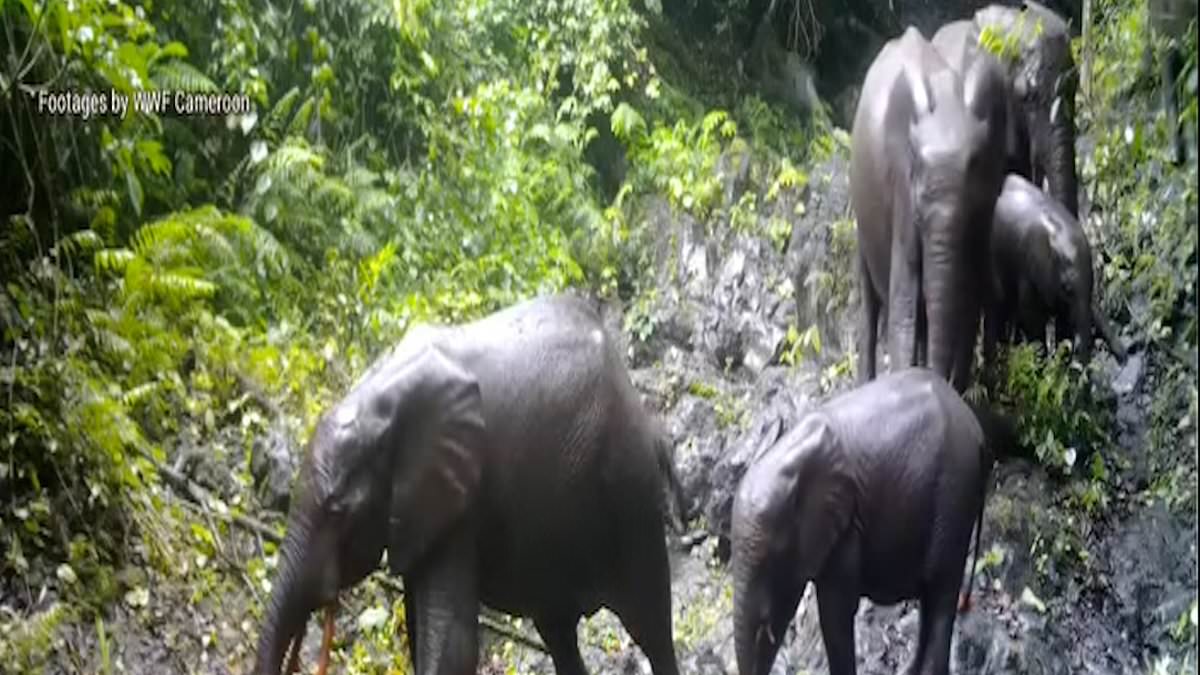
A Swiss man has been killed and a British tourist gored in an elephant rampage on the slopes of Mount Cameroon.The group, consisting of four British tourists, an American, and the Swiss citizen, were hiking the highest mountain in West and Central Africa when they encountered a herd of elephants during their trek.They had chosen a path on their descent that is also used by elephants migrating to a nearby lake. The animals apparently perceived their young to be threatened, prompting them to react aggressively, according to news reports.'They all fled, running in different directions. Some climbed up into the trees,' said a spokesperson for the Ministry of Forests and Wildlife following the incident on Thursday.The Swiss tourist, identified as Throo Alain Mathieu Han, is believed to have fallen into a ditch while fleeing, and was killed after he was impaled by one of the animal's tusks.A British hiker was also wounded but his injuries are not life-threatening. According to the testimony of the tourists, the group's guide was lifted up by the trunk of one of the elephants and put on top of Han, who had been hit already. The group had chosen a path on their descent that is also used by elephants migrating to a nearby lake Shellshocked British tourists describe how they survived the elephant ambush Swiss tourist Throo Alain Mathieu Han is believed to have fallen into a ditch whilst fleeing and was killed by one of the elephantsSpeaking to Cameroon media about the incident, one of the British tourists who successfully escaped said three members of the group 'were all running towards the path. I saw these elephants almost next to me, and I thought, if I go down this path as well, I'm going to get hit.'So I just moved to the opposite direction. They ran down the path, I ran and hid in the bush. I heard some screaming,' he said, adding that he heard one person 'get hit quite early on.'He heard more shouting, and assumed the noise came from the guides trying to scare the elephants off.But he soon realised the screams came from the people being seriously attacked.'I just hid in the tree stump for two hours,' he said.The tourists found Han when he was still alive and talking. They described how he had a black eye, his arm was in pain, and they suspected he was suffering from internal bleeding.The group escorted Han away from the scene on a stretcher they made, but he succumbed to his injuries.'The elephants attacked him, they smashed him,' one man on the tour said. Another British tourist describes how their fellow trekker Throo Alain Mathieu Han was killedAlerted by the guides, the Mount Cameroon National Park team quickly intervened, supported by the military, to secure the tourists and take them to safety in Bakingili.Authorities received Han's remains from the mountain. Two other tourists sustained minor injuries and were treated at the Limbe Regional Hospital in the Southwest Province of Cameroon before being released. A crisis meeting was then held at the sub-prefect's office in Idenau, attended by administrative and forestry officials.There have been clashes between trekkers and the heavy elephant presence on Mount Cameroon for years. African forest elephants are the elusive cousins of the African savanna elephant. They inhabit the dense rainforests of West and Central Africa. Forest elephants have a much slower reproductive rate than savanna elephants, so they cannot bounce back from population declines at the same rate. Their last strongholds are located in Gabon and the Republic of Congo, with smaller populations remaining in other African countries such as Cameroon, Central African Republic, Equatorial Guinea, Côte d'Ivoire, Liberia, and Ghana.Both African elephant species are threatened with habitat loss and habitat fragmentation due to the conversion of forests for agriculture, livestock farming, and human infrastructure. As a consequence, human-elephant conflict has increased. Poaching for ivory is the most immediate threat for African forest elephants, however.Their populations declined by 62 per cent between 2002 and 2011, and during that period, the species also lost 30 per cent of its geographical range. The African forest elephant was declared Critically Endangered by the IUCN in 2021. In April, a South African safari park owner was killed by a charging elephant after claiming he would rather die that way than shoot one of the animals dead. Gary Freeman, 65, was leading a group of tourists on a guided hike when he brandished his revolver to try to scare off the animal but did not pull the trigger.A source said the elephant was 'very quickly' on Freeman, who was a co-owner of the 148,000-acre Klaserie Private Nature Reserve.The source added: 'Gary tried to break the charge but he never fired a shot. The elephant was very quickly on him and it was as you can imagine not pleasant.'There is nothing anyone can do to stop six tonne of angry elephant. Fortunately it was all over quickly.'Freeman's group of four tourists helped to get him on to a vehicle and 'rushed him to try and get medical attention but nothing could be done'.'He had succumbed to his dreadful injuries,' the source said.Freeman had been leading his group along the banks of the Klaserie River inside the reserve, which sits on the western border of Kruger National Park - one of South Africa's largest game reserves - in the north-east of the country.Judy Connors, from Johannesburg, attended Mr Freeman's safari camp at Klaserie in February, writing on Facebook: 'In the past we have heard Gary speak of his deep respect and love for the elephants.'He said he would rather be killed by an elephant than shoot one.'Perhaps this is what I want to believe but there must have been a special bond, soul-to-soul, for this elephant to be the chosen one tasked with his deliverance.'
Swiss man is killed and a Brit gored in elephant rampage: UK tourists hid in tree stumps and climbed trees to stay alive during Cameroon hike
Full Article
Original Source
Read the full article at Dailymail →KhanList aggregates and links to publicly available news content. We do not host full articles from third-party sources. Always verify important information with original sources.