
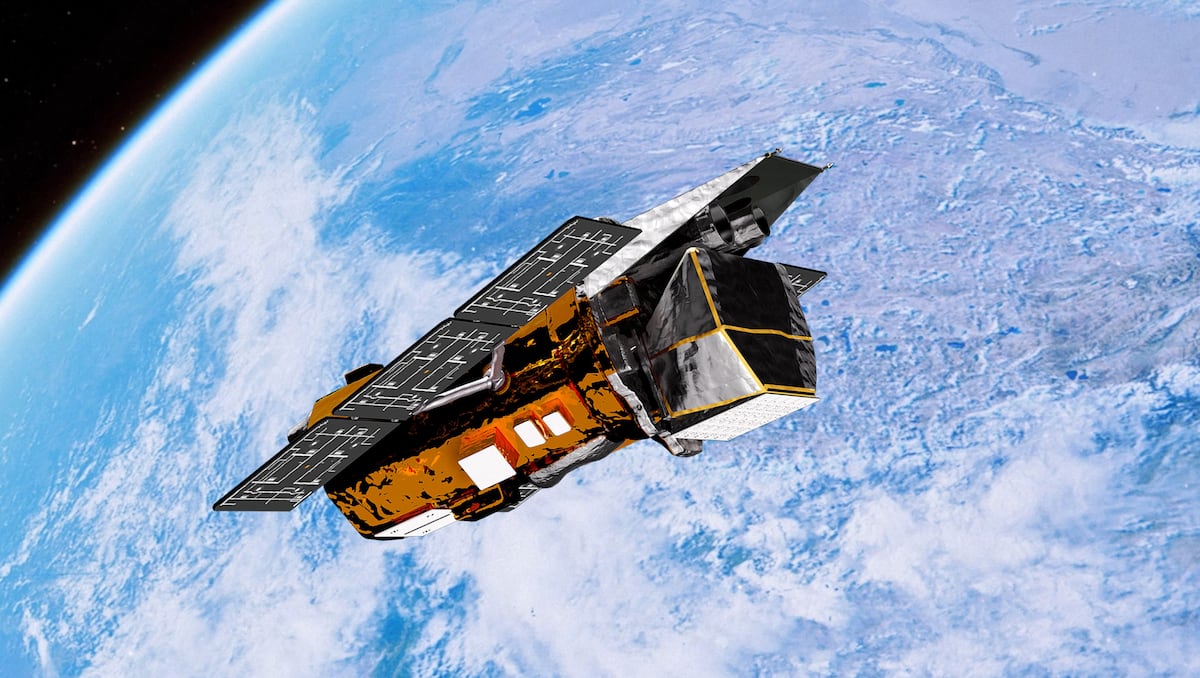
The Swift space telescope is about to be engulfed by Earth’s atmosphere. After nearly 22 years of service, the NASA observatory will re-enter the atmosphere uncontrolled in the coming days, at an unspecified time after sunset on Tuesday. This is the result of the failure of an emergency rescue mission, which the U.S. space agency organized in an unprecedented collaboration with a startup, given the importance this small satellite had acquired for the international astronomical community. With its loss, we are losing a unique tool for detecting the most violent explosions in the universe and alerting other telescopes so they can study them in greater detail.Swift had been, since 2025, very close to the altitude at which an object in orbit inevitably falls and disintegrates, pulled down by Earth’s gravity and heated red-hot by friction with the atmosphere. Past the point of no return, the time and place of its fall can only be calculated with reasonable precision shortly before it occurs. In the meantime, only open-ended estimates exist.Late on Monday, reentry was expected around 10.00 a.m. Wednesday, peninsular Spanish time (4 a.m. EST), with an uncertainty margin of 12 hours before and after, according to calculations by Aerospace Corporation, one of the main organizations that track decaying space objects. For astronomer Joseph Remis, a specialist in these calculations, Swift’s fall could be brought forward by up to four hours. Remis says a solar storm over the past weekend “has significantly advanced the reentry date.”Update: obj. 28485 SWIFT decay prediction: November 04, 2026 UTC 05:31 ± 12hThe October 31 G2 geomagnetic storm increased atmospheric drag, significantly advancing the re-entry date. pic.twitter.com/UpmnA2pO6j— Joseph Remis (@jremis) November 1, 2026 Every day, one or two of the more than 10,000 Starlink satellites in Elon Musk’s network fall to Earth; with limited ability to propel themselves and escape, they have an on-orbit life expectancy of about five years. As with them, the precise impact site for Swift cannot yet be determined. Its orbit traces a band roughly between 21 degrees north and south latitude. Although most of that part of Earth is ocean, it also includes territories in Africa, Asia, and Latin America. During reentry most of this roughly 1.5-ton observatory will disintegrate — it is five times heavier than first-generation Starlink satellites that are falling daily. Still, experts expect a few small, charred fragments to reach the surface.Swift’s descent had been scheduled for the final weeks of 2026, but it was accelerated by solar activity, which increases friction with the upper atmosphere and slows the satellite. NASA announced the end of its operations a few days ago: on October 20 the telescope had descended to an altitude of about 275 kilometers (170 miles) and entered “survival” mode after being unable to compensate for that drag. The high-value scientific telescope then sent the order to terminate its mission and prepare for reentry from the control center at Pennsylvania State University (U.S.), which had been operating it since 2024.A failed rescueOn August 19, NASA and Katalyst Space conceded they had lost the chance to save Swift. The robot sent to rescue it, LINK, suffered an orientation problem that prevented an attempt to capture the telescope and raise its orbit. That probe had launched on July 3, just seven weeks earlier, on a mission never before attempted by NASA. With its failure, the observatory lost its last opportunity and was once again doomed to reenter Earth’s atmosphere. The agency nevertheless kept the objective of carrying out close-approach maneuvers between the two craft to test technologies that could enable future robotic satellite-servicing missions.The operation had been prepared against the clock. In September 2025, NASA awarded Katalyst a $30 million contract, and the company developed the mission in nine months. LINK was to grab an observatory that had never been designed to be towed with three robotic arms and lift it from about 360 kilometers (223 miles) of altitude up to the 600-kilometer (373-mile) height of its original orbit. The goal was to gain several more years of observations. The urgency was imposed by the Sun. Its activity intensified drag in the upper atmosphere and sped up the descent of Swift, which had been operating for more than two decades despite being conceived for an initial two-year mission.Sign up for our weekly newsletter to get more English-language news coverage from EL PAÍS USA Edition
‘Swift’ telescope to crash into Earth after NASA rescue attempt fails
Full Article
Original Source
Read the full article at English →KhanList aggregates and links to publicly available news content. We do not host full articles from third-party sources. Always verify important information with original sources.