
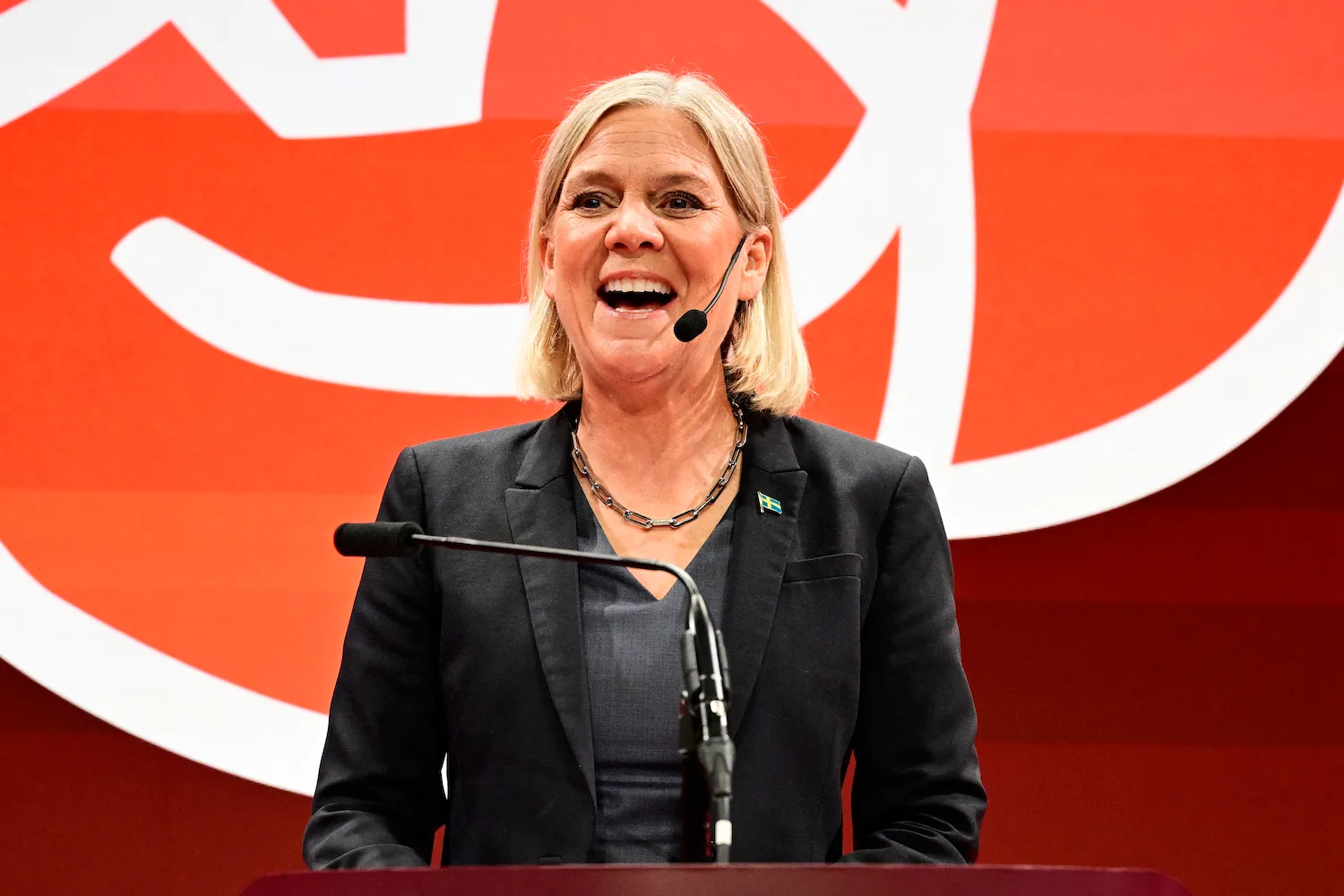
Welcome back to World Brief, where we’re looking at Sweden’s shift to the left, evidence of U.S. war crimes in Iran, and Canada’s response to possibly joining the European Union. An Election Upset What was supposed to be an easy parliamentary win for Sweden’s ruling right-wing coalition instead resulted in a bitter defeat and the formal resignation of Prime Minister Ulf Kristersson on Thursday. Although the center left now faces a tough road to form a government, progressive leaders are hailing the result as a significant blow to the far right, whose influence over Europe has only grown in recent years. Welcome back to World Brief, where we’re looking at Sweden’s shift to the left, evidence of U.S. war crimes in Iran, and Canada’s response to possibly joining the European Union. An Election Upset What was supposed to be an easy parliamentary win for Sweden’s ruling right-wing coalition instead resulted in a bitter defeat and the formal resignation of Prime Minister Ulf Kristersson on Thursday. Although the center left now faces a tough road to form a government, progressive leaders are hailing the result as a significant blow to the far right, whose influence over Europe has only grown in recent years. Analysts initially assumed that Sunday’s parliamentary election would be a shoo-in for Kristersson’s bloc; after all, the premier had unified the country’s right-leaning parties, whereas the left remained largely fragmented. However, Kristersson’s decision to ally with the far-right Sweden Democrats appears to have backfired, as voters seem to have taken issue with the party’s neo-Nazi and white supremacist roots despite the group having successfully pushed forward one of the continent’s strictest migration policies to date. “After four years of a right-wing government with the far right, the Swedes are once again backing the welfare state, social justice and the green agenda,” Spanish Prime Minister Pedro Sánchez, who leads one of Europe’s few progressive governments, wrote on X. According to results released by the Swedish Election Authority on Thursday, Kristersson’s bloc secured 173 seats in the 349-seat parliament. This put the conservative coalition three spots shy of the country’s four left-wing parties, led by the Social Democrats. A mere 50,000 or so votes separated the two sides. The Swedish people have “voted for a new direction for our country, voted for unity and against division,” Social Democrats leader Magdalena Andersson said on Thursday in a victory speech. “The Swedish people have voted to take Sweden forward, and I will realize the new direction that you have voted for.” Among her priorities, Andersson—who became Sweden’s first woman to serve as prime minister in November 2021 but held the post for less than a year—highlighted healthcare reform, immigration, education policy, and climate change. She has already sent invitations to Sweden’s three other left-leaning parties to begin coalition talks, which parliamentary speaker Andreas Norlen will oversee. But such discussions could drag on for weeks—if not longer. Sweden’s four left-leaning parties—the Social Democrats, the Left, the Centre, and the Green—each hold different policy opinions. Whereas the Centre wants tax cuts, the other three favor increases. The Greens oppose nuclear energy, the Left wants a billionaire tax, and the Centre has said that it refuses to be part of any mandate that the Left is in. Such divisions are common in Sweden, where the right-wing bloc also consists of four main parties. In 2022, Swedish legislators took 37 days to form a government. And in 2018, they took a whopping 134 days. Today’s Most Read Why Existential AI Fears Have Hit a Crescendo by Rishi Iyengar Are Chinese Firms Handing the United States Data? by Deng Yuwen Trump and Xi Won’t Find Common Ground on AI Safety by James Palmer What We’re Following War crimes evidence. A United Nations fact-finding mission found “reasonable grounds” on Thursday to believe that the U.S. military committed war crimes when it launched separate strikes on an Iranian school and sports facility in February. On Feb. 28, U.S. forces launched two strikes on civilian targets: an elementary school in Minab, where 156 individuals were killed, including 120 schoolchildren, and a sports hall in Lamerd, where at least 21 people were killed and roughly 100 others were injured. A preliminary U.S. military investigation determined that the United States was at fault for the Minab strike, but the military has denied responsibility for both attacks and slow-walked investigations into the incidents. According to Thursday’s report, the United States’ failure to update its targeting databases and confirm that the Minab building was not a military facility amounted to more than just negligence. “Rather, the U.S. directed the strikes at the building of the school while being aware of a substantial risk of striking a civilian object and acting recklessly as regards the possibility that this would happen,” it said. The report also found that Iranian authorities had committed crimes against humanity during Tehran’s deadly crackdown on anti-government protesters the month before. On Dec. 28, 2025, mass demonstrations erupted across Iran over the country’s high inflation rate and the collapse of its currency. The regime responded with deadly force. In just a few weeks, more than 7,000 people were killed, and tens of thousands of others were arbitrarily detained, according to human rights experts. Iran has not commented on Thursday’s report. Meanwhile, White House spokesperson Anna Kelly denied the allegations, arguing that “the only party in this conflict that has committed war crimes is the Iranian regime.” She went on to accuse the U.N. Human Rights Council, which oversaw the fact-finding mission, of having “accomplished nothing for human rights while spouting unserious nonsense for decades.” Associate member status. Canadian Prime Minister Mark Carney on Thursday welcomed the idea of Canada becoming the European Union’s first associate member. “Europe and Canada are each strong. Europe and Canada are even stronger together,” Carney said in a speech to the European Parliament, just one day after European Commission President Ursula von der Leyen floated the possibility of expanding the bloc beyond the continent. According to Carney, such a partnership would stop short of full membership but would include deeper integration in the trade, energy, defense, critical minerals, artificial intelligence, and space industries, among others. “We do not seek power to dominate others,” Carney added. “On the contrary, we are pursuing resilience so that no one can control our open markets; impair our sovereignty; threaten our territorial integrity; or undermine our freedoms, our democracies, our rule of law.” On Wednesday, von der Leyen similarly insisted that the proposal was not targeted against any one country. But that hasn’t stopped the White House from feeling threatened. Trump warned the EU on Wednesday that granting Canada associate member status could be viewed as a “hostile act” and could prompt him to potentially impose more tariffs on the bloc or even cut off trade with Europe in certain areas. The U.S. president went on to call Ottawa a “terrible trade partner.” Rome seeks new suppliers. Italian Prime Minister Giorgia Meloni met with Norwegian Prime Minister Jonas Gahr Store in Oslo on Thursday to discuss bolstering bilateral cooperation in critical minerals, defense, and energy. As the expanding Middle East conflict exacerbates the global energy crisis, Rome is looking to strengthen its relationships with gas-producing partners outside of the region. In March, Meloni visited Algeria to secure better access to liquified natural gas, and in May, she pursued a stronger critical minerals partnership with Azerbaijan. Her trip to Norway on Thursday is a continuation of that agenda; the Nordic country produces around 40 percent of the European Union’s natural gas imports; holds massive oil reserves; and is home to vast deposits of titanium, graphite, and phosphate. On Wednesday, Aker BP, a Norwegian oil company, discovered a new gas site in the North Sea that the Norwegian government estimates could hold between 1 million and 15 million barrels of oil equivalent. Meloni’s trip marked the first visit to Norway by an Italian leader in nearly 15 years. Several business executives—including those representing Italian aerospace company Leonardo and Italian shipbuilder Fincantieri—also attended the summit. Odds and Ends Looking for a little more “Starman” in your life? A new collection of never-before-heard songs by late singer David Bowie is set to be released on Friday. Called The Shel Talmy Recordings, the album will consist of 22 songs, including 10 newly released tracks and demos produced in 1965, when Bowie was still going by the stage name Davie Jones. For a preview, you can listen to “I Want Your Love” and reminisce about the good old days of a rock legend.
Sweden’s Right-Wing Reckoning
Full Article
Original Source
Read the full article at Foreignpolicy →KhanList aggregates and links to publicly available news content. We do not host full articles from third-party sources. Always verify important information with original sources.