
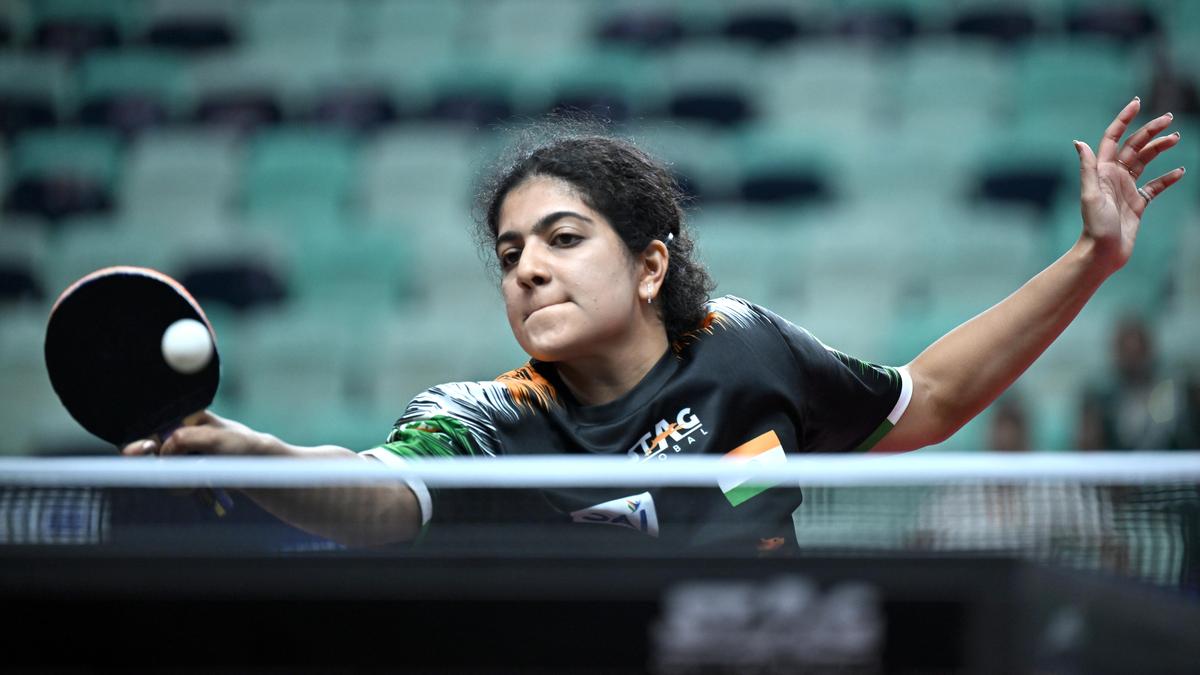
The first thing Swastika Ghosh wanted to do after the biggest win of her career was not celebrate it. She wanted to build on it.On Thursday (September 3, 2026), the 23-year-old Navi Mumbai paddler stunned second seed Miyuu Kihara of Japan 3-1 in the first round of the WTT Star Contender in Almaty, Kazakhstan. Kihara, the World No. 25, had been expected to have the advantage over Ghosh, ranked 149th.Instead, it was Ghosh who walked away with the result. “This is one of the most significant moments of my journey so far. I hope I can build on it and keep improving my game, performance and ranking,” she told The Hindu.She could not quite extend the run, losing to Russia’s Vlada Voronina in straight games in the Round of 16. But the week offered Ghosh something more valuable than another round in the draw: proof that the comeback she had been working towards is beginning to look real.The setbackSwastika has been through a lot in the last two years. In 2024, she visited a sports medicine doctor for a routine check-up after experiencing slight discomfort. The examination revealed an ovarian cyst.What followed was an interruption at an awkward stage of her career. Surgery, eventually performed earlier this year, was not something she had anticipated when the problem was first detected. It forced her to withdraw from the singles events at the National Table Tennis Championship and dealt a blow to her Asian Games ambitions.For Swastika, though, the immediate target was simpler: get back on the table. “The surgery was not expected,” she recalled, explaining how she had been preparing with the team before the medical setback forced her to reassess her plans.A return, however, is rarely just a matter of physical fitness. For a sportsperson who has spent months away from competition, there is the uncertainty of how the body will respond, the loss of match rhythm and, perhaps most significantly, the question of whether the confidence remains.Rebuilding confidenceSwastika understood that her comeback had to answer more than one question. “I am ready, I am here, I belong here” was the message she wanted her performances to convey.There were, in effect, two audiences. One was everyone who had watched her progress and perhaps wondered whether the medical setback would affect her standing in the team. The other was Swastika herself.“Ek cheez message jaana tha, doosra khud ka confidence,” she said — there was the message that needed to go out, and there was her own confidence to rebuild.That confidence has been returning steadily. In August, Ghosh was part of the Indian team that won gold at the 23rd Commonwealth Table Tennis Championships in New Delhi. She is the first standby for the Asian Games and, last week, reached the semifinals of the season-opening National Ranking tournament in Kanpur.The Kihara victory, though, carried a different weight. It was an international statement, against an opponent ranked more than 100 places above her.Learning to train differentlySwastika now has to ensure that such performances become less of an exception and more of a habit. That means negotiating the competing demands of the Indian ranking system and international table tennis.“The system now has weightage both the Indian ranking and the international ranking,” she said. “So in India also, you have to perform.”But preparing for the domestic circuit and preparing for the highest level internationally are not necessarily the same thing. “At the bigger destination, you have to train exactly differently,” she said.That has implications for how Swastika uses her training time. If she is putting in two sessions a day, simply adding more hours is not the answer — the sessions have to serve different purposes, with quality sparring and match situations forming an important part of the preparation.“If you are doing two sessions in a day, one session can be sparring,” she said, referring to the need to replicate competitive situations in training.That becomes particularly important for a player like Swastika, who belongs to a relatively rare breed of Indian women paddlers using plain rubbers. Different opponents present different tactical and technical problems, and what works in one environment may not automatically translate to another.Her physical strengths, too, need to be converted into usable advantages at the table. The objective is not simply to become stronger or train harder — it is to become better equipped for the demands of international competition. That is where the role of her father-cum-coach Sandeep also assumes importance. Swastika has been pushed hard through her career, and the discipline required to make the next step will be no different.The harder partThe medical setback delayed her progress, but it also appears to have altered her perspective. The return itself has become part of the journey rather than something to be taken for granted.The Commonwealth gold was one milestone. The Asian Games standby berth was another. The Kanpur semifinal offered further evidence of her progress. Almaty provided the most emphatic sign yet.After a period in which her career was interrupted by circumstances beyond her control, Swastika finally had the opportunity to tell herself — and everyone else — that she was back. Now comes the harder part: proving it often enough.
Swastika Ghosh’s long road back to the table
Full Article
Original Source
Read the full article at Thehindu →KhanList aggregates and links to publicly available news content. We do not host full articles from third-party sources. Always verify important information with original sources.