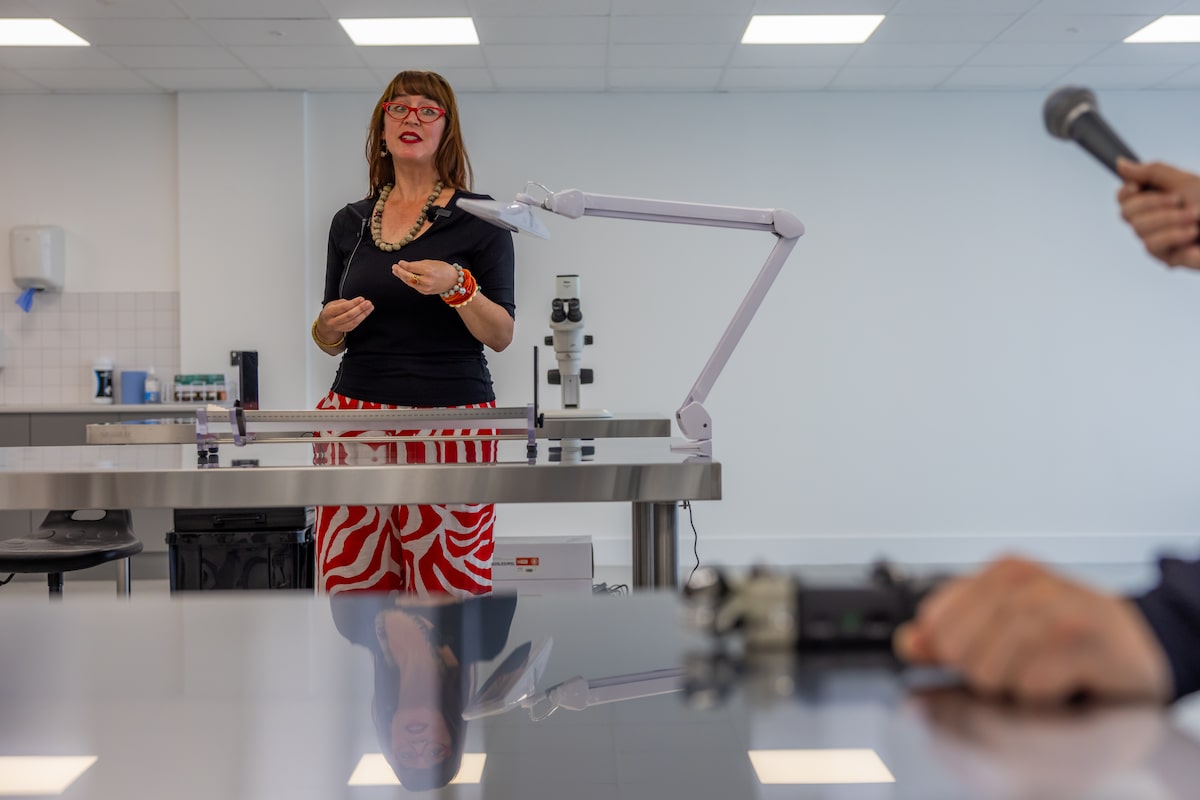
Open this photo in gallery:U.S. forensic anthropologist Allysha Winburn is heading a forensic lab set up in Tuam, Ireland, to help identify the remains of hundreds of children who died at the St. Mary’s Mother and Baby Home.Anna Liminowicz/The Globe and MailPat Duffy tried to keep his emotions in check as he walked by eight stainless steel tables where forensic anthropologists will begin examining the remains of hundreds of long-forgotten children buried in this corner of western Ireland. All Mr. Duffy could think about as he walked past the tables, microscopes and measuring equipment was: “It could have been me.” He and hundreds of other survivors of the St. Mary’s Mother and Baby Home hope this new forensic lab will finally uncover the truth about what happened to nearly 800 children who are believed to have died at the institution, nestled on the outskirts of the small city of Tuam. An Irish town searches for truth as it digs for a long-suspected mass graveLast week, Mr. Duffy was among 100 survivors and family members who toured the lab and met members of the forensic team that will start piecing together the stories of those who died. The people involved say similar techniques could be used in Canada to help identify the thousands of children who went missing from Indigenous residential schools.“It’s a very emotional day for us all,” said Mr. Duffy, 74, who spent the first six years of life at St. Mary’s and is haunted by nightmares and anxiety. “I just thank God the children are being recognized.”Open this photo in gallery:Pat Duffy wears a ring bearing the image of the cross and Jesus. He says he still believes in the Lord, but not the institution, and no longer goes to church.Anna Liminowicz/The Globe and MailSt. Mary’s was one of dozens of homes for unwed mothers scattered across Ireland and other countries, including Canada, between the 1920s to 1990s. They were run by Catholic priests and nuns who shared a belief that women who had a child out of wedlock had committed a sin.For the past year, a team of 16 forensic archaeologists have been combing through the grounds of St. Mary’s, which was torn down in the 1970s to make way for a housing development. They’ve been guided by the work of a local historian, Catherine Corless, whose painstaking research led to the discovery in 2012 that as many as 796 children died at St. Mary’s and were buried in unmarked graves or dumped in sewage tanks. Open this photo in gallery:Experts believe that 796 children died at the home when it was open between the 1920s and 1960s.Anna Liminowicz/The Globe and MailMs. Corless’s findings were ignored for years but after persistent lobbying by the relatives of those who died, the Irish government finally ordered the excavation, which began in July, 2025. Similar efforts have been called for in Canada. In Montreal, officials have been urged to excavate a parking lot at the site of the former Misericordia Hospital, which was run by Catholic nuns for decades, much like St. Mary’s. More than 70,000 unwed mothers gave birth at the Misericordia between the 1850s and 1970s. Nearly forty per cent of those born at the hospital died within one year, and most of the rest were put up for adoption.The site is being redeveloped by Hydro-Québec as a substation, and a recent archeological survey indicated that there could be remains buried in one location under a parking lot.Open this photo in gallery:Raymond Costello, right, and his friend Frank peer through the fence surrounding the former St. Mary’s Mother and Baby Home.Anna Liminowicz/The Globe and Mail“There’s so many of our people that disappeared. Nobody knows what happened to them,” said Kahentinetha Bear, a member of the Mohawk Mothers, which has been pushing for an excavation. “People should know about it, because it gives you a deep-seated anger that you grow up with.”Kim Murray spent two years as Canada’s Independent Special Interlocutor for Missing Children and Unmarked Graves and Burial Sites. She has compared the issues raised in Ireland with Canada’s residential schools. “I see lots of similarities in the failure of the state to respond adequately,” said Ms. Murray.Opinion: I was born in one of Ireland’s Mother and Baby Homes. I know what it’s like to be wary of a Papal apologyOne of the recommendations in her 2024 report was that Canada should establish a commission of investigations into missing and disappeared children. “Canada hasn’t moved on that,” she said. Daniel MacSweeney, who heads the Office of the Director of Authorized Intervention, Tuam, which is overseeing the St. Mary’s excavation, has held meetings with several First Nations in this country to explain the project. “What we’re doing now will be relevant to anybody,” he said. “It’s the first time this has been done, so we’re pathfinders.”Open this photo in gallery:Daniel MacSweeney is the director of the excavation.Anna Liminowicz/The Globe and MailThe archaeologists searching the grounds have found the remains of 99 children so far and they’ve yet to search several large areas or the sewage tanks. That could take another year or more. The newly opened lab is staffed by seven forensic anthropologists who will begin analyzing the remains.Their role “is to tell the stories of these children and to provide a fuller accounting of their lives and deaths,” said Allysha Winburn, an American who is overseeing the lab.Dr. Winburn spent more than 15 years as a consultant to law-enforcement agencies in Florida. She’s also worked with the U.S. military to retrieve the remains of American soldiers who died overseas. Open this photo in gallery:St. Mary’s was torn down in the 1970s to make way for a housing development.Anna Liminowicz/The Globe and MailShe was drawn to the Tuam project after a colleague sent her a link to newspaper stories about St. Mary’s. “I just remember sitting on my couch and reading and reading and going deeper and deeper and crying, and just thinking if not this, then what?” she said. “I feel very strongly that this is where I need to be right now.”She’s been joined by experts from Ireland, Spain, Australia and South Africa. Many specialize in child skeletons and co-mingled remains. The lab is meticulously organized. There’s a climate-controlled storage area and two rows of long examination tables where the remains will be cleaned, measured and assembled into skeletons. Forensic photography is used for more detailed examinations and an odontologist will be able to determine the age of a child based on the growth of their teeth. Two giant plaques listing the names of all 796 children adorn a wall near the entrance of a family room. It’s here where the experts will share their findings with relatives.Open this photo in gallery:Two plaques commemorate the 796 children who died.Anna Liminowicz/The Globe and MailDr. Winburn said the goal is to develop a profile of each child that includes their age, any diseases or injuries they suffered, and details of their daily lives. “We have the resources to tell a story for every deceased person,” she said. “I’ve never had a skeletal case where I could say nothing.”A separate team will extract bits of DNA and match them with samples from descendants to determine identification. So far, 200 people who believe they had relatives at St. Mary’s have provided DNA samples. Niamh McCullagh, one of the forensic archaeologists, approaches her work as a scientist but she’s a mother too and she’ll never forget the first time she saw the bones of a dead child from St. Mary’s. She’d been hired in 2016 by the Irish government to determine whether Ms. Corless’s findings had any merit. On the first day of a test dig, she uncovered the lid of one of the sewage tanks and peered through a crack. Open this photo in gallery:Anna Corrigan, left, speaks to survivors and relatives. She has spent more than a decade searching for information about her two brothers who died at the home.Anna Liminowicz/The Globe and Mail“We could see that at a very great distance from that lid, there was infant remains,” she said. “It was a shock.”She’s not sure how many bodies researchers will uncover but it could be in the hundreds. “It’s not outside the realms of probability that we will find up to 800 individuals.”Mr. Duffy couldn’t stop asking questions when he visited the lab. He wanted to know everything about the forensic process and how many of his lost childhood friends might be found.He’s been tormented by St. Mary’s all his life and battled depression, alcohol addiction and thoughts of suicide. And yet, he hasn’t lost faith and believes that God helped turn his life around.He wears a ring on his right hand that’s decorated with a cross and a depiction of Christ. “I believe in the Lord,” he said firmly. “But not the church.”
Survivors search for answers as pathologists examine remains of buried children in Tuam, Ireland
Full Article
Original Source
Read the full article at Theglobeandmail →KhanList aggregates and links to publicly available news content. We do not host full articles from third-party sources. Always verify important information with original sources.