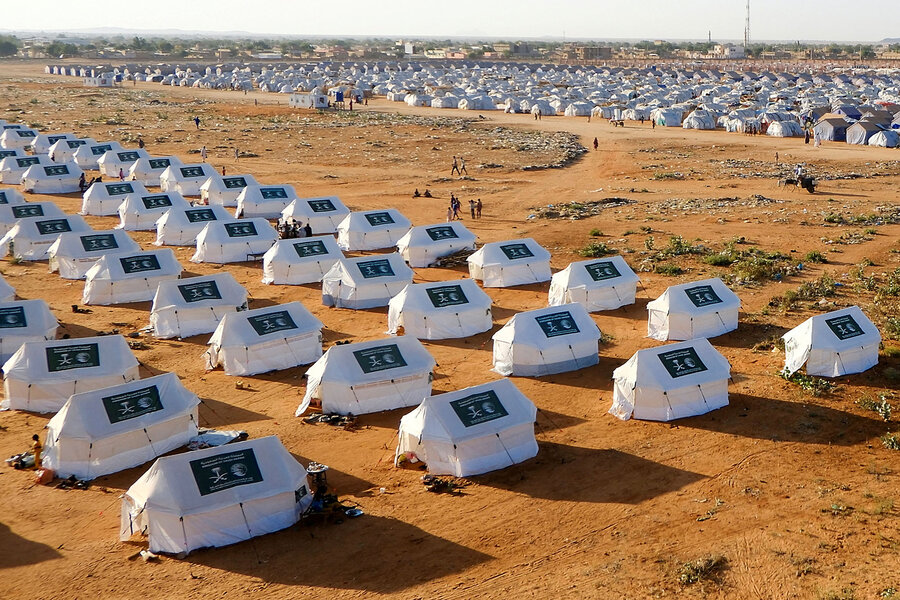
Hamid dove on the ground after hearing a drone whiz by overhead. Seconds later, he felt the earth shake when a nearby fuel tanker exploded.Covered in dust, Hamid got up to check on his friends before running to the site of the blast, where he joined dozens of bystanders and volunteers to take survivors to the hospital.“Many of the injured needed urgent surgery, or they would die,” Hamid says about the June 28 drone strike. The Christian Science Monitor agreed to identify him and other sources for this story with pseudonyms, because they fear retaliation by local military forces. Why We Wrote This Local humanitarian groups in el-Obeid, a city near the front lines in Sudan’s civil war, have set up Emergency Response Rooms to provide critical assistance for the civilian population. Hamid is in his mid-30s, and he’s one of several thousand local relief workers in the city of el-Obeid, Sudan. It’s now the front line of the country’s civil war, between the paramilitary Rapid Support Forces (RSF) and the national army, known as the Sudanese Armed Forces, or SAF.The city sits at a crossroads between SAF-controlled northern and eastern Sudan, and RSF-held territory to the south and west, making it a strategically vital location.Officials from the United Nations – and the United States – have warned that an RSF ground attack could lead to mass atrocities, possibly on the scale of el-Fasher. That city, in Sudan’s vast western region of Darfur, is where the RSF committed genocidal violence after capturing it in October 2025, according to a U.N. inquiry.While the SAF still controls el-Obeid, the RSF has intensified drone attacks in recent weeks. The U.N. documented 15 RSF drone strikes in el-Obeid during a span of three weeks in June that killed at least 45 people.The strikes have continued into July, destroying fuel tanks, markets, and electricity generators. And they are causing shortages of fuel, food, and water for some 500,000 civilians who remain in el-Obeid. Because of the collapse of Sudan’s state institutions and cuts in foreign assistance – including the 2025 gutting of the U.S. Agency for International Development – grassroots initiatives have been forced to shoulder more of the humanitarian response.“We were faced with a choice at the start of the war: Do nothing, or provide services to our people, regardless of who controls the city,” says Hamid.Filling the voidWhen Sudan’s civil war erupted in April 2023, neighborhood groups known as Emergency Response Rooms emerged across the country. They grew out of an old Sudanese tradition called nafeer, which translates as “call to mobilize” or “collective work.”These ERRs rely on remittances, aid grants, and community donations to finance relief efforts. Both warring parties have targeted local activists with these groups for their perceived opposition to either side.Hamid, who works with an ERR in el-Obeid, says volunteers are overwhelmed right now, because clean water is hard to find and medical facilities are struggling to keep up with demand. El Tayeb Siddig/Reuters/File Displaced women from Sudan's South Kordofan state sit on the ground in el-Obeid, Sudan, Jan. 15, 2026. El-Obeid is home to as many as 100,000 displaced Sudanese who have fled the country's civil war. According to the U.N., more than 15 million people have been displaced during Sudan’s civil war, and nearly 20 million face acute levels of hunger. El-Obeid alone hosts at least 100,000 displaced people, many of whom live in makeshift, open-air camps under the scorching sun. Some of the camps consist of hundreds of huts built mainly out of tree branches, straw, and pieces of fabric.“We are doing everything possible to help them,” said Ahmed, another ERR volunteer.“However, there is a major fuel crisis and a lack of transport. The situation is really hard.”Aid shortages and diversionBoth the RSF and SAF have diverted food assistance earmarked for civilians living outside their control, according to the U.N.“Food is the most urgent issue right now [in el-Obeid],” says Hamid. “We also fear there could be a drought in a city that already has limited resources.”Volunteers often buy staples, such as rice and lentils from local markets, and prepare meals for the crowds that gather at communal kitchens. Activists also distribute food to displaced families, prioritizing families staying in abandoned buildings or crowded apartments.The camps are closely guarded by military authorities and receive some food assistance from global aid groups, says Musa, a local ERR member.Meanwhile, volunteers are organizing blood drives amid acute shortages at hospitals. The campaign is critical due to the rising casualties from RSF drone strikes. Musa explains by text message to The Monitor that civilians rely on volunteer facilities, because they can’t trust the SAF to run them.“The SAF-backed Ministry of Health’s priority is to provide medical and life-saving supplies to SAF forces. For instance, civilians don’t benefit from [the ministry’s] blood bank at all,” Musa said.The SAF did not respond to a question from the Monitor about the allegation.Fear and solidarityOver the last 16 months, the RSF has surrounded el-Obeid from the west, north, and south. Some civilians have decided to flee the city, fearing that they could soon face atrocities like those carried out in el-Fasher last year.The population that has stayed is forced to get by with less and less. The threat of drone strikes has dissuaded many traders and fuel-tanker drivers from entering the city, though some still slip through at night on perilous journeys from the east.“It is a huge risk [for drivers] because the RSF targets any trucks that it suspects are carrying support to SAF,” says Montasser, a resident of el-Obeid.Civilians are worried that the RSF could soon cut off access to the city from the east. El Tayeb Siddig/Reuters/File A flock of sheep at the livestock export market in el-Obeid, Sudan, Jan. 17, 2026. That prospect terrifies Hamid, the relief worker who survived the drone strike. He says basic food stocks would quickly disappear. Civilians would also struggle to get out of the city, he adds in a text message.Whatever happens, Hamid insists that he and his ERR volunteers won’t abandon their communities.“The people [of el-Obeid] have faith in us,” he says. “They know that we have to rely on each other.”
Surrounded by warring factions, Sudan’s el-Obeid must rely on local relief
Full Article
Original Source
Read the full article at Csmonitor →KhanList aggregates and links to publicly available news content. We do not host full articles from third-party sources. Always verify important information with original sources.