
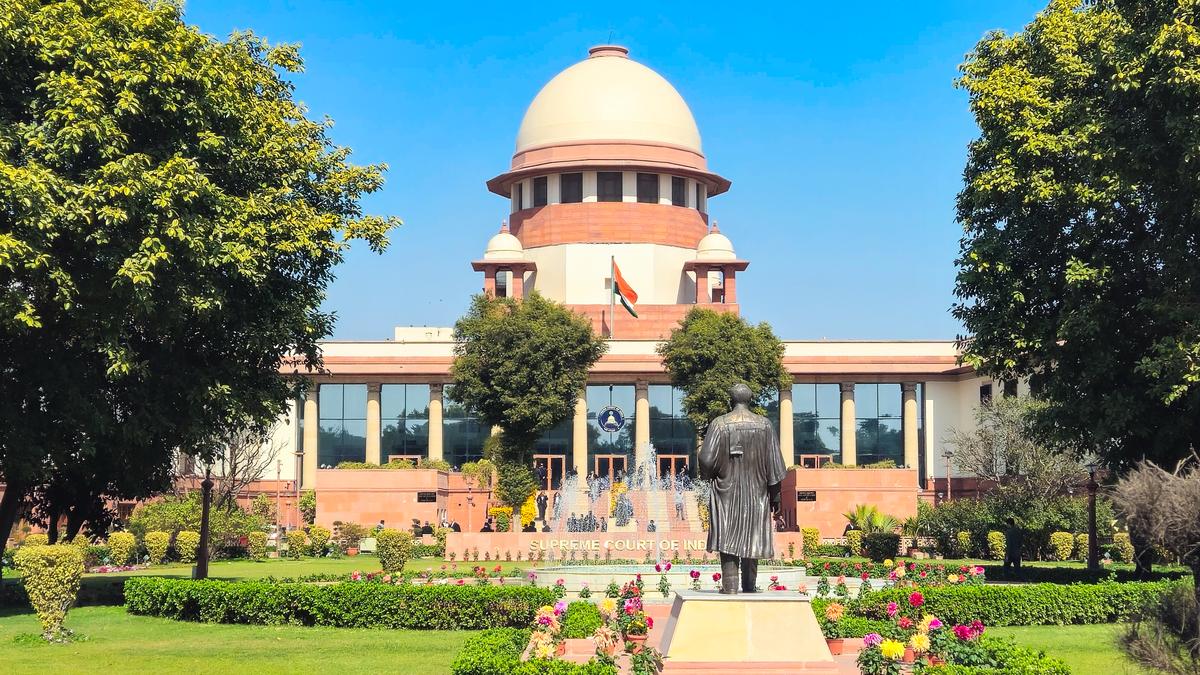
The Supreme Court on Friday (November 27, 2026) observed that regulatory reforms had substantially addressed the principal concerns raised in a plea seeking to facilitate the identification and recovery of unclaimed bank deposits, mutual fund investments and securities by legal heirs of deceased persons. The court, however, declined to mandate the creation of a unified portal for tracing and reclaiming such assets, noting that substantial sector-specific mechanisms were already in place.A Bench comprising Justices Vikram Nath and R. Mahadevan disposed of a public interest litigation (PIL) filed in 2022 by journalist and managing editor of Moneylife magazine Sucheta Dalal. The PIL highlighted the accumulation of unclaimed deposits and investments with financial institutions and the procedural difficulties faced by nominees and legal heirs in recovering them.“…we find that the principal concerns which prompted the institution of the present writ petition have been substantially addressed. The subsequent establishment of centralised search facilities, simplification of claim procedures, strengthening of nomination and transmission mechanisms, and implementation of public awareness initiatives constitute significant progress towards addressing these concerns,” the Bench said, adding that any specific grievance concerning unclaimed financial assets may be pursued before the competent authority in accordance with law.The petition sought directions to streamline the settlement of claims by legal heirs regarding bank deposits, insurance proceeds, post-office deposits and other financial assets to avoid unnecessary litigation. It also stressed the need for a centralised online database under the aegis of the Reserve Bank of India (RBI), providing particulars of deceased account holders, including their names, addresses and the dates of their last transactions.The Bench noted that the RBI had launched the Unclaimed Deposits, Gateway to Access Information (UDGAM) portal in August 2023, enabling individuals to trace unclaimed deposits across multiple banks through a common platform. The search facility was subsequently extended to 30 banks, which together accounted for approximately 90% of the unclaimed deposits held in the Depositor Education and Awareness Fund (DEAF) in terms of value.The Department of Financial Services informed the court that unclaimed financial assets worth approximately ₹6,453 crore had been returned to their rightful claimants as of April 18, 2026, through a nationwide campaign titled ‘Aapki Poonji, Aapka Adhikar’, launched in October last year. Outreach and facilitation camps had been organised across 748 districts.The Bench also noted that the Banking Laws (Amendment) Act, 2025, permitted bank customers to designate up to four nominees. Revised guidelines issued by the RBI in November last year provided for settling death claims within 15 days of receiving complete documentation, simplified procedures for certain claims involving accounts without nomination of up to ₹15 lakh, and compensation for delays.Arguments for unified portalAdvocate Prashant Bhushan, appearing for Ms. Dalal, contended that despite these measures, a comprehensive platform still did not exist through which individuals or legal heirs could identify and reclaim financial assets held across different financial institutions. He further submitted that grievances concerning unclaimed insurance proceeds, post-office deposits and provident funds had not been adequately addressed.The Bench, however, declined to issue such a direction, pointing out that banking, securities, insurance and other financial sectors operated under distinct statutory and regulatory frameworks, with differing requirements concerning ownership, verification and transmission of assets.“While greater coordination between these mechanisms may be desirable, the establishment of a unified platform involves questions of regulatory policy, technical feasibility and administrative coordination. In the absence of any demonstrated violation requiring judicial intervention, we do not consider it necessary or appropriate to mandate the adoption of one particular institutional arrangement, particularly when substantial sector-specific mechanisms have already been established,” the Bench said.The court also declined to order a general investigation into unclaimed deposits purportedly belonging to government bodies, welfare schemes and charitable institutions, observing that the mere existence of such deposits did not establish any illegality in their transfer to the DEAF or a failure of regulatory oversight.Similarly, it refused to issue omnibus directions for penalising banks over alleged non-compliance with RBI circulars in the absence of specific findings of regulatory violations. It clarified that the RBI was at liberty to examine individual instances of default and take appropriate action in accordance with law.While declining to monitor the implementation of these measures further, the court took on record the assurances given by the authorities and said it expected them to continue making the process of tracing and reclaiming unclaimed financial assets more accessible.“We take on record the statements and assurances made in their respective affidavits and expect the concerned authorities to continue their efforts towards improving the accessibility, efficiency and transparency of the mechanisms for identifying and recovering unclaimed financial assets,” the Bench said.SC lauds DalalBefore parting with the matter, the Bench placed on record its appreciation for Ms. Dalal’s efforts in pursuing the litigation, observing that the proceedings had been instituted not for personal gain but to safeguard the financial interests of countless depositors, investors and their lawful claimants.“The concerns raised were genuine, and the pursuit of appropriate institutional measures to address them reflects a responsible exercise of public interest litigation,” the Bench said.
Supreme Court refuses to mandate unified portal for tracing unclaimed deposits; cites regulatory reforms
Full Article
Original Source
Read the full article at Thehindu →KhanList aggregates and links to publicly available news content. We do not host full articles from third-party sources. Always verify important information with original sources.