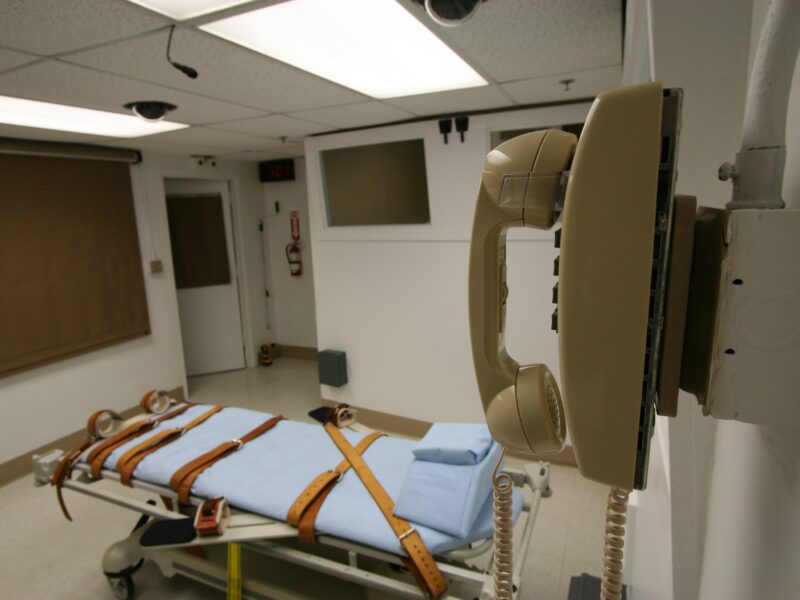
Florida is executing more people than any state across the country, and now the Sunshine State will set a new record by doubling up on two lethal injections in one day. WASHINGTON (CN) — The Supreme Court allowed Florida to proceed with a rare double execution on Tuesday, permitting the state to carry out its 11th and 12th death sentences this year.Republican Governor Ron DeSantis scheduled James Aren Duckett and Dominick Anthony Occhicone Jr. to be put to death just six hours apart on Tuesday, prompting concerns about lethal injection protocols as the state sets an unprecedented execution pace under the modern death penalty.Florida last carried out a double execution over 60 years ago, but it has never done so by lethal injection.Both men asked the Supreme Court for an emergency stay, blocking the Sunshine State from conducting their executions. Duckett, 68, and Occhicone, 81, claimed that the timing and manner of the state’s planned lethal injection procedures created the risk of botched executions.“The Eighth Amendment’s guarantee of protection from cruel and unusual punishment applies both at sentencing and in the carrying out of the sentence,” attorneys for Duckett wrote. “By combining Mr. Duckett’s execution day with Mr. Occhicone’s, the risk of a botched execution is exponentially increased due to factors including the impact of the prison and execution teams not being prepared to conduct two executions on the same day and the risk of errors with the lethal injection drugs.”The Supreme Court denied emergency applications and certiorari petitions from both men without explanation, allowing the executions to move forward. There were no noted dissents.The high court’s short orders came about an hour after Duckett’s execution was scheduled to begin, and he was put to death a short time later. Occhicone’s execution was scheduled for 6 p.m.Duckett was convicted of the rape and murder of 11-year-old Teresa McAbee in 1987 while on duty as a police officer. Prosecutors say Duckett was the last person to be seen with McAbee, and claim her fingerprints were found on the hood of his patrol car.But Duckett has maintained his innocence, arguing he was sentenced to death on circumstantial evidence. In a series of post-conviction appeals, Duckett has claimed key witnesses in the case provided false testimony and challenged limited physical evidence tying him to the crime.In 2003, Duckett was able to get DNA testing on some evidence but wasn’t able to obtain any results due to limitations on the technology. Earlier this year, the Florida Supreme Court stayed Duckett’s execution to conduct additional DNA testing, but the results came back inconclusive.However, Duckett challenged the testing procedures, pushing for additional analysis. The state refused and the Florida Supreme Court vacated his execution stay.Occhicone was sentenced to death for the murders of his ex-fiancee’s parents in 1986. In post-conviction litigation, Occhicone challenged evidence provided to the jury during sentencing, but lost those appeals.After DeSantis signed his death warrant, Occhicone sought public records from the Florida Department of Corrections related to the state’s lethal injection protocols. He raised concerns about the availability of execution drugs, his health conditions and the psychological effects that Florida’s multiple executions have had on correctional staff.Occhicone will be the oldest prisoner executed in Florida’s modern history.Florida urged the justices to deny emergency appeals from both men, claiming the court needed to bring finality to cases that have been unsuccessfully litigated for decades. The state argued there is no precedent finding that double executions constitute cruel and unusual punishment.“Petitioners contend that scheduling their executions on the same day constitutes cruel and unusual punishment because it could result in their needless suffering because of the alleged additional stress placed on the execution team, which may increase the likelihood that the execution team will make a mistake,” the state wrote. “But as the Eleventh Circuit correctly concluded: This claim rests on pure conjecture that the execution team will fail to perform Florida’s lethal-injection procedures correctly.”Florida is one of only two states that allow non-unanimous jury verdicts for death sentences. The jury in Duckett’s case recommended the death penalty in an 8-4 vote, while the jury in Occhicone’s case returned a 7-5 recommendation for death. Under current state law, however, at least eight jurors are required to impose a death sentence.Opponents to the death penalty argue that non-unanimous sentencing heightens the risk of executing innocent people. According to the Death Penalty Information Center, Florida has had 30 exonerations from death row — the most of any state.Last year, Florida executed 19 individuals, more than any other state and over twice the previous record of eight executions in 2018. In 2026, the state had already executed an additional 10 people prior to Tuesday’s scheduled lethal injections.Subscribe to our free newslettersOur weekly newsletter Closing Arguments offers the latest about ongoing trials, major litigation and rulings in courthouses around the U.S. and the world, while the monthly Under the Lights dishes the legal dirt from Hollywood, sports, Big Tech and the arts.Additional Reads
Supreme Court lets rare double execution move forward in Florida
Full Article
Original Source
Read the full article at Courthousenews →KhanList aggregates and links to publicly available news content. We do not host full articles from third-party sources. Always verify important information with original sources.