
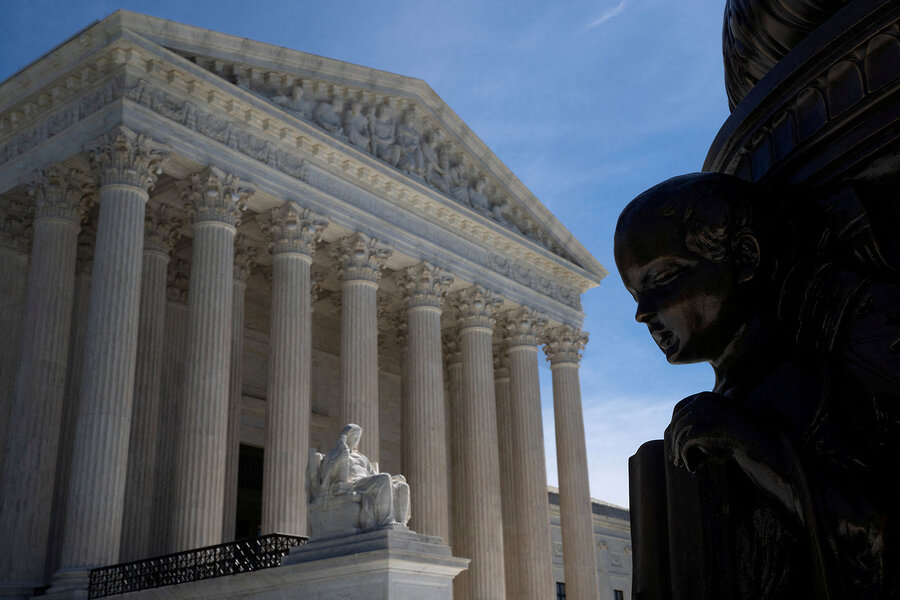
The U.S. Supreme Court will gavel in a new term on Monday, and it will do so with its public approval at record lows.In theory, members of the nation’s highest court – and the federal judiciary as a whole – aren’t supposed to worry about public approval. Judges and justices are supposed to follow the law, not public opinion, which is why the Constitution grants them lifetime appointments. Where electoral politics might leave Congress and the president vulnerable to majoritarian impulses, an independent judiciary is designed to check such impulses when they exceed the law.At the same time, the Supreme Court needs the public to trust that it’s doing its job properly, since justices have no independent mechanism for ensuring their rulings are followed. It has been several years since a majority of Americans viewed the court positively, however. Polls, while an inexact science, show that public trust in all institutions – especially government institutions – has been declining for years. The Supreme Court has historically enjoyed stronger public approval than Congress or the presidency, but that support has waned amid both a steady stream of decisions favoring conservative policies and intense criticism from President Donald Trump and his allies when courts have ruled against his administration’s priorities.The current lows in public approval have been exacerbated by a drop in confidence among Republicans over the past year, even as overall support for the court remains higher among conservatives. Support among Democrats and independents stands at record lows, according to Gallup polling from September.“It’s just very hard to be a national institution these days that maintains public trust,” says Aziz Huq, a constitutional law scholar at the University of Chicago Law School. “The court is caught in the broader story of increasing partisan polarization in the United States.” “When the court loses legitimacy,” he adds, “it’s not later regaining all the support it loses.”Perhaps mindful of that, the high court is displaying some indications that it’s taking criticism into account, court-watchers suggest, although the influence of public opinion is likely to remain limited.What’s behind the dropMore than half of the country doesn’t like how the Supreme Court is doing its job.In July, Pew found that 53% of Americans surveyed had an unfavorable opinion of the court. Gallup’s September survey found that 61% of U.S. adults disapprove of how the court is doing its job, higher than at any point since 2001. SOURCE: Gallup, Pew Research Center, Supreme Court | Jacob Turcotte/Staff Some changes have been tied to high-profile, politically coded decisions from the court. High Republican approval rates, for example, have followed decisions overturning a national right to an abortion in Dobbs v. Jackson Women’s Health Organization in 2022 and declaring affirmative action at universities unlawful in 2023.That trend appears to have shifted. Republican approval of the court has dropped in recent months, likely because of decisions the justices made to strike down key Trump administration policies on tariffs, birthright citizenship, and the deployment of the National Guard domestically. Meanwhile, approval of the court on the left has barely shifted, in contrast with recent history when decisions favoring liberal policies – such as upholding the Affordable Care Act and declaring same-sex marriage constitutional – were followed by spikes in Democrats’ approval of the court. Morry Gash/AP/FileAfter the U.S. Supreme Court struck down Roe v. Wade in 2022, abortion legislation returned to the state level. Here, protesters in 2023 make their way to the Wisconsin Capitol rotunda during a march supporting the overturning of Wisconsin's near total ban on abortion, Jan. 22, 2023, in Madison, Wisconsin. Ultimately, polling’s usefulness is limited, especially for an institution like the Supreme Court, writes Kate Shaw, a professor at the University of Pennsylvania Law School, in an email. “‘Approval’ and ‘disapproval’ are imprecise ways to ask about the court, when we’re mostly interested in the public’s trust in the court, and its confidence that the court rules based on legal principles rather than pure politics,” she adds.The causes of this decline are many, court-watchers say.When Mr. Trump confirmed his third justice in 2020 – cementing a six-justice supermajority of Republican appointees on the high court – Republicans might have expected the dawn of a new era of conservative jurisprudence.But that hasn’t quite played out, with the court’s rejection of some flagship Trump administration policies in the past term, even as it also expanded presidential power over the executive branch.“Where liberals view the Supreme Court as handing President Trump a great deal of power, some right-of-center observers are going to perceive the court as hobbling President Trump and his political agenda,” says Justin Driver, a professor at Yale Law School. While the court’s decision-making is a significant factor in how it’s perceived, other factors could also be at play. J. Scott Applewhite/APPresident Donald Trump greets (from left) Chief Justice of the United States John Roberts, Associate Justice Elena Kagan, Associate Justice Brett Kavanaugh, and Associate Justice Amy Coney Barrett as he arrives for his State of the Union address at the Capitol in Washington, Feb. 24, 2026. After rulings that have gone against his priorities, President Trump has publicly criticized the justices he appointed. The integrity of the Supreme Court, and the judicial branch as a whole, has been publicly questioned by Mr. Trump. The GOP leader described some justices in February as an “embarrassment to their families.” He criticized justices twice in September, seeming to focus his rebukes on his three appointees. Those statements have come as violent threats against judges at all levels have been increasing.The Supreme Court has also been criticized for its lack of a clear ethics policy and questionable ethical behavior by some justices.The country is “in an era in which people generally view government as captured by elites,” says Professor Huq.Given its makeup of nearly all Ivy League grads, several with deep government ties, he adds, the Supreme Court “suffers from the distrust of elites more than other national bodies.”The consequencesIs the depth and breadth of disapproval something the justices should be taking into account as they go about their work? Some observers note that the court seems to have changed one practice on account of public criticism.In recent years, the court has been faulted for how it uses its emergency docket. Intended for short, procedural orders, the justices have instead been using the docket to make substantive legal decisions with perfunctory orders that offer thin or zero legal reasoning, after minimal briefing and, often, no oral argument.In the last two terms, however, the court seems to have changed its behavior, providing more written explanation and, at times, holding oral arguments. According to Steve Vladeck, a Georgetown Law professor who tracks the emergency docket, during the 2024-2025 term, the court issued 28 orders on the emergency docket, and only three came with written opinions explaining the decision. During the 2025-2026 term, the court issued 19 such rulings, and eight came with written opinions from the majority. “To me, [that change is] evidence that they’re aware of criticisms,” says Professor Driver at Yale.Justice Elena Kagan said as much during congressional testimony on Capitol Hill in July, when she noted that on the emergency docket, the court had “done a better job in the recent past of explaining ourselves ... at least to a moderate degree.” But could public opinion influence the justices’ regular merits docket rulings in the upcoming term, when they consider cases after full briefings and oral arguments? Professor Driver is doubtful.“It’s not their job to be popular, is how they would perceive it,” he says. “They would also say, whether an opinion is popular today isn’t necessarily indicative of whether a decision will be popular 25 years hence.” ALREADY A SUBSCRIBER? LoginReal news can be honest, hopeful, credible, constructive.The Christian Science Monitor was founded in 1908 to lift the standard of journalism and uplift humanity. We aim to “speak the truth in love.” Our goal is not to tell you what to think, but to give you the essential knowledge and understanding to come to your own intelligent conclusions. Join us in this mission by subscribing.
Supreme Court hits record low approval: What it means for the new term
Full Article
Original Source
Read the full article at Csmonitor →KhanList aggregates and links to publicly available news content. We do not host full articles from third-party sources. Always verify important information with original sources.