
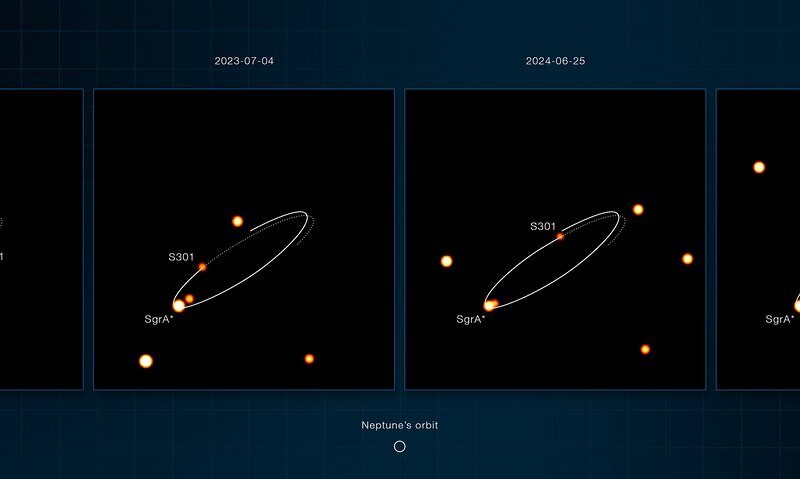
Stellar movement near the supermassive Sagittarius A may offer scientists evidence for the long-held understanding that black holes rotate.(CN) — A cosmic dance between a star and a nearby supermassive black hole in the middle of the Milky Way was first observed by physicists in Germany recently, with new implications for how black holes work — and even the origins of the Milky Way.A study published Wednesday in the journal Nature reveals a star designated S301 is sensitive to the movement — and suspected rotation — of Sagittarius A, the nearest supermassive black hole to Earth. At about 26,000 to 27,000 light years away, Sagittarius continues to be a source of theories and fascination, especially for its power.Scientists at the Max Plank Institute for Extraterrestrial Physics in Garching, Germany, observed S301 rapidly accelerating — at over 15,500 miles/second, or 8% of the speed of light — as it approached the black hole.“That is unheard of,” Stefan Gillessen, a senior staff scientist at the institute and one of the authors of the study, said in an email to Courthouse News. “In that instance of time, it will be the fastest (macroscopic) object in the galaxy.”The scientists say the measurements of the star using the European Southern Observatory’s Very Large Telescope Interferometer give insight into Sagittarius A, without directly measuring the black hole. S301 has an 8.7-year orbit around the black hole.“Black holes in general relativity have just two additional degrees of freedom beyond mass: spin and charge,” the authors note in the study. “Astrophysically relevant is the spin. As all objects in the universe rotate, we expect the same for black holes, in particular, because the angular momentum of material creating a black hole is conserved.”Sagittarius A is a dormant black hole, meaning it isn’t actively feeding on a nearby star or pulling in surrounding matter. It also doesn’t produce high levels of X-ray radiation.Because a star close to a black hole can be a test case for certain measurements, S301’s sensitivity to Sagittarius A could indicate its gravitational potential, its gravitational redshift, and help scientists postulate about its possible rotation.“For some of the massive ones found in the centers of galaxies, there is a particular reason to believe they rotate: The presence of jets, large outflows of material, is only understandable if the central engine rotates,” Gillessen said about supermassive black holes. “Yet, we have no direct evidence that they actually do rotate. So, we can test our very basic understanding of how black holes work.”Not only can S301’s movement provide insight into Sagittarius A, it also provides more data for possible theories about other supermassive black holes, and about the origins of the Milky Way galaxy — and the universe.“Interestingly, black holes relate to their host galaxy, and galaxy formation is tightly coupled to black hole growth,” said Gillessen. “Knowing the rotation of Sagittarius A will tell us a lot [about] how the black hole was being fed in the past. Since when is it dormant? How did it get its mass? These questions are entangled with its rotation.”In future research Gillessen and the team hope to get a more precise measurement of Sagittarius A’s spin, and with that knowledge, a broader understanding of interstellar space.“We assume that the galactic center is a laboratory nearby,” Gillessen said of the relationship between S301 and Sagittarius A. “[It’s] telling us also how things behave in galaxies much further away.”Subscribe to our free newslettersOur weekly newsletter Closing Arguments offers the latest about ongoing trials, major litigation and rulings in courthouses around the U.S. and the world, while the monthly Under the Lights dishes the legal dirt from Hollywood, sports, Big Tech and the arts.Additional Reads
Superfast star could be following the lead of a black hole’s spin
Full Article
Original Source
Read the full article at Courthousenews →KhanList aggregates and links to publicly available news content. We do not host full articles from third-party sources. Always verify important information with original sources.