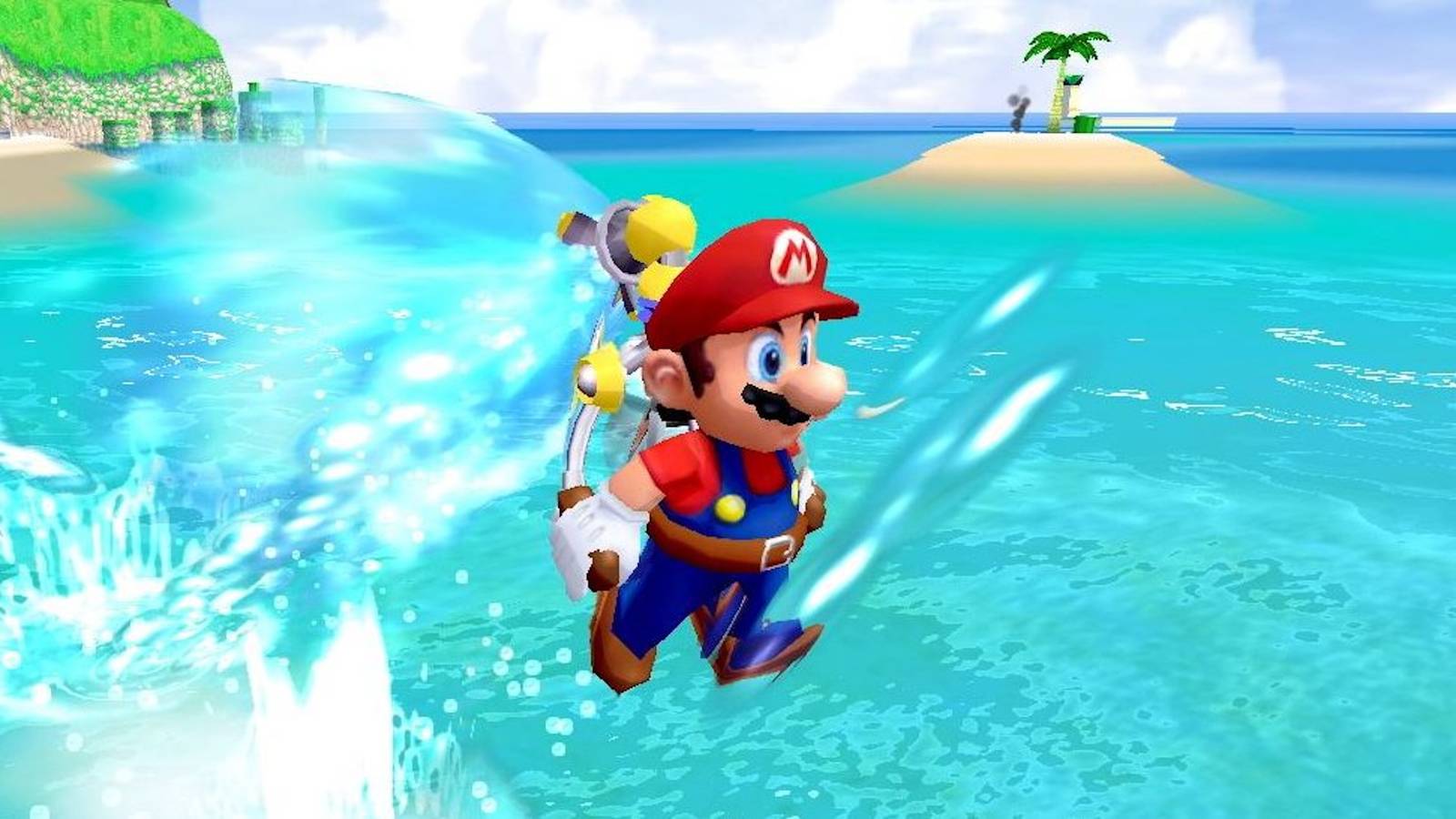
Published Aug 13, 2026, 11:00 AM EDT A Fludd of memories 24 years later, Super Mario Sunshine is still a revelation Image: Nintendo I can’t remember what I had for lunch yesterday, but I still remember the day Super Mario Sunshine launched in 2002. It was a summer's day and I couldn’t wait to line up at the GameStop in the Natick Mall to pick up my pre-ordered copy. It was getting rave reviews — a 9.4 from IGN, a 9.75 from Game Informer, perfect marks from Nintendo Power! — so it felt like an instant classic. Players at the time seemed to agree, considering that the 3D platformer would go on to become the third best-selling GameCube game of all time. Everyone loved Super Mario Sunshine. In 2026, that sounds like a bit of revisionist history. These days, Sunshine is regarded as one of Nintendo’s most divisive games; it’s both overrated and underrated at the same time. Some players continue to go to war for it, praising its wealth of creative ideas. Others are proud haters who point to poor camera controls and a handful of dud levels to give its apologists a reality check. Switch 2 owners will get to play jury this week, as Super Mario Sunshine is available now as part of Nintendo Switch Online’s GameCube collection. Allow me to play the role of prosecution as you dive into Mario’s most polarizing adventure: Despite some undeniable flaws, Super Mario Sunshine is the one Mario game that best captures the ethos of the entire series. Even today, I am still happy to go to bat for one of Nintendo’s most inventive and focused games. Super Mario Sunshine was a heck of a curveball in 2002. Rather than following up the generational Super Mario 64 with a reliable sequel that included more levels in the more-of-the-same vein, Nintendo put an inventive twist on the traditional 3D platformer. Mario could still jump, but he also got a water-squirting backpack (the FLUDD) which he could use to clean up the polluted Isle Delfino. It doubled as a traversal tool too, giving him the ability to hover and rocket boost with the power of water. That more or less replaced your standard power-ups, aside from Yoshi. To this day, Super Mario Sunshine is still the most experimental Mario game by a mile. Rather than throwing players into straightforward platforming gauntlets, it played more like a grab bag of level design ideas. A casino filled with water-controlled slot machines! A rollercoaster boss fight! A watermelon-rolling challenge! Some ideas worked better than others (two-word horror story: Pachinko minigame), which is partially why Sunshine has such a split reputation in recent years especially. You’ll no doubt bump into at least one level you downright loathe if you’re playing it for the first time in 2026. Image: Nintendo But here’s the thing: That’s why I love Sunshine. Yes, even returning to it decades later, unclouded by kid vision. Its willingness to get weird with the Mario formula makes for a creatively unpredictable game that’s eager to keep you on your toes. It feels like the true predecessor to Super Mario Bros. Wonder in that way. In that game, grabbing a Wonder Flower is like opening a blind box; you never know what wild effect it’s going to trigger. Sunshine plays with that idea from a big-picture level. One minute you’re hanging onto a giant sand bird for dear life, the next you’re butt-stomping solar panels. For every idea that doesn’t land, there are far more that continually surprise and delight me on every playthrough. All of this could have made for a disjointed collection of levels, but Sunshine remains remarkably cohesive throughout. That’s thanks to its tropical island setting, which aesthetically unites every location. It looks and sounds like a summer vacation, right down to the excellent soundtrack filled with ukulele and steel drums. It’s one of the few Mario games, 2D or 3D, that feels like it's set in an actual place rather than a collection of carefully themed levels that fulfill a platforming checklist. Ricco Harbor, for instance, brilliantly transforms a dock into a jungle gym made up of steel girders. That location fits right in next to Gelato Beach, a breezy getaway populated by roaming Cataquacks. Image: Nintendo I don’t mean this as a knock against games like Super Mario Odyssey, which are more invested in building a variety of playgrounds rather than one thematically-linked one. That’s arguably part of the appeal of a Mario game, dating as far back as Super Mario Bros. 3; these are kingdom-trotting adventures. The trade-off is just that you’re sometimes left with levels that are memorable on an individual basis, sometimes in a vacuum within the broader game they are part of. Sunshine instead imagines how every level in a Mario game can feel part of a specific place, something later explored in the Switch’s excellent Bowser’s Fury. Even then, it’s still consistent with the series’ broader philosophy. If I had to explain the heart of a Mario game in as few words as possible, I’d say that they’re all about travel. Each game is about setting you loose in unfamiliar worlds and tasking you with figuring out their languages in real-time. You are a tourist in Super Mario Bros. 3. When you enter the desert world, you quickly need to learn about tornados, hopping blocks, and a very angry sun to successfully navigate to Bowser’s castle. Mastery comes once you’re fluent in a level’s special quirks. You can apply that same idea to anything from Super Mario Land 2: 6 Golden Coins to Super Mario Odyssey. Image: Nintendo Sunshine is the most logical iteration of that design philosophy. You’re quite literally a tourist. Every Mario game feels like exploring a new place while you’re on a summer vacation, so why not set a game on an island complete with a hotel resort? Sunshine is a lens that you can view the entire series through, and it will help you see classic games in a new light. As imperfect as it can feel in spots, Sunshine remains a personal favorite from an important moment in Nintendo history. The GameCube era saw Nintendo eager to reinvent its most beloved franchises, completely rethinking what they look like while still holding on to their core DNA. It’s the kind of thinking that gave us The Legend of Zelda: Wind Waker, a game that was despised for its art upon reveal but has since become a fan favorite. It’s where we got Metroid Prime, and learned how Samus’ adventures are defined by isolation rather than 2D platforming. It’s where we got Donkey Kong Jungle Beat, a bongo-smashing adventure that set the stage for Bananza in retrospect. Super Mario Sunshine fits right into that proud lineage, whether you love it or hate it.
Super Mario Sunshine is Better Than Ever on Switch 2
Full Article
Original Source
Read the full article at Polygon →KhanList aggregates and links to publicly available news content. We do not host full articles from third-party sources. Always verify important information with original sources.