
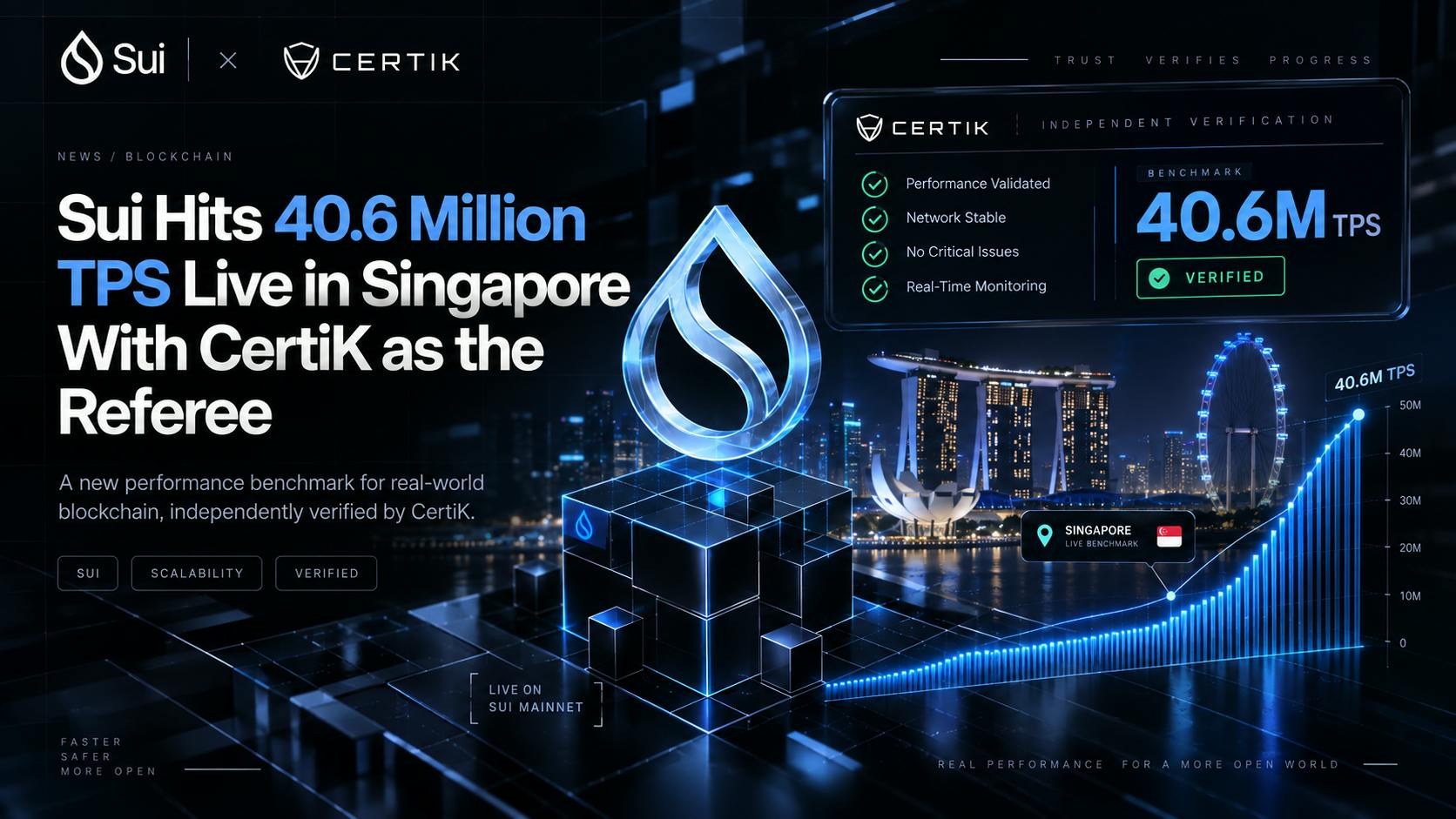
Visa processed 257.5 billion transactions in 2025, which works out to an average of about 8,165 every second across every card, merchant and country on its network. On 7 October, on the Summit Stage at Sui Basecamp 2026 in Singapore, Sui pushed 40,614,180 transactions per second settled to its mainnet, roughly 6.7 times the record it set in July and nearly 5,000 times Visa's average load. CertiK, the Web3 security firm that has worked with more than 5,500 enterprise clients, served as the independent evaluator and will publish a performance report once it has reviewed the evidence behind the number. How the Record Was Set The demonstration closed the first day of Basecamp in a session titled "Break the World Record: Sui's TPS", which the livestream schedule placed at 4:35pm local time and which was led by Adeniyi Abiodun, co-founder and chief product officer of Mysten Labs. Event participants and AI agents opened more than ten thousand tunnels across chat, games and payments, transacting gaslessly offchain before each tunnel closed with a mutually cosigned settlement that anyone can verify on Sui mainnet. Sui Basecamp livestream: Adeniyi Abiodun on stage beside the MillionTPS dashboardThe live dashboard showed what that load looked like in practice, with participants and agents playing blackjack, poker, tic-tac-toe and battleship, sending paid and flash chat messages and settling payments through a tip jar and payment channels. As more people joined, the global counter on screen climbed from about 1.19 million to more than 2.62 million transactions per second within roughly a quarter of a minute, while the run went on to peak at the 40.6 million figure Sui reported after the session. Abiodun framed the result around a design choice rather than raw speed, arguing that in an agentic economy Sui does not need to process every interaction itself so long as it serves as the trust layer for all of them.Why Forty Million Transactions a Second Abiodun's argument going into the attempt was that no human market needs this kind of throughput because people simply do not move that fast, while AI agents that negotiate, pay and coordinate on behalf of people and businesses could. The arithmetic makes the point vivid, since spreading Sui's new record across a world population of roughly 8.2 billion would require every person on Earth to make about 428 transactions a day, or one every three and a half minutes around the clock, against Visa's current load of about one payment per person every 12 days. Spreading Sui's 7 October record across 8.2 billion people would require about 428 transactions per person per day, compared with roughly 0.086 per person per day on Visa in 2025, which is the gap AI agents would have to fill. Sources: Visa via Wikipedia, Sui via Chainwire and McKinsey via Digital Commerce 360, with per-person figures calculated by Ishan PandeyWhat Effective TPS Measures The record measures effective TPS made possible by programmable tunnels, which Sui describes as offchain state and payment channels that settle to Sui mainnet when they close. The design resembles the channels of Bitcoin's Lightning Network, although Sui's tunnels are programmable, so they can carry games, messages and trades as well as payments, with only the opening and closing of each tunnel written to the base layer. Placing the new figure next to the throughput of other networks shows the scale of the jump. Chainspect currently records live base-layer rates of about 9 transactions per second on Bitcoin, about 20 on Ethereum and about 1,800 on Solana, while Solana's theoretical ceiling is 65,000. Because Sui's record counts activity inside tunnels rather than only transactions written directly to the base layer, the number describes the capacity of the whole system for agent activity, which is precisely why the evidence behind it matters.On a log scale, Sui's 7 October effective throughput of 40,614,180 TPS sits nearly 5,000 times above Visa's 2025 average and 6.7 times above its own July record, while live base-layer rates on major chains range from about 9 to about 1,800 TPS. Sources: Chainspect, Visa via Wikipedia A more intuitive way to read the comparison is to ask how long each system would take to clear Visa's entire 2025 workload. At Bitcoin's live rate the job would take almost 900 years and at Solana's live rate about four and a half years, while at the throughput Sui showed in July it would take just under 12 hours and at the Basecamp rate the full year of Visa transactions would clear in about one hour and 46 minutes.At Sui's Basecamp throughput, Visa's 257.5 billion transactions from 2025 would clear in about one hour and 46 minutes, against 11.8 hours at the July record and centuries at the live rates of Bitcoin and Ethereum. From 297,000 to 40.6 Million in Two Steps Sui's July livestream peaked at 6,086,766 TPS, which the network reported as more than 20 times its earlier controlled benchmark of 297,000 TPS. The Basecamp run multiplied that record by a further 6.7 times in roughly three months, so the network's headline throughput figure has grown about 137-fold from the earlier benchmark across the two public demonstrations. Sui's effective throughput benchmark rose from 297,000 TPS in an earlier controlled test to 6.09 million in July and 40.61 million at Basecamp, with CertiK's review of proofs, logs, journals and evidence still to be published. Why the Independent Report Matters Throughput claims are among the most quoted and least comparable numbers in blockchain, because each network measures them under different conditions with different definitions of what counts as a transaction. CertiK's role is designed to address that by overseeing the test as an independent community stakeholder and examining the proofs, execution logs, journals and supporting evidence, after which it will publish a performance report detailing what it found. Yuannan Yang, director of security engineering at CertiK, has framed the assignment as reporting accurately whatever the result turns out to be. His view is that transparent and independently verifiable performance measurements will matter more as blockchain infrastructure scales, because an objective basis for results builds trust in the systems that next-generation applications will depend on, both on Sui and across the wider industry.[COMMENTARY IMAGE PLACEHOLDER: Yuannan Yang, Director of Security Engineering, CertiK] The Payments Case Behind the Benchmark The push for agent-scale throughput sits alongside early signs of payment demand on Sui itself. After Mysten Labs removed fees on stablecoin transfers at the protocol level on 10 June 2026, The Defiant reported that the network processed nearly $65 billion in stablecoin transfers over the following five days. McKinsey has estimated that agentic commerce could orchestrate about $1 trillion of US retail revenue by 2030 and between $3 trillion and $5 trillion globally, which is the scale of activity Sui is designing its tunnels to absorb. McKinsey's 2030 estimates put agent-orchestrated commerce at about $1tn in US retail and $3tn to $5tn globally, while Sui recorded nearly $65bn in stablecoin transfers in the five days after it removed transfer fees and more than 10,000 tunnels were opened during the Basecamp run. What to Watch Next Basecamp runs alongside TOKEN2049 Singapore and brings together leaders from blockchain, finance and AI, so the result landed in front of the audience most likely to scrutinise it. The figure announced on stage is the first half of the story, because the more durable result will be CertiK's published report on how the throughput was produced, measured and settled, which will give builders a reference point for judging what Sui's tunnels can carry when agents arrive in volume. Don’t forget to like and share the story!Vested Interest Disclosure: HackerNoon has reviewed the report for quality, but the claims herein belong to the author. #DYOR.
Sui Hits 40.6 Million TPS Live in Singapore With CertiK as the Referee
Full Article
Original Source
Read the full article at Hackernoon →KhanList aggregates and links to publicly available news content. We do not host full articles from third-party sources. Always verify important information with original sources.