
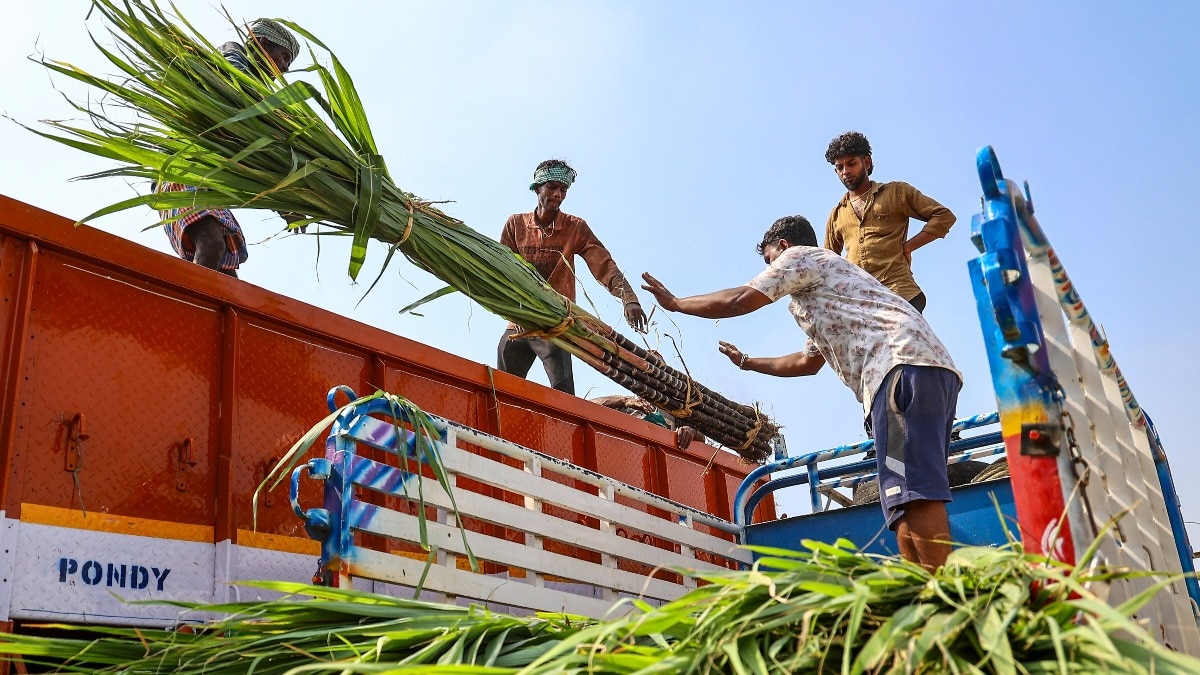
Sugar prices in India's retail market have hit a record high even ahead of the festive season when demand peaks. The situation is so bad that India, a sugar exporter, is looking to import the kitchen staple. Experts are blaming the crisis on the diversion of sugarcane to produce ethanol, which the Centre is blending with petrol.Despite a deficit monsoon this year, sugarcane cultivation has remained resilient, with acreage even increasing. (Image: PTI)India's sugar market is caught in an unusual crisis. The country has enough sugarcane in the fields, hundreds of distilleries built to feed its ambitious ethanol programme, and a government that has already restricted exports to protect domestic supplies. Yet sugar prices are climbing to record levels, forcing New Delhi to consider an option it has largely avoided for decades: importing sugar. Experts largely blame the crisis on the diversion of sugarcane for production of ethanol.As a precursor to importing sugar, India, according to a report by Reuters on Tuesday, was planning to remove the 100% import duty that had been in place on the commodity.The timing of the sugar price rise could hardly have been more difficult. India's festival season, when demand for sweets and processed foods rises sharply, is approaching. At the same time, a growing share of sugarcane is being diverted towards ethanol production as India pushes towards its E20 target, creating a difficult policy trade-off between fuel security and food prices.Wholesale sugar prices in Kolhapur, Maharashtra, one of India's key sugar trading centres, have risen nearly 20% since the beginning of August to a record Rs 5,350 per 100 kg. According to Consumer Affairs Department data, the all-India average retail price was at Rs 52.3 per kg on Tuesday (August 18). In some markets, the spike has been considerably sharper. Retail sugar prices in Punjab have touched around Rs 65 per kg, while prices in parts of Mumbai, Bhopal and other markets have moved towards Rs 58–63 per kg.And with Ganesh Chaturthi, Dussehra and Diwali ahead, the government is racing to ensure that a sugar shortage does not become a festive-season inflation problem. Experts are warning that a balance needs to be maintained that the Ethanol Blended Petrol programme doesn't end up disturbing food prices, as is happening in the case of sugar.SUGAR'S PRICE HIKE IS AN IMPACT OF ETHANOL RUSHAt the heart of the problem of sugar's high price is a supply deficit. India has increasingly diverted sugarcane towards ethanol as it seeks to reduce its dependence on imported crude oil and achieve its E20 target.The government has pushed to build dozens of distilleries in recent years for this purpose, taking ethanol production capacity to around 1,822 crore litres a year across 499 sites by mid-2025, according to the All India Distillers' Association (AIDA).Sugarcane forms around 30–35% of ethanol feedstock, with the remainder coming from maize and rice, according to data shared by AIDA with India Today Digital.That diversion has consequences for the sugar market."A diversion of sugarcane to produce ethanol has resulted in high prices of sugar in India," agriculture expert and Lucknow University professor Sudhir Panwar told India Today Digital.Panwar argues that the sugar market should not have tightened to the extent it has and suspects that factors beyond production are also contributing to the spike."The market forecast for sugar wasn't that bad, which also signals market manipulation by sugar stockists and retailers," he said, adding, "The prices would have been under control if cane hadn't been diverted to ethanol manufacturing."His main concern is that India's fuel policy should not come at the expense of food prices."Sugarcane diversion towards ethanol shouldn't be at the cost of sugar, and shouldn't increase food prices. We need correct estimates of sugarcane production and sugar requirements of India, and the international situation and sugar prices," Panwar, a former member of the Uttar Pradesh's Planning Commission, told India Today Digital.The supply situation has also been affected by crop disease."Sugarcane productivity and sugar recovery dipped, especially in Uttar Pradesh, in 2025-26 because of crop disease," Panwar added.This, despite the sugarcane cultivation acreage having increased.Sugarcane acreage in July – even as the country witnessed a deficit of rainfall — was 1.5% higher than other crops like paddy, pulse, cotton and oil seeds, than during the corresponding period last year, according to a report in The Times of India on Tuesday.That makes the question more complicated that if acreage has increased, why are supplies still tight?Panwar believes part of the answer lies in how much cane is ultimately converted into sugar and how much is diverted to ethanol."When the government released estimates of cane and sugar production, the situation wasn't so serious. That means either the statistics weren't right, or the market was manipulated or the diversion to ethanol was disbalanced," he said.WHY IS INDIA CUTTING IMPORT DUTY ON SUGAR?The government's policy response highlights how sharply the situation has changed. India is the world's second-largest sugar exporter after Brazil. It has been exporting sugar since 1960 and at its peak shipped more than 12 million tonnes in 2021-22.But the country's export policy has steadily tightened as the government prioritised domestic availability.For the 2025-26 sugar season, India permitted an export quota of around 2 million metric tonnes, a fraction of the more than 12 million tonnes exported in 2021-22.India then went further in 2026, banning sugar exports with immediate effect from May 13 until September 30, as the government sought to protect domestic supplies, control prices and prepare for uncertainty over production and global commodity markets.The ban is significant because India had previously relied on export restrictions, quotas and quantitative limits rather than imposing a blanket prohibition on general shipments for an extended period. Even during earlier restrictions, smaller quota-based and preferential shipments, including to the US and European Union, continued.Despite these measures, domestic prices have continued to climb.India exported 2,01,547 tonnes of sugar through February in the current 2025-26 marketing year, with the United Arab Emirates emerging as the top destination, according to the All India Sugar Trade Association (AISTA).Now, according to reports, the government is considering the next step of cutting the import duty on sugar. The move could allow overseas sugar into India for the first time in nearly a decade, potentially easing domestic supplies just as the festival season begins."Local supplies of sugar are tight. Only imports can help increase supplies and bring down prices during the festival season," Ashok Jain, president of the Bombay Sugar Merchants Association, told news agency Reuters.India's return to the international sugar market could have consequences on its borders. As one of the world's biggest sugar consumers, Indian imports could support benchmark sugar prices in London and New York, even as they help New Delhi contain prices at home.WHY GOVERNMENT IS SUDDENLY IN A PANIC MODE ON SUGARThe current spike did not emerge overnight. Indian retail sugar prices have broadly risen from around Rs 40–45 per kg in early 2023 to more than Rs 50 by August 2026, although prices vary considerably by state, quality and market.The acceleration has come in recent months.By mid-August 2026, the all-India daily average had reached around Rs 51.7–52.3 per kg, representing an increase of roughly 7–8% in a month and around 12–13% year-on-year from about Rs 46.3 per kg in mid-August 2025.But the current surge, coming right ahead of the festive season, has forced the Centre to act.The authorities therefore are considering more than just imports. Officials are also weighing restrictions on the amount of sugar that bulk traders can hold, in an attempt to prevent stockpiling and hoarding from worsening the shortage.Earlier, officials had also been considering another intervention of reducing the amount of "sugarcane diverted towards ethanol and prioritising sugar production instead". Reuters reported on August 10 that a decision on the issue could be taken by the end of September.The government should work out the food-versus-fuel trade-off when it comes to blending ethanol with petrol, suggested India's Chief Economic Advisor V Anantha Nageswaran in an opinion piece he co-wrote for The Indian Express.The government should hold at E20 and not go for higher blends "until India has thoroughly costed the food-versus-fuel trade-off, rather than assuming it away," he wrote in the piece published on August 17.GOVERNMENT FACES POLITICAL HEAT OVER SUGAR CRISISThe price rise of sugar is also beginning to generate political criticism. Activist and founder of Team Bharat, Tehseen Poonawalla alleged that the diversion of cane towards ethanol production had contributed to the crisis and questioned the beneficiaries of the policy."India exported a huge amount of sugar. But due to the diversion of cane to ethanol production, the situation has turned to India banning exports. The diversion spiked the prices of sugar and now the government is planning to remove import duty on sugar," Poonawalla said in a video message on X.Poonawalla also alleged that politicians and their families had benefited from the situation.He announced that his outfit Team Bharat, which has been protesting and holding talks with the government over rapid implementation of E20 petrol, would hold a protest and hunger strike at New Delhi's Jantar Mantar on August 22 and 23.For the government, the immediate task is to ensure that a staple commodity does not become prohibitively expensive just as India's biggest festival-shopping season begins.But the larger policy question is considerably harder for the authorities to deal with.How much sugar should India produce for its people, and how much cane should it divert into its fuel tanks to fulfil its ambitious project?The E20 programme promises lower oil dependence and greater energy security. Sugar exports bring foreign exchange and support the farm economy. But when cane is diverted to ethanol and sugar prices climb, the trade-off reaches the household kitchen. The centre is now weighing imports, stock limits, export restrictions and possibly a rethink of cane diversion.- EndsPublished By: Avinash KateelPublished On: Aug 19, 2026 18:25 IST
Sugar prices hit record high as cane goes to E20; India rushes to contain crisis
Full Article
Original Source
Read the full article at Indiatoday →KhanList aggregates and links to publicly available news content. We do not host full articles from third-party sources. Always verify important information with original sources.