
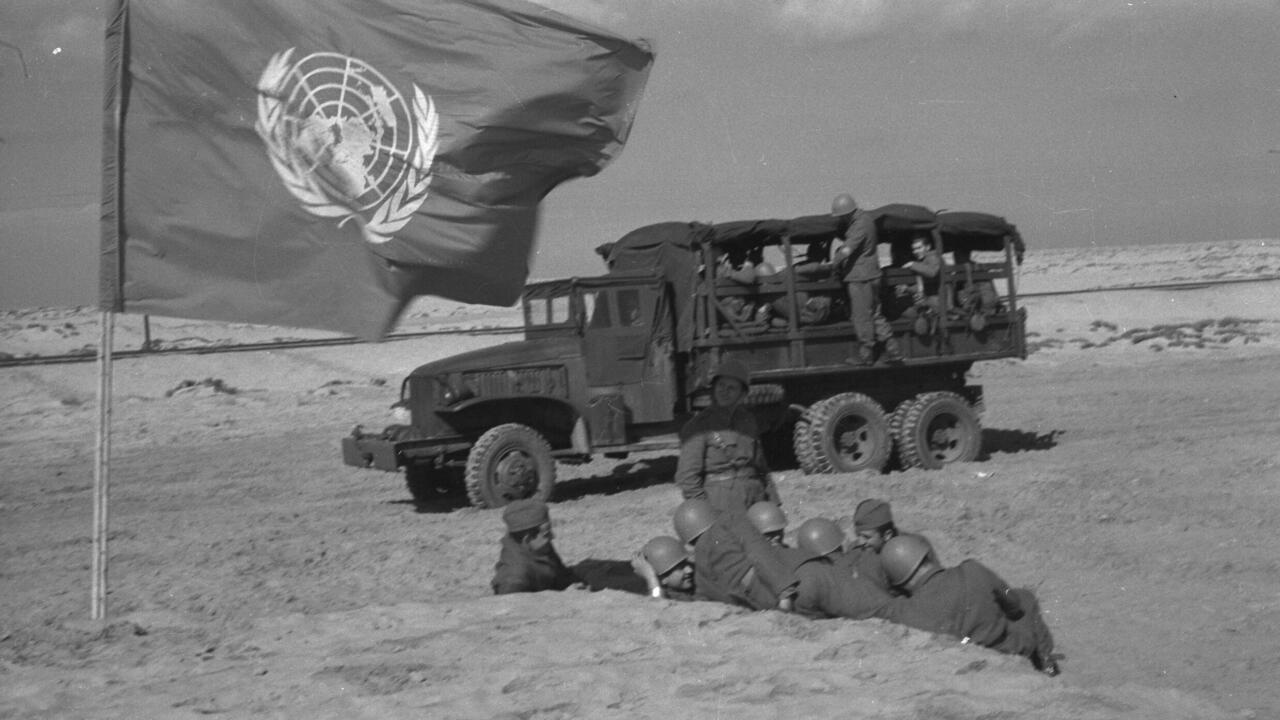
Seventy years after France, the United Kingdom and Israel invaded Egypt following its nationalisation of the Suez Canal, the military operation is remembered as a diplomatic disaster. Friday marks the anniversary of a ceasefire that halted the fighting under international pressure, despite the invading forces' success on the battlefield. Archive footage excluded from French cinema newsreels shows the humiliation that followed, as Europe's colonial powers faced the limits of their influence. Egyptian leader Gamal Abdel Nasser nationalised the Suez Canal in July 1956, bringing it under state control. The invasion followed three months later. Historian Franck Mazuet explores the crisis in an episode of Boîte Noire (Black Box), a series from France's National Audiovisual Institute (INA) and the educational platform Lumni Enseignement. In the seven-minute episode 1956, The Suez Canal Affair, Mazuet examines footage of the failed invasion that French authorities kept off cinema screens, revealing how news coverage was censored to protect France's image. It draws on material left out by Actualités Françaises (French News), a state-controlled company that produced newsreels – filmed news reports shown in cinemas – from 1945 to 1969. “These images that never made it into the newsreels tell us a great deal, particularly about how successive governments viewed information and censored it,” Mazuet said. Egypt inaugurates new Suez Canal Gateway to empire Opened in 1869, the Suez Canal began as a joint French-Egyptian project. French shareholders held the majority, although many were small investors. In 1875, Egypt's ruler, heavily in debt, sold his shares to the United Kingdom. That made the UK, under prime minister Benjamin Disraeli, the largest shareholder in a waterway vital to its colonial empire. Seven years later, Disraeli's successor William Gladstone launched the military conquest of Egypt. While the UK effectively controlled the country, Egypt officially remained part of the Ottoman Empire. This arrangement was known as a veiled protectorate. Egypt gained independence in 1922, but British troops remained in the canal zone until June 1956. For France and the UK, the canal was crucial to their overseas empires – particularly their territories in Asia, including India and Indochina. France also relied on it for shipping between Madagascar and mainland French ports on the Mediterranean. India's independence in 1947 made the canal a little less important to the UK, but the growing oil trade largely made up for that. Egypt's monarchy was overthrown in a military coup in 1952. Two years later, Nasser, then a lieutenant colonel in the Egyptian army, took power, promoting pan-Arab nationalism, secular government and socialist-leaning policies. ‘Too arrogant, too sure of itself’: France confronts its legacy in Africa Nasser in the crosshairs Wary of the major powers, Nasser nevertheless secured the Soviet Union's blessing in 1955 to buy weapons from Czechoslovakia as a way to counter British influence. That same year, he signed defence agreements with Syria and Saudi Arabia. His growing ties with the Soviet bloc, along with his recognition of communist China in May 1956, prompted the United States to withdraw an offer to finance the Aswan High Dam on the Nile. Tensions with Israel ran high. Palestinian fighters carried out raids from Gaza, prompting Israeli military reprisals. On both sides, no one had forgotten that Nasser had been one of Egypt's heroes in the 1948-1949 Arab-Israeli war, the first conflict between Israel and neighbouring Arab countries following the creation of the Israeli state. He barred Israeli ships from the Suez Canal and blocked the Strait of Tiran, a narrow waterway linking the Red Sea to the Gulf of Aqaba and the Israeli port of Eilat. Conservative British prime minister Anthony Eden went so far as to liken Nasser's actions to those of Benito Mussolini and Adolf Hitler in the 1930s. In France, Socialist prime minister Guy Mollet's government strongly supported continued French rule in Algeria. It regarded Egypt as a base for Algeria's independence movement, the FLN, and as an enemy of Israel, France's main ally in the Middle East. British intelligence services plotted to remove Nasser from power and maintained contacts with the Muslim Brotherhood, an Egyptian Islamist movement opposed to his secular government. France also set up an Arabic-language radio station near Paris that portrayed the Egyptian leader as a puppet of Moscow serving Zionist interests. The UK broadcast similar propaganda from Cyprus. “Poverty is no disgrace, but the exploitation of peoples is,” Nasser said in Alexandria on 26 July 1956, announcing the nationalisation of the canal. “We will take back all our rights, because these funds are ours and this canal belongs to Egypt.” The Paris movement that planted the seeds of Algerian independence, a century on Pact at Sèvres From 22 to 24 October, representatives of France, the UK and Israel met in secret in Sèvres, near Paris, to agree on a military operation. Under their plan, Israel would attack Egypt on 29 October. The next day, France and the UK would issue an ultimatum demanding that both sides withdraw to positions about 15 kilometres on either side of the canal. In practice, this meant requiring Egypt to abandon the Sinai Peninsula. If Nasser refused, the two European powers would intervene from 31 October. The operation had been under discussion since August and already had a name: Musketeer. United Nations troops parade in Port Said, Egypt, following the French and British military intervention during the 1956 Suez Crisis. © INA archives Fighting began on schedule, with Israeli forces invading the Gaza Strip and the Sinai. Backed by widespread public support, Nasser rejected the ultimatum. French and British forces launched a major air campaign. Some French fighter jets operated under Israeli markings, with the Star of David covering their French insignia and pilots carrying false identity documents. Egyptian air bases were methodically pounded and much of the country's air force was destroyed. On 2 November, the United Nations General Assembly adopted a resolution demanding an immediate ceasefire. The two European powers ignored it and sent ground troops into Egypt three days later. On 5 November, the Soviet Union issued exceptionally severe threats against the British and French governments, even raising the possibility of using nuclear weapons. The US also opposed the intervention, arguing that it undermined Western credibility as Soviet troops crushed an uprising against communist rule in Hungary. France and the UK ordered a ceasefire, which took effect overnight on 6-7 November. Their forces finally withdrew on 22 December. Around a thousand civilians were killed during the fighting. Despite the fact that Egyptian troops had been defeated militarily, Nasser emerged as the political victor, with Egypt's nationalisation of the canal now accepted around the world. Support for the operation was far from unanimous in the UK's House of Commons. In France, however, most political parties backed the government, apart from the communists. The twin crises in Egypt and Hungary nonetheless weighed heavily in changes within the French left, leading in 1960 to the creation of the Unified Socialist Party, or PSU. It rejected both the Soviet model and the socialism of the governing French Section of the Workers' International, known as the SFIO. Egypt imposes energy-saving curbs as Hormuz closure hits fuel supply Images of defeat One sequence excluded from French newsreels shows a monument to Ferdinand de Lesseps, the French diplomat who led the construction of the Suez Canal. It was filmed in the Egyptian city of Port Said on 22 December 1956, as the last French and British troops were leaving. Soldiers had attached their national flags to the statue, an act the Egyptians regarded as provocative. The following day, the Egyptian military blew up the monument – even though Nasser had not planned to make it a symbol. The statue of Ferdinand de Lesseps, the French diplomat who led the construction of the Suez Canal, in Port Said, Egypt, on 22 December 1956, as the last French and British troops withdrew. The statue was destroyed the following day. © INA archives Other footage kept out of public view shows UN troops replacing national flags with the organisation's own banner as it took over responsibility for maintaining the ceasefire. “At the time, this was the UN's first operation,” Mazuet said, describing the images of soldiers changing the flags. “French authorities, whether on the right or the left, had a very low opinion of the UN back then. Journalists instead portrayed Nasser as a lawless dictator who wanted to take over a canal built by Europeans, who managed and owned it.” The images also show French troops withdrawing from Port Said and UN soldiers parading through the city – scenes that were kept from cinema audiences at the time. “After the Suez Crisis, France no longer appeared to be a great power,” said Ludivine Lopez, a journalist who appears in the Boîte Noire series. “Disowned by the UN and humiliated on the international stage, France now had to negotiate with the two superpowers, the United States and the Soviet Union.” This story was adapted from the original version in French by Olivier Favier.
Suez Crisis at 70 reveals the humiliation France tried to keep hidden
Full Article
Original Source
Read the full article at Rfi →KhanList aggregates and links to publicly available news content. We do not host full articles from third-party sources. Always verify important information with original sources.