
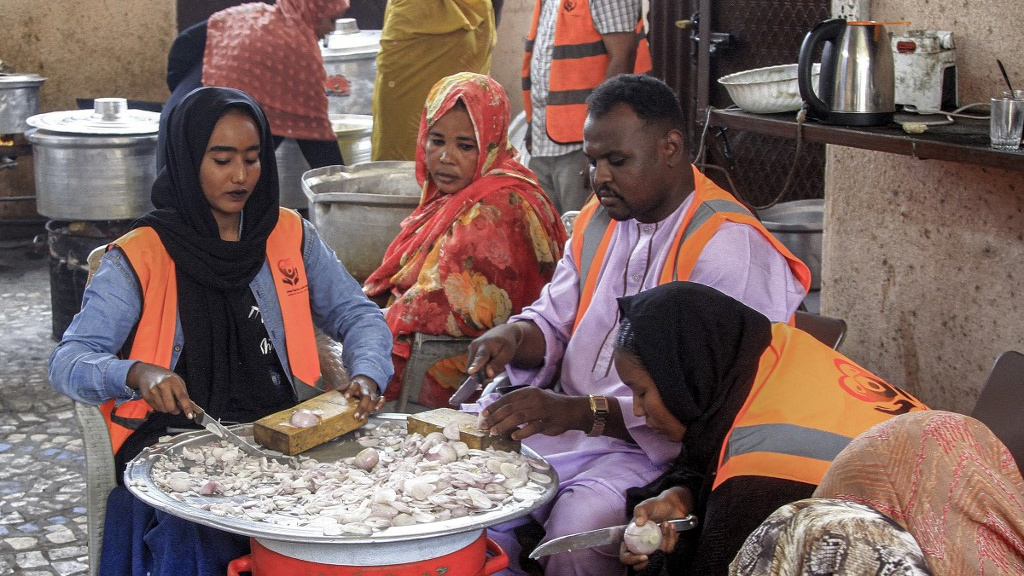
On a Friday night in the UK city of Leeds, a nurse taps “send”. Thousands of miles away, a phone buzzes in a courtyard in Omdurman, Sudan, and a ledger of trust begins to turn. She does not think of this as economics. She thinks of it as family obligation - not as finance, and certainly not as policy. Yet the journey of that single payment, from a British bank account to a pot of lentils shared among displaced neighbours, is a map of how Sudan survives. It is a journey across a collapsing currency. Before the war, a dollar bought roughly 600 Sudanese pounds. Last month it passed 10,000, and the currency is still sliding. Shopkeepers have shuttered their stores rather than sell at a loss when the rate lurches overnight. Average incomes have fallen to levels last seen in 1992, while government revenues dropped from roughly 10 percent of GDP in 2022 to below five in 2024. Banks are closed across conflict zones, supply chains have snapped, and the state has little left to offer. In this vacuum, ordinary Sudanese have built something else. New MEE newsletter: Jerusalem Dispatch Sign up to get the latest insights and analysis on Israel-Palestine, alongside Turkey Unpacked and other MEE newsletters The mechanics are unforgiving. Sudan imports most of its wheat, so every fall in the pound affects the price of bread; bakeries in Khartoum have closed as wheat and fuel costs climb. The country’s finance minister attributes the slide to demand for dollars as imports outstrip exports. For a household, that abstraction becomes simple: the money earned this morning buys less by evening. The price of liquidity Step one is a broker. Formal transfers into Sudan are slow, restricted and often impossible, so the nurse’s money moves the way Sudanese money has long moved when trust outranks paperwork: through a network. Hawala networks and traders have moved remittances and extended credit for centuries, and today they help deliver humanitarian cash as well. The nurse pays sterling to a contact abroad; in Omdurman, a trader with banknotes in hand releases the equivalent in Sudanese pounds, at a rate that rewards whoever holds hard currency. The broker’s margin is the price of liquidity. Nobody signs anything. Everybody knows everybody’s mother. Step two is a phone. The trader pays out through Bankak, the Bank of Khartoum’s app, which has become the arterial road of the wartime economy. Intermittent outages freeze it without warning, and when they do, markets seize up and the demand for cash spikes. The question is whether the world will keep treating that obligation as a miracle to admire, or begin treating it as a system worth backing Even when it works, it is not free: informal agents who turn digital balances into banknotes reportedly charge between 10 and 50 percent, depending on location and liquidity. One hundred pounds sterling that left Leeds might arrive as 70, or 60, or half. Step three is the kitchen. The recipient, a volunteer treasurer in a neighbourhood emergency response room never touches the money as cash. She sees a balance. These rooms - volunteer networks that grew from prewar neighbourhood committees - now number roughly 700 nationwide, staffed by teachers, engineers and students. Nominated twice for the Nobel Peace Prize, they run communal kitchens that are funded largely by diaspora remittances and small daily donations collected locally. When blackouts strike, volunteers lose access to the e-banking systems they use to receive and spend money amid cash shortages; a kitchen without a signal is thus a kitchen without a budget. Power, in other words, is as much a part of the food supply as flour. Step four is the market, where the economics turn cruel. Prices reset daily. Flour prices in some markets rose by about half during the latest slide, as inflation roughly doubled the cost of providing a communal meal. So the treasurer buys what she can, when she can: lentils, onions, oil, flour, a share of cooking fuel. By evening, a pot simmers over a fire in a school courtyard, and dozens of displaced neighbours, some of them strangers a week ago, queue with plastic bowls. The tradition of takaya, in which communities feed people in streets and under trees, has found its organised heir. Notice, too, where the money goes next. The lentils come from a local trader, the cooking fuel from a neighbour with a stock, the labour from displaced women who are fed for their work. A remittance that begins as a family obligation becomes, within hours, a small stimulus to a street economy that formal institutions have abandoned. This is not charity standing outside the market. It is the market, rebuilt around need. Principal currency Follow that one payment, and you glimpse an economy that statistics cannot capture. It has no licence, no regulator, and no line in the national accounts - yet it moves money across continents, clears payments, extends credit and delivers nutrition. Call it the informal war economy, but note what makes it unusual: its principal currency is neither the Sudanese pound nor the dollar. It is trust. Bashair Ahmed, founder of the Shabaka research group, says diaspora remittances dwarf foreign investment and international aid combined - yet the humanitarian system still treats them as an afterthought. This is not a romantic story. The fragility that makes the system agile also makes it brittle. Nearly half of Sudan’s community kitchens had closed in the six-month period up to April, according to Islamic Relief, as funding dried up; in Port Sudan, six out of seven shut. Sudan war: Sanctions and donor pledges do not fix the catastrophe on the ground Read More » Diaspora generosity is finite, because migrants have rents of their own. Fees leak value at every junction. And parallel systems are multiplying: Future Bank, an unlicensed money-transfer platform aligned with the Rapid Support Forces, points to a monetary landscape splitting along the front lines. Meanwhile, the formal system lags. The 2026 humanitarian plan seeks $2.9bn, and according to UN tracking, remains only half funded, while Emergency response rooms have received just a fraction of the money donors have given to humanitarian actors. The people closest to the hungry are the last to be paid. What follows from this? Firstly, the informal economy should be treated as infrastructure, not an anomaly. Donors who insist on formal channels strand their own money. The Dutch humanitarian group Cordaid already routes support through trusted intermediaries to emergency response rooms in all 18 states, with an average activity budget of about $5,000 - proof that small sums, well placed, travel far. Secondly, the payment rails need repair. Technology experts have urged that Bankak and other electronic payment platforms be connected under central bank leadership, rather than left as isolated islands. Thirdly, cheaper, safer remittance and cash-out channels would return to families what fees now take away. And finally, compliance rules meant to starve armed groups of cash should be calibrated so they do not also starve a grandmother’s lifeline. Blanket suspicion of small transfers punishes families, not commanders, and pushes still more money into channels that no one can see. Return to the nurse in Leeds. Her 100 pounds, diminished by every hand it passed through, still became dinner for a block of neighbours who had nothing else. That is no substitute for a state, a functioning currency or a funded humanitarian response. It is something rarer: proof that when institutions fail, obligation does not. The question is whether the world will keep treating that obligation as a miracle to admire, or begin treating it as a system worth backing. The views expressed in this article belong to the author and do not necessarily reflect the editorial policy of Middle East Eye.
Sudan war fuels an invisible economy of survival
Full Article
Original Source
Read the full article at Middleeasteye →KhanList aggregates and links to publicly available news content. We do not host full articles from third-party sources. Always verify important information with original sources.