
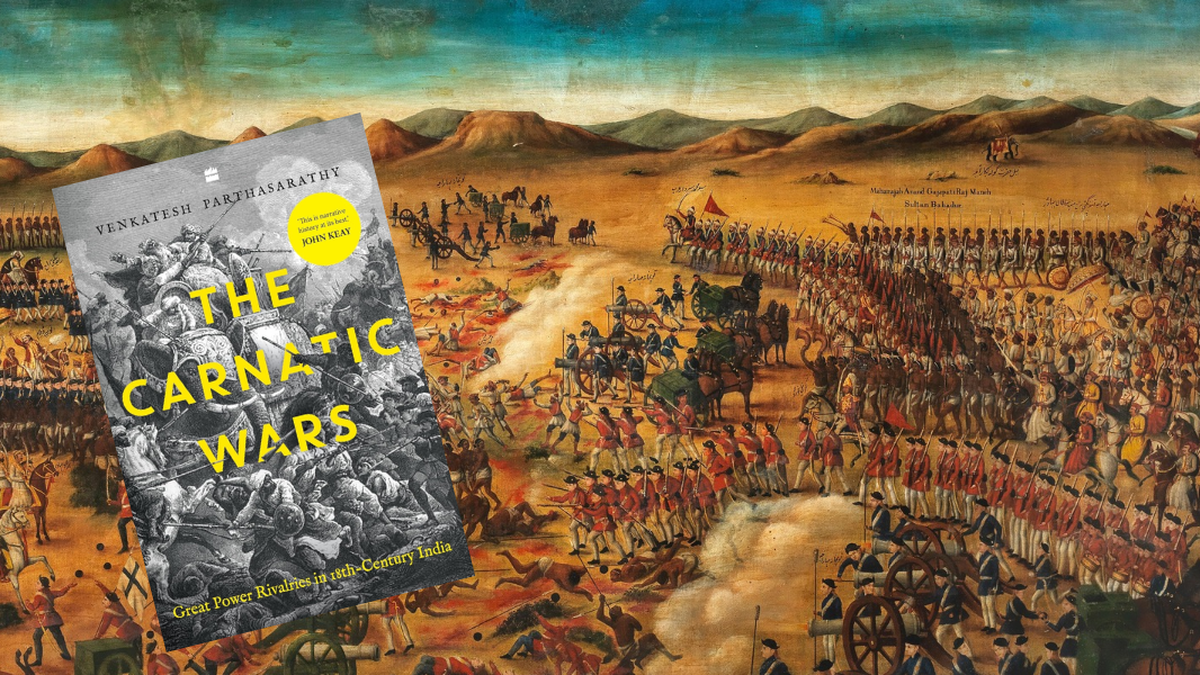
A painting depicting the Battle of Condore (1758), fought between East India Company and French forces during the Third Carnatic War. | Photo Credit: (WKIMEDIA COMMONS) At some point in his 30-year reign, Mughal emperor Shahjahan is said to have expressed his opinion on Europeans, increasingly visible in India by then. White men, this 17th-century monarch believed, had it in them to be a “great” people but for three defects. First, their religion; second, their appetite for pork; and finally — presumably the worst — their refusal to wash their bottoms. Similar ideas circulated in the south, with some adding that the parangi (foreigner) also liked eating little children fried in butter. Meanwhile, Sanskrit works like the Viswagunadarsana Champu acknowledged the Europeans’ utility on account of the “curious” articles they traded. But this only marginally diminished their patent “villainy”, “inexpressible at the end of the tongue”.As it happens, the parangis had their own fears and anxieties about Indians. But in a twist few would have predicted, by the middle of the next century they would be on the ascendant in the land. The story, as typically told, features Robert Clive, the Battle of Plassey, the submission of the Mughals at Buxar, and so on. Only that as Venkatesh Parthasarathy notes in The Carnatic Wars, the road to the subcontinent’s colonisation really began in the peninsula. It was here, in the commercial contest between the English and the French trading companies, enmeshed in intricate local political rivalries, that “Europeans lost their fear of Indian armies”. Everything that followed, Parthasarathy argues — Plassey, the fall of the Marathas, down to the end of Sikh power a century later — stemmed from this. “Lovers of military history will have much to devour in this book. Admirers of historical minutiae will also dog-ear every second page to make notes. But for the general reader, The Carnatic Wars can often feel challenging. The pages are busy, and there is a lot happening.”Manu S. PillaiA motley castThe Carnatic Wars begins with an 11-page cast of characters section offering a glimpse of the type of figures the reader will encounter. There is someone who lost his head to a cannon shot, and someone else who was executed by his own troops. One political figure escaped captivity in a food basket, while another retired from battle hurt “more in the mind than in the body”. Yet another specimen “preferred peace but spent all his time at war”. The people we meet in the main text subsequently live up to these standards — the author is very matter-of-fact when he speaks, for instance, of a nawab who was “expected to die any day” from “recurrent diarrhoea”. Another, in Game of Thrones fashion, had his dogs named after his parents and fed on a diet of criminals.Beginning with the disintegration of the Vijayanagara empire and the advent of Mughal power in the south, Parthasarathy’s main narrative stretches through the 1740s and 1750s. There is a lot of male-heavy military action, though female influences are not absent. The book cannot be accused of false advertising — The Carnatic Wars is a dizzying sequence of battles. In the space of a few pages, a figure might enter the scene, rise to prominence, make enemies, and fall by assassination. There are moments when one wishes a certain character had succumbed: Robert Clive came very close to being liquidated in 1752 and was grievously wounded. But at a critical moment when he was fired at, as was often the case with 18th-century muskets, instead of the intended target it was people near him who dropped dead.Not an easy readLovers of military history will have much to devour in this book. Admirers of historical minutiae will also dog-ear every second page to make notes. But for the general reader, The Carnatic Wars can often feel challenging. The pages are busy, and there is a lot happening.The sheer number of names is a lot to keep up with, and the many battles can be exhausting. Parthasarathy’s aim is to resurrect characters and incidents that are usually relegated to the footnotes. Even so, there are elements that should perhaps have stayed in the footnotes instead of crowding up the main text. For example, we read of how a nawab’s widow fled to Pondicherry. But an extra line here on a relative’s wife having “already reached” only to die of burns days later is a detail that takes up space on the page without serving much purpose.What The Carnatic Wars needed was stricter editing. Even so, Parthasarathy’s stupendous effort is palpable. In addition to tracking local as well as transregional shifting sands, a bird’s-eye view of all the meticulous chronicling also tells you something about the making of empires. That unlike the tidy tales of glory they masquerade as, the real process is messier, featuring luck, pluck, all species of accidents, and enterprise. Wars were as much about money and territory as about managing men, rationing alcohol, and losing pigs. Read this book for a glimpse of the many layers that constitute historical events; for the contradictions and machinations that underlie any supposed inevitability. But also go into its pages with patience — Parthasarathy’s offering is a mosaic, and the pieces can be demanding. The Carnatic Wars: Great Power Rivalries in 18th-Century India Venkatesh ParthasarathyHarperCollins₹799The reviewer is a historian. Published - November 20, 2026 06:05 pm IST
Subcontinental shift | Review of Venkatesh Parthasarathy’s The Carnatic Wars
Full Article
Original Source
Read the full article at Thehindu →KhanList aggregates and links to publicly available news content. We do not host full articles from third-party sources. Always verify important information with original sources.