
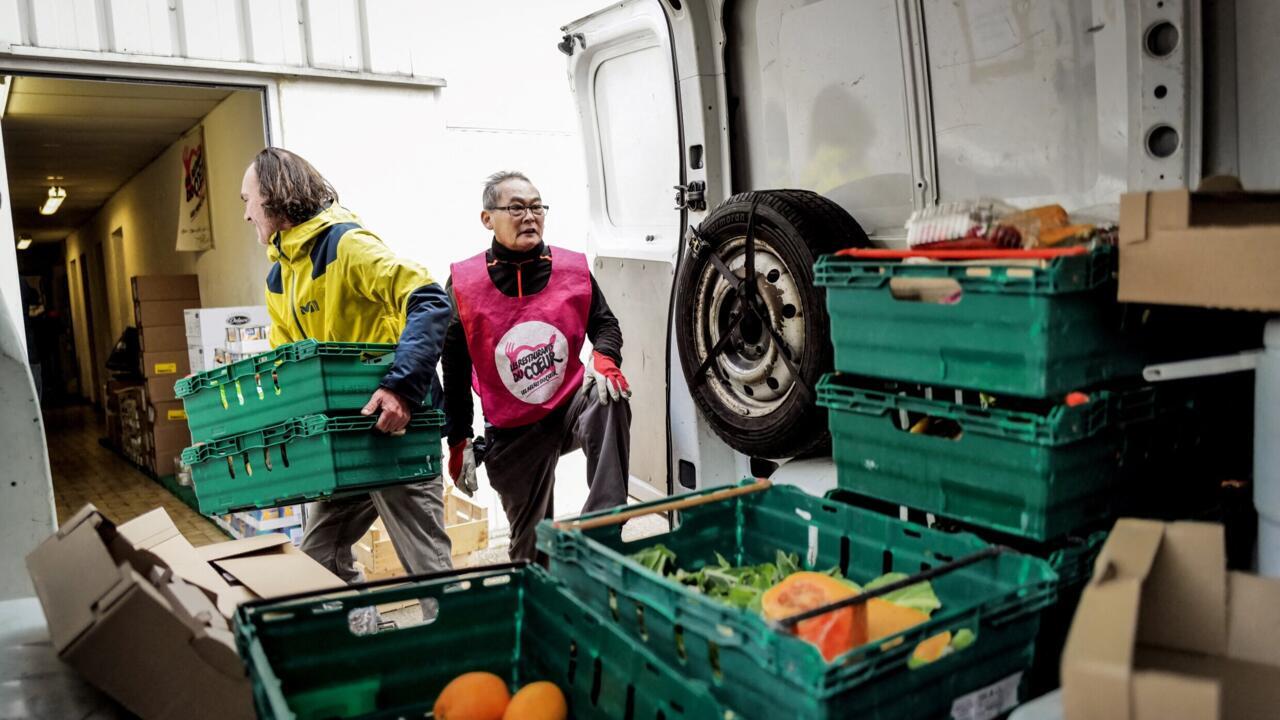
An international study published Monday by France’s largest food aid charity Restos du Cœur shows that the number of people living in extreme poverty in France and other wealthy countries, increased by 37 percent between 2018 and 2025. The number of people living in extreme poverty has risen by 37 per cent between 2018 and 2025, according to data collected from French charity Restos du Cœur. The analysis (Extreme Poverty in Wealthy Nations: Evidence from France) was carried out by an international team of five people in Europe and the United States between 2018 and 2025. It shows how 5.5 million of the charity's beneficiaries have fallen into extremely precarious situations. It warns that one in ten people risks needing food aid over the next decade. According to the study's authors, public policies have little effect in helping people who have already fallen into extreme poverty. "The longer someone has been receiving assistance from Les Restos, the harder it is for them to break free from that situation," Yves Mérillon, a member of the national board of Les Restos du Cœur told public broadcaster franceinfo. He believes that "prevention remains the most powerful tool, and public policies have a role to play" through more targeted measures. Matter of survival On the tables at a Restos du Cœur branch in the 10th arrondissement of Paris, there are tins of food, packets of pasta and biscuits. Further along, in the next room, there is fresh fruit and vegetables. This is also where yoghurts and chilled dairy products are available. France's most vulnerable households are getting poorer, warns charity In her shopping trolley, Mariam has collected "some milk. I’ve also got some prawns. I’ve got potatoes. Pasta. I’ve got fruit. Peaches. And a packet of madeleines for my children’s snacks," she tells RFI. Mariam lives on €200, €300, sometimes nothing at all. With so little money, it’s mainly a matter of survival. "But we’re struggling," she continues, "thank goodness the Restos du Cœur help us a lot." Like many women who come here, Mariam is a single mum without papers. What upsets her most is not being able to make her seven-year-old daughter happy. "Sometimes she finds €0.02 or €0.01 and says to me: 'Mum, we’ve got loads of money, why don’t we go to a restaurant?' I tell her no, that’s not enough money to go to a restaurant – you need at least €10…" Inflation For Jacques Bagge, who has been volunteering for six years at the branch in Paris’s 10th arrondissement, his view of extreme poverty is "people who are unable to meet their basic needs for food and housing." "In other words, most of the people we see here and to whom we distribute food are those who are staying in emergency accommodation centres, social housing or even on the streets," he explains. The study by Restos du Cœur reveals that difficulties in securing accommodation have soared by 62 per cent between 2018 and 2025. One in every 200 people in France is homeless, living on the streets or without their own home. Among those receiving support from Restos du Cœur, 50 percent live in city centres and "inflation is responsible for 52 percent of the rise in homelessness since 2018," the study notes. France faces homelessness crisis as deaths and child poverty soar "We’re in Paris, where housing conditions are difficult because rents are very high," explains Bagge. "And so there are many students who, in order to be able to pay for their room or accommodation – sometimes in a shared flat, or a flat shared by several people – are forced to rely on outside help to feed themselves," he adds. Patrice, a 25-year-old student with multiple degrees, lives in a shared flat on a very low income. "I’d say I’m on less than €600. Once the rent’s paid, I’m left with less than €200 a month. The food aid we’re given here really helps; it takes the pressure off," says the student, a carton of milk and a packet of crisps in his hands. "And on top of that, I’ve just finished my studies, so I’m looking for a job and it’s awful. You get up in the morning, send out loads of applications and nothing – no replies at all." But there are also the working poor. Sam, a 30-year-old cannot get by without food aid. "I’ve been coming here for a few years now, so it’s become a bit like going to the shops," he admits, adding that the aid can last him "three or four days." 'Escaping extreme poverty is very difficult' Among those most at risk of poverty, children aged 0 to 9 account for nearly 25 percent of people experiencing housing insecurity. The majority comes from single-parent families headed by single mothers. In 2024-2025, one in two people receiving aid at the Restos du coeur was under 25, and 23 percent of the families receiving aid were single-parent households. Francine Rivaud, a volunteer, confirms what the study shows: it is very difficult to escape extreme poverty. "Firstly, because it’s generally women we see here who are unable to work. They don’t have the right papers, but they have children, and those children go to school. It’s absolutely essential that we help these children so that the next generation doesn’t end up in this poverty," she warns. It’s midday, and the soup kitchen is about to close. Amira has come with her little boy, who has a dummy in his mouth. She says it doesn’t matter if she doesn’t always get enough to eat. What matters to her is that her child is never denied a meal. This article was adapted from the original version in French by RFI's Laurence Théault.
Study shows extreme poverty, homelessness on the rise in France
Full Article
Original Source
Read the full article at Rfi →KhanList aggregates and links to publicly available news content. We do not host full articles from third-party sources. Always verify important information with original sources.