
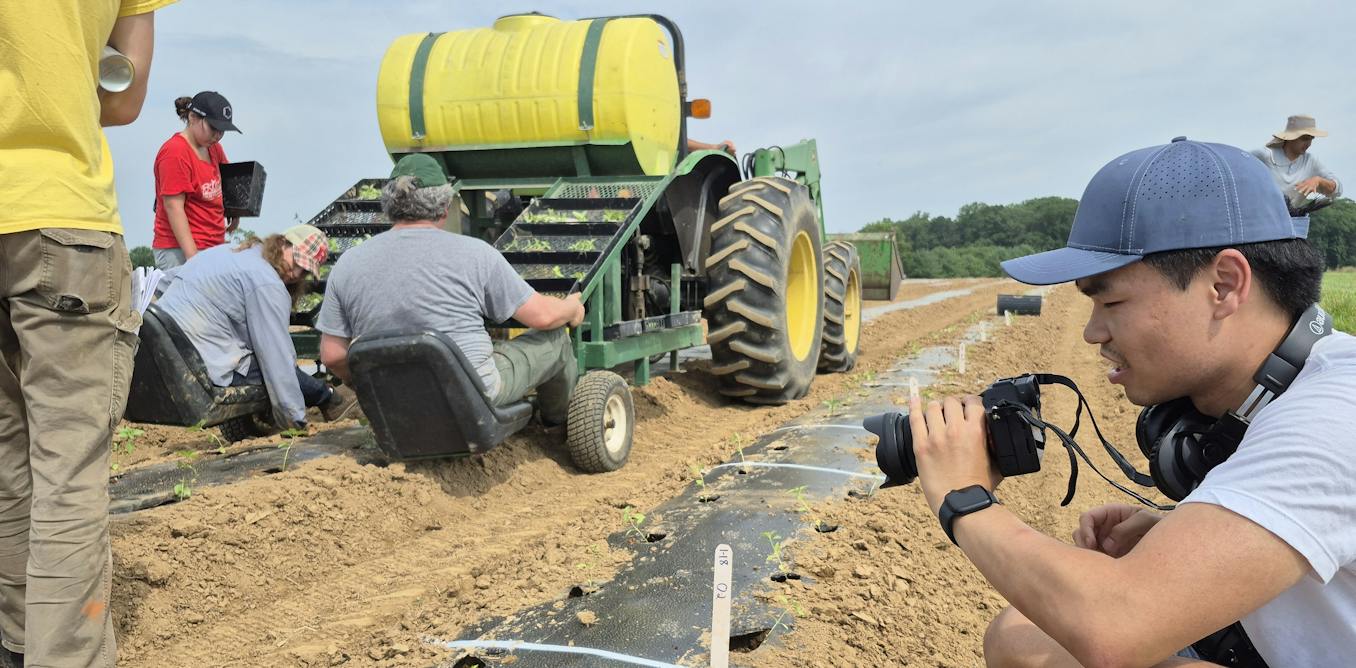
Marine scientists navigate autonomous glider robots across the Atlantic Ocean and along the West Antarctic Peninsula, collecting data to help predict storm intensity. When farmers’ fields are destroyed by an unknown pathogen, plant scientists spend years breeding new varieties of disease-resistant food crops. A team of microbiologists explore deep-sea volcanoes in search of organisms that may contain anticancer compounds. The science-in-action model teaches students to create documentaries that show the scientific research process. These are passionate people who are dedicated to seeking solutions to real-world problems. They are also the main characters in science documentaries produced in the Rutgers Immersive Learning Science Storytelling Lab that I oversee. Our lab pairs students with working scientists to co-create documentaries about research as it happens, while earning experiential learning credit. At a time when confidence in science is declining, I was approached by scientists who wanted their authentic research stories communicated to broad audiences. I am an educator, a researcher and anthropologist, and a science filmmaker who has been making science documentaries with Rutgers students and researchers since 2008. The science-in-action storytelling model I developed is intended to make the human journey of science visible to the public. Our stories communicate the process, motivations and integrity behind science, which helps earn public confidence and trust in science. I also partner with STEM learning researchers to gauge whether our documentaries increase the relatability of scientists, increase public understanding of scientific processes and help students find belonging in STEM. Our storytelling process Science-in-action storytelling is composed of five steps that support student-scientist relationships. First, the storytellers develop trust with the participating university scientists. This trust stems from shared respect and a mutual understanding of the co-creation process. The scientists then invite storytellers into their labs and field sites, where we capture their research processes in real time. This is Step 2. Undergraduate philosophy major Ben Lerner was invited to accompany oceanographers to Barbados to make the documentary ‘Growing the Caribbean Glider Fleet.’ Leah Hopson, CC BY Our professional storytelling team, which includes students, then documents scientists conducting research, including experiments and data collection, as they describe the why and how of their work. Depending on the complexity of the project, we collect dozens to hundreds of hours of science-in-action video footage. Importantly, this video data is maintained in our storytelling lab, as it often includes recordings of federally funded research. Maintaining the video data repository is a key component to establishing and sustaining trust with the participating scientists. Step 3 invites students to immerse themselves in the video data and begin shaping the footage into documentary scenes, constructed using only the scientists’ words, without narration. As they analyze hours of footage, our students learn about the authentic scientific processes; in doing so, they participate in research through the process of storytelling. Master’s student Shaniya Utamidata directs a 26-minute documentary called ‘Where the Waters Meet on the Breathing Shore,’ about scientists studying estuary biodiversity. Dena K. Seidel, CC BY Our students are not graded on their documentary skills, nor are they required to make a film. Instead, they are graded on the science they learn through the storytelling process. Step 4 requires that the students share drafts of their documentary scenes with the featured scientist to verify the accuracy of the science communicated. This step is part of the foundational trust agreement with the scientists but is also an opportunity for the students to personally connect with scientists. For Step 5, our lab works to distribute the documentaries to a wide variety of audiences, including the general public. Here we partner with STEM learning experts to assess audiences’ understanding of and trust in the science communicated in the film and audience perceptions of the featured scientists. Reach far beyond the lab Our completed science-in-action documentaries have reached audiences far beyond the university. Our National Science Foundation-funded “Antarctic Edge: 70° South” had a theatrical release and aired on Netflix. “Atlantic Crossing” was broadcast on PBS stations and was included in a three-year Smithsonian exhibit. “Fields of Devotion” was shared by the Association of American Universities as part of its campaign to increase public trust in science. And our lab’s newest long-form documentary, “Mysteries of 9° North,” co-created with 14 undergraduates and featuring scientists studying life at deep-sea volcanoes, will be released to the public in early 2027. Students introduce the first work-in-progress screening of the National Science Foundation-supported, feature-length documentary ‘Mysteries of 9° North’ at the Woods Hole Oceanographic Institution in 2026. Sean Feuer, CC BY Our surveys capture how these science documentaries change audience understanding of science and how it is done. For example, after screening “Antarctic Edge,” viewers’ self-reported understanding of climate change rose from 71% to 91%. On a 15-item knowledge quiz, average scores rose, with gains of up to 24 percentage points on the concepts they knew least about. Creating belonging for students in STEM When 102 undergraduates were asked what made the scientists in “Fields of Devotion” relatable, they named passion for the subject (72%), desire to help others (71%) and commitment to their work (70%). Our survey results also suggest that students who participated in the lab gained confidence and feelings of belonging in a science community. Undergraduates who once said they did not feel “smart enough” reported that they could now see themselves as scientists. All participating students reported that their collaboration with scientists positively transformed their understanding of science. For the documentary ‘Amaranth: Cultivating Culture,’ undergraduate Zolani Kizito documents scientists as they analyze medicinal plant samples. Dena K. Seidel, CC BY Nonscience majors gained a deep understanding of the scientific process, while science majors gained rare access to research outside their own disciplines. Student-directed science documentaries include “Growing the Caribbean Glider Fleet,” featuring scientists monitoring hurricane development; “Biting Back: The Lifesaving Potential of Catnip,” about the development of natural insect repellents; “Where Waters Meet on the Breathing Shore,” featuring climate scientists studying coastal ecosystems; “The B.A.S.I.L Project,” about USDA-funded plant-breeding research; “Ocean Farming,” about NOAA supported oyster breeding; “The Women of Nsongwe,” about USAID-supported agriculture projects in Zambia; and “Skycatcher,” about an NSF-funded atmospheric chemistry study in Alabama. This science-in-action model offers a path forward that other universities could follow. Institutions can strengthen students’ STEM learning and science identities while training a new generation of credible, relatable voices for science. Uncommon Courses is an occasional series from The Conversation U.S. highlighting unconventional approaches to teaching.
Students creating documentaries with scientists deepens STEM belonging and public trust in science
Full Article
Original Source
Read the full article at Theconversation →KhanList aggregates and links to publicly available news content. We do not host full articles from third-party sources. Always verify important information with original sources.