
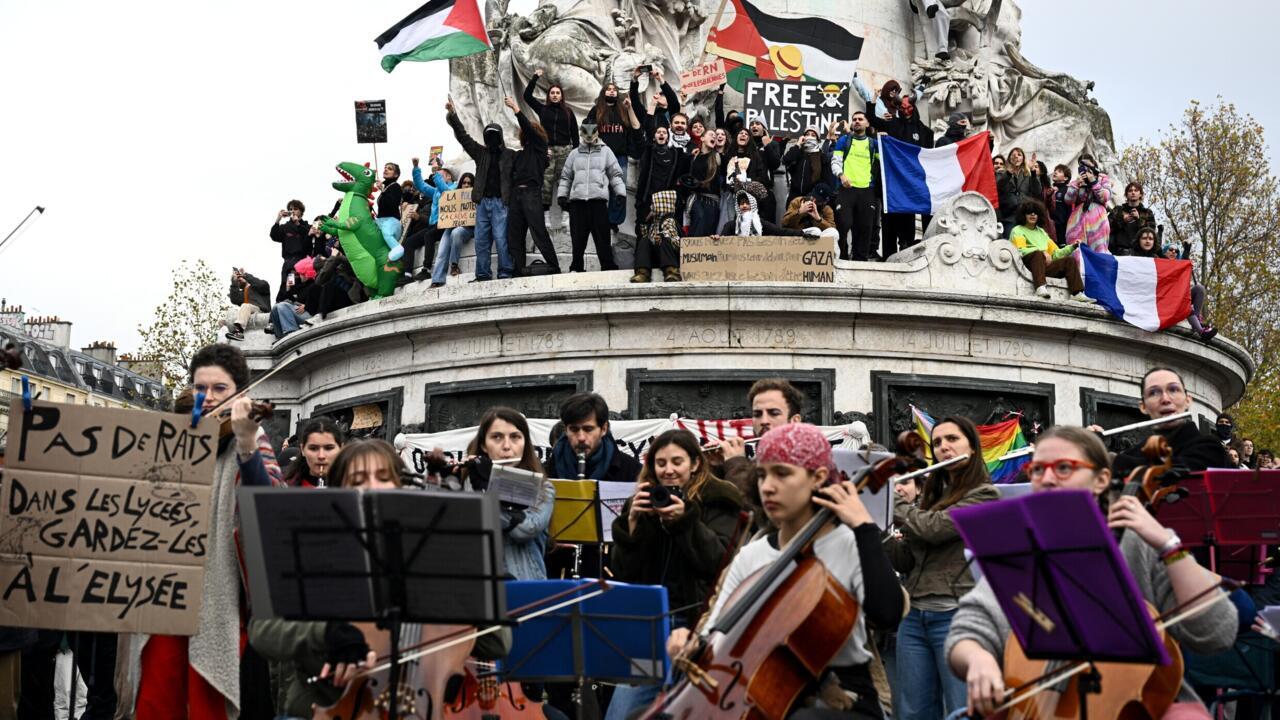
Thousands of demonstrators took to the streets across France on Saturday for a sixth consecutive weekend of protests against rising living costs, deteriorating public services and growing inequality. The movement, which began with student demonstrations in September, has since broadened into a nationwide campaign and inspired similar rallies elsewhere in Europe. Issued on: 21/11/2026 - 17:43 3 min Reading time Thousands of people gathered in cities across France on Saturday as a wave of protests over the cost of living, public services and police conduct entered its sixth consecutive weekend, bringing together students, trade unions and political activists. In Paris, several thousand demonstrators converged on Place de la République, where musicians, food trucks and colourful costumes created a festive atmosphere despite the increasingly serious political grievances driving the movement. Trade union banners and flags representing left-wing political parties mingled with those of student organisations and the Yellow Vest movement, which emerged eight years ago to challenge President Emmanuel Macron's government over fuel prices, taxation and declining purchasing power. Some demonstrators carried homemade placards demanding greater investment in education, healthcare and social protection, while others highlighted what they described as the growing difficulty of making ends meet. One sign summed up the frustration felt by many young protesters: "I want to live, not survive." Another group erected mock gravestones symbolising the death of France's public services, including its education and social security systems. The demonstrations come amid persistent concerns over economic insecurity, widening inequality and the ability of public institutions to meet the needs of ordinary citizens. Cost of living protests set to continue across Europe over weekend Student anger fuels wider movement The protests began in mid-September when secondary school students mobilised to demand better learning conditions, more resources and improvements to the education system. What started as a campaign focused largely on schools has since expanded into a broader movement against rising prices, inadequate public services and allegations of excessive police force. University students, trade unions and political organisations have joined the demonstrations, helping to turn an initially youth-led mobilisation into a wider expression of public discontent. Although participation has declined since the movement's early weeks, organisers have continued to bring demonstrators onto the streets, with Saturday's rallies highlighting the persistence of concerns over living standards. For student representatives, the movement reflects difficulties shared by young people well beyond France's borders. "In a number of countries, young people are going through the same thing, namely precarity. You have to choose between having a roof over your head, getting medical care, and being able to eat your fill," said Manon Moret, general secretary of the Unef student union. The French demonstrations follow a series of rallies across Europe on Friday, when protesters gathered to challenge government policies on living costs, military spending and climate change. While the demands vary between countries, many demonstrators have expressed similar frustrations over economic insecurity and what they see as political leaders' failure to address the concerns of younger generations. National Assembly backs greater legal protection for police using firearms Police legislation adds to tensions Saturday's mobilisation also came a day after France's parliament adopted controversial legislation strengthening legal protections for police officers who use their firearms. The measure, backed by the government and conservative lawmakers but strongly criticised by the left, has added a fresh source of tension to an already strained relationship between demonstrators and law enforcement. In Paris, one protester carried a placard reading "No to the licence to kill", reflecting fears among opponents that the legislation could weaken police accountability. The issue has become increasingly prominent since clashes between riot police and demonstrators during earlier rallies. Although the protest movement has been largely peaceful, some gatherings last month descended into violence, with shops looted and buildings attacked or set alight. Police have also faced accusations of excessive force, further fuelling criticism from student groups, civil liberties campaigners and opposition politicians. Ahead of Saturday's demonstrations, Interior Minister Laurent Nuñez instructed regional prefects to remain "particularly vigilant regarding the groups most hostile to law enforcement", following the adoption of the new police legislation. However, the Interior Ministry said the latest mobilisation had begun in a "generally calm" atmosphere, with turnout lower than at previous demonstrations. The demonstrations also coincide with the eighth anniversary of the Yellow Vest movement, providing a reminder of how grievances over purchasing power and inequality have repeatedly fuelled social unrest in France. (with newswires)
Students and unions unite for sixth weekend of protests across France
Full Article
Original Source
Read the full article at Rfi →KhanList aggregates and links to publicly available news content. We do not host full articles from third-party sources. Always verify important information with original sources.