
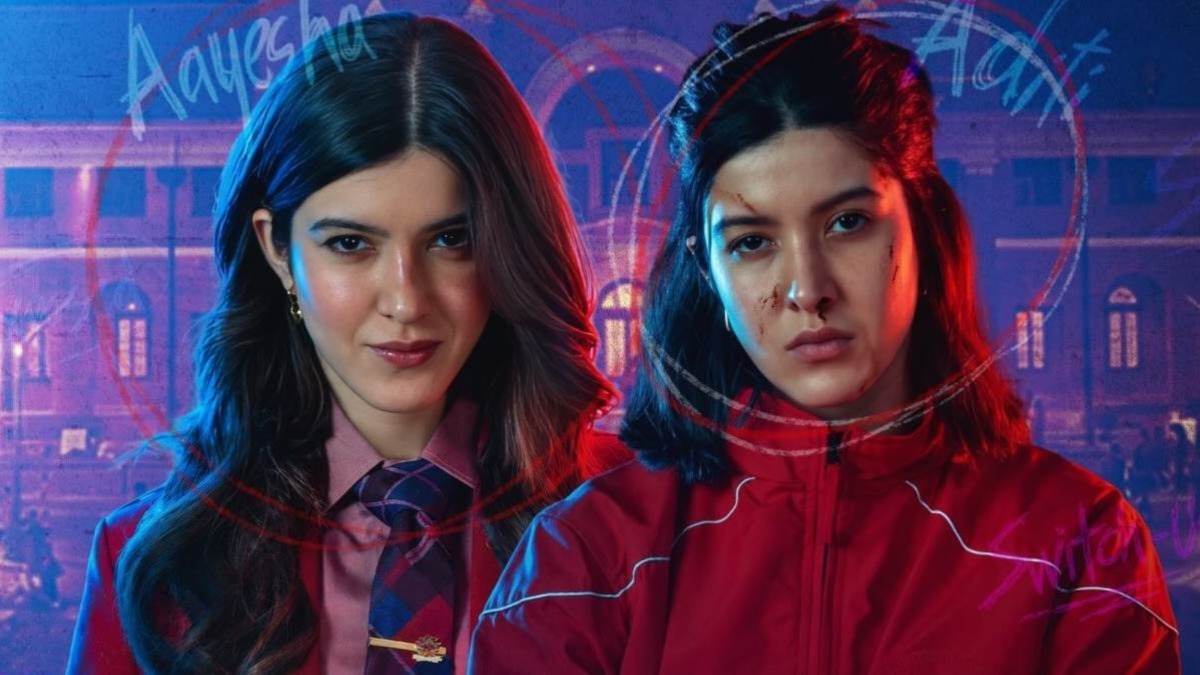
"Poori duniya hi jhooti hai (The whole world lies)." There is a line in Student of the Year: After Dark that pretty much sums up the world this show wants to create. And, honestly, it isn't entirely wrong. Everyone is in a race to win, and when the stakes are high, morality, friendship and basic humanity can take a backseat. The real question is: how far will you go to get what you want?The original Student of the Year, with Varun Dhawan, Alia Bhatt and Sidharth Malhotra leading the campus race, gave us a rather PG version of ambition, popularity, youthful rivalry and relationships. Its latest instalment, SOTY After Dark, wants to take things several shades darker. This time, the Gen Z crowd comes armed with secrets, sinister social media pages, messy relationships and a murder mystery. Except, somewhere between wanting to be a campus drama and a psychological thriller, the show loses its plot. Quite literally, at times.The six-episode series opens with Aayesha (Shanaya Kapoor) being drowned in a frozen lake. Her twin sister Aditi's return to school sets off an investigation, with practically everyone becoming a suspect. Friends, classmates, teachers, boyfriends: nobody gets a clean chit.The family dynamics are equally messy. Separated parents, twins raised apart and a strained mother-daughter relationship provide the emotional backdrop. But the campus is where the real drama unfolds. There is a boyfriend who cannot get over being friend-zoned, another who seems suspiciously perfect, a roommate who hates her and a best friend whose loyalty comes with an expiry date. Basically, nobody is happy, and nobody is trustworthy. The Student of the Year competition is the big prize everyone is fighting for. It is the ultimate badge of validation, the title that can make or break reputations. Everyone wants to be the best, but nobody seems interested in playing fair. The tasks, however, are surprisingly juvenile. What could have been harmless school-level challenges get a sinister makeover, with every round designed to expose vulnerabilities, trigger rivalries or unleash secrets. The competition drives the conflict, but its execution feels more dramatic than convincing. You understand why everyone wants to win, but don't quite buy into the lengths they are willing to go.And yet, there is something interesting in the show's commentary on today's generation. Everyone wants to be liked, nobody wants to be questioned, and being authentic is apparently the riskiest thing one can do. Friendships are built on convenience, relationships run on half-truths and social media validation is the ultimate currency. The person who dares to speak the truth is conveniently painted as the villain. There is even a hilarious moment when, in the middle of a heated confrontation, a best friend pauses to point out to Aayesha how her mascara is smudging. The show also touches upon grief, PTSD and the different ways people process trauma. But these threads get buried under endless twists and interpersonal drama. At times, you want the series to stop chasing revelations and actually understand its characters.The biggest problem is the storytelling. Director Reema Maya attempts a non-linear narrative, jumping between timelines and perspectives to keep the mystery alive. Instead, it often leaves you wondering what exactly is happening and why. The screenplay has enough material for an engaging thriller, but the scattered treatment makes it difficult to stay invested. The final episode does pick up pace, but the first five have already tested your patience. At one point, you genuinely wish that JioHotstar had a 2x speed option. Not because the story is complicated, but because you desperately want it to get somewhere.Performances don't quite help matters. Shanaya Kapoor tries hard to carry the emotional weight, but the intensity doesn't always translate on screen. The supporting cast is equally uneven. Abhinav Singh, Manya Grover, Divik Sharma and Deeya Damini show promise, but there is too much exaggerated role-playing and too little character depth. Everyone seems to be performing angst rather than experiencing it.There are, however, glimpses of Reema Maya's potential as a filmmaker. Some scenes capture youthful insecurities, toxic friendships and the complicated business of growing up. She has an eye for atmosphere and occasionally gets the emotional beats right. Sadly, these moments don't add up to a satisfying whole.We have seen plenty of young-adult thrillers and campus dramas - from Class and Elite to Pretty Little Liars, 13 Reasons Why and Euphoria. But the good ones know exactly what they want to be. Darkness alone doesn't make a thriller. You need characters worth rooting for, a mystery worth solving and, most importantly, the intent to keep the audience hooked. Student of the Year: After Dark tries to be a murder mystery, a commentary on Gen Z, a family drama and a psychological exploration of trauma. In an attempt to tick every box, it exhausts itself. As a standalone campus thriller, perhaps this story could have worked with sharper writing and more conviction. As a franchise extension, though, it feels like an unnecessary makeover.Not every campus rivalry needs a dead body, and not every familiar franchise needs to be dragged into the dark to feel relevant. The original gave us a campus worth revisiting. This one makes you want to bunk class.- Ends
Student of the Year After Dark review: Secrets, drama in Shanaya's show but no thrill
Full Article
Original Source
Read the full article at Indiatoday →KhanList aggregates and links to publicly available news content. We do not host full articles from third-party sources. Always verify important information with original sources.