
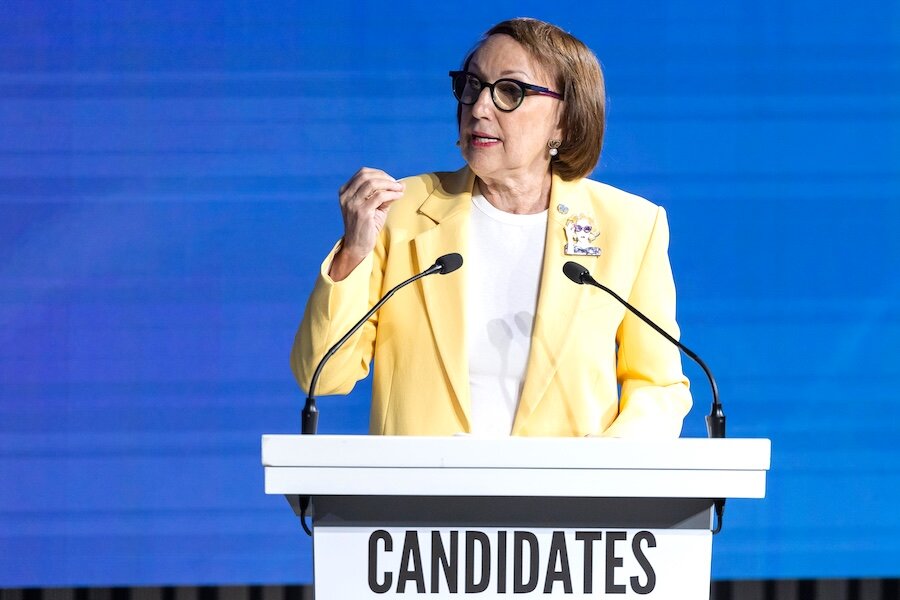
One of this year’s world-shaping elections has been largely hidden from the world. Since July, the 15 members of the United Nations Security Council have held three secret straw polls to select the U.N.’s next secretary-general by January. No clear front-runner has emerged. But here is the headline so far: Two of the top three candidates are women. In the U.N.’s 81 years, only men have been chosen as its top executive. Typically, a secretary-general ends up serving two five-year terms. What’s more, the two women leading the informal balloting are from Latin America. The last U.N. secretary-general from that region left 35 years ago. The Security Council’s choice this time will certainly reflect the usual backroom horse-trading among the body’s three major veto-wielding nations – Russia, China, and the United States. This week, heads of state and government are in New York for high-level talks during the opening session of the U.N. General Assembly. The 193-member Assembly has the final say on the choice. It has already made clear that it strongly prefers a woman. In addition, a wide consensus prefers someone from Latin America or the Caribbean.Beyond the geopolitical concerns, however, the women campaigning for the job have set a tone that suggests they would bring feminine qualities of leadership – such as a listen-first approach that is inclusive and empathetic – to an organization in need of basic reform to revive its historic role as a peacemaker. “Despite the understanding that when women are part of peace processes, outcomes improve, the transformative potential of women’s leadership in peace remains largely unrealised,” Carolyn Rodrigues-Birkett, Guyana’s envoy to the U.N., stated two years ago. She is currently a leading candidate.“Peace will never be sustainable without the participation of half of those who should benefit from it – women,” she added. “Women must not be seen only as victims, but also as active participants and decision-makers in building peace.”The other leading candidate, Rebeca Grynspan, a former vice president of Costa Rica, pitches herself as a peacemaker able to head off wars before they start. “I will land before conflicts erupt, be the first to pick up the phone ... and will mediate among the mediators,” she has stated. In 2022, as head of U.N. Trade and Development, she brokered a deal between Russia and Ukraine to allow grain exports following Russia’s invasion. The ability to forge a peacemaking consensus has long been a key skill needed in a U.N. secretary-general. The whole point of the U.N., stated U.S. President Harry Truman in 1945, is to find common ground. “That is the essence of keeping the peace in the future,” he said. Deepen your worldviewwith Monitor Highlights.Politics with respectGet political stories with respectful analysis.There‘s a world of new ideas in everyBooks newsletter.There‘s more to life, enrich yours withCulture & Learning weekly.Follow humanity‘s discoveries withScience & Nature stories in your inbox.Gain a spiritual perspectivefrom the stories in your inbox.Want to understand the deeper impact of critical events? Learn the Monitor‘s insight.Already a subscriber? Log in to hide ads. Today, only about 15% of peace negotiators are women. Yet peace agreements have been 35% more likely to last at least 15 years when women are meaningfully involved in negotiations, according to the U.N. Come January, when the new U.N. chief could be a woman, those numbers would most likely rise. ALREADY A SUBSCRIBER? LoginReal news can be honest, hopeful, credible, constructive.The Christian Science Monitor was founded in 1908 to lift the standard of journalism and uplift humanity. We aim to “speak the truth in love.” Our goal is not to tell you what to think, but to give you the essential knowledge and understanding to come to your own intelligent conclusions. Join us in this mission by subscribing.
Straws in the wind for women peacemakers
Full Article
Original Source
Read the full article at Csmonitor →KhanList aggregates and links to publicly available news content. We do not host full articles from third-party sources. Always verify important information with original sources.