
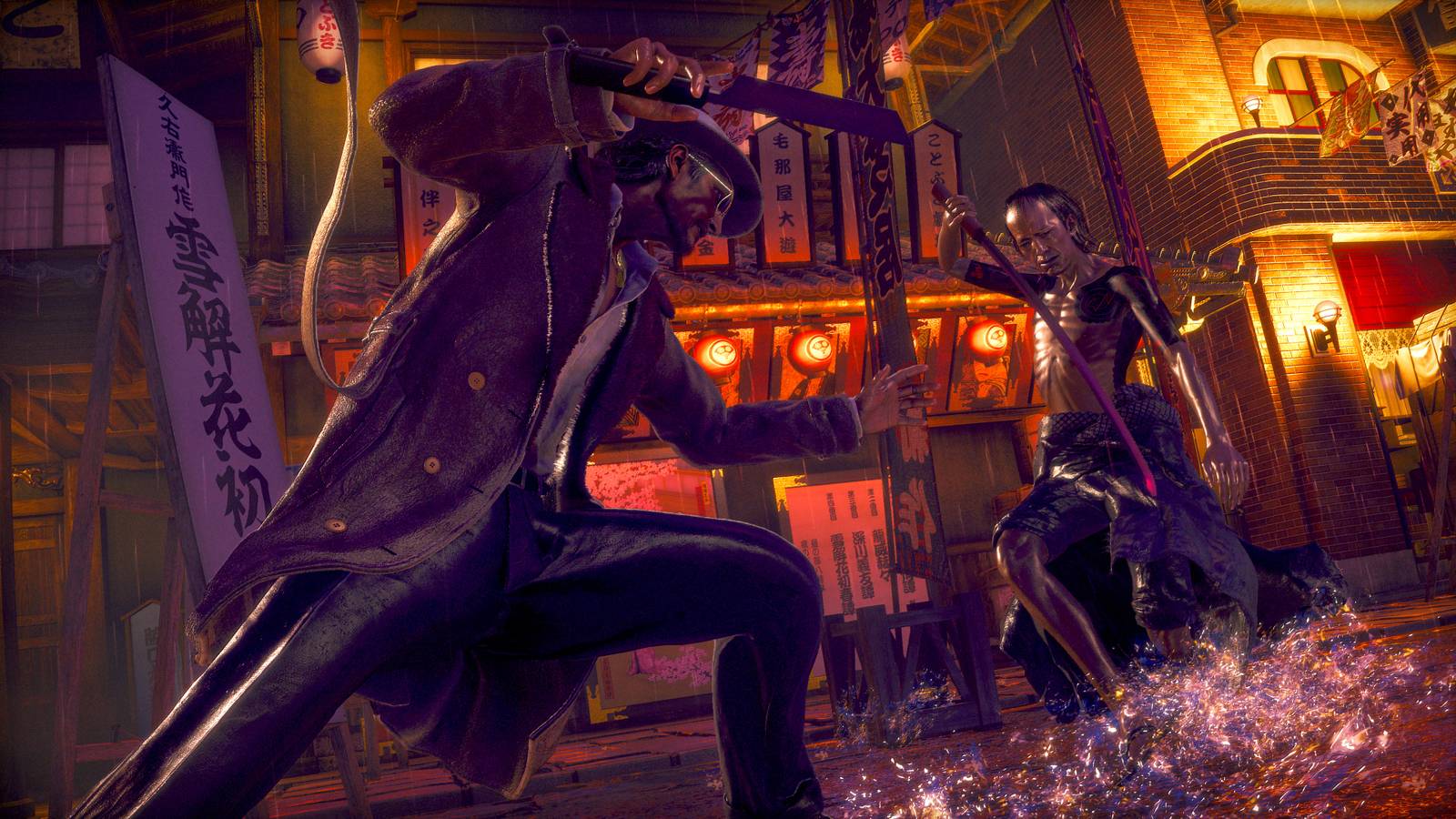
I’ve always preferred the action combat of wham-bam ‘Take a bike to the face, man!’ in Ryu Ga Gotoku Studio games, so I was ecstatic to learn that Stranger Than Heaven would let me return to my button-mashing ways. Or so I thought. After going hands-on with a three-battle combat demo at Gamescom, I awkwardly realised that I need to “git gud” and actually hone (read: obtain) some proper combat skills. Stranger Than Heaven’s combat is unique in that it utilises independent left and right body controls using your controller's shoulder buttons and triggers. You also have weapons you can equip, use, and swap between during a battle, though be warned that your enemies won’t stop while you swap your large hammer for a little knife. We had three battles of increasing difficulty to complete; the only real difficulty for me was learning to actually block attacks for once. I normally just suck it up and let my characters act like a sponge while I spam attacks, but that didn’t work here, as I soon found out in the second encounter. I died so many times I lost count, but eventually I had to get better, or else I’d have to leave in shame. I knuckled down and started being more careful about timing, blocking, and evading, and finally made it through to the final, most challenging battle… only to find it way easier than the previous one once I realised I had to actually fight like a good girl and not be lazy. Stranger Than Heaven Wants To Make Its History Feel Authentic After finally completing all three battles and escaping with my gamer card mostly intact, I spoke with producer Hiroyuki Sakamoto and director Mikinobu Abe. “With Stranger Than Heaven, we wanted to create a completely new title, and that was also the reason for this new combat style because we wanted to go back to this original action game feeling that, with time, your skills develop and you have a deeper gameplay,” Sakamoto says. There wasn’t a concern that some fans would find the combat too difficult, with Sakamoto saying, “it shouldn't be that complicated that people can't play it”, adding, “even for those who are not used to action games”. Besides, you could always just lower the difficulty. Or you know, get good. Stranger Than Heaven feels more brutal than fans are used to from RGG Studio, and Sakamoto explains that as the game tells the story of the origins of yakuza, detailing the roots of the organisation and outlaw world, “it’s kill or die, so it has to be brutal”. He tells me that he wanted to ensure that the yakuza world didn’t have any fantasy elements, and that it was “important that we can show this realistic origin of yakuza and show all the drama and all the tragedy which comes with it”. Throughout Stranger Than Heaven, players will experience both the violence of the Japanese underworld and the highlights of show business and the music industry. While this might seem like polar opposites at first glance, the two are actually intrinsically linked. Sakamoto says it all comes back to wanting “to show the reality of the origin of yakuza”, as “how the yakuza as an organisation thrived and went out to society, it was also through show business and especially singing, so this is a historical fact”. The team researched the different eras shown in Stranger Than Heaven by looking at books, movies, and other video footage from those times. Abe says that “everything was surprising” as they dived back through the history books. “How they used to get on with their days, lifestyles, working hours, everything was so unique and so interesting. Everything was so fresh to us, so we took a lot of inspiration from them and tried to recognise the lives and the atmosphere that they had. That interest inspired us a lot in creating the atmosphere that we have in the game.” RGG fans have grown accustomed to the balance of hard-hitting emotional narrative with the most bizarre and lovable comedic moments throughout the Yakuza/Like a Dragon series. However, for Stranger Than Heaven, the team wanted to “show a drama that is very close to the era”. Entertainment in the past was very different from modern-day, where we have parody and comedy. “Life in 1915 was not that light-hearted; the entertainment style was very different”, and so Stranger Than Heaven will feature “era-specific entertainment”. Likewise, the minigames will depict games from the eras the game is set in. “The era is in the past, and we can’t put in minigames based on technologies that were not there”, and so instead they chose minigames of the time that would allow players “to experience this era and the atmosphere and the way people lived”, adding that the minigames are “rather conservative, not that popping, but rather decent. I think it will be very fun to play.” Stranger Than Heaven will feature five different eras throughout protagonist Makoto Daito’s life, but interestingly, Abe explains these time periods were not chosen based on what was happening historically, but what would be happening with Daito at that time. “The way we chose the timeline was basically, we have the beginning of the story and the ending of the story, and we tried to choose the most important moments for our main protagonist's life. We didn't particularly choose that era just because there was some event going on in the world, but it was more focused on, ‘Okay, what could happen to Daito's life if we put this character in this environment or this time in Japan?’” Depicting a character over so many time periods is a huge undertaking, but Sakamoto says there were “no compromises made along the way” and that “from the very beginning depicting 50 years and five different eras was already a huge achievement for us”. Leaving Like A Dragon Behind Came With A Lot Of Pressure Sakamoto tells me that “the motivation was really high” to create something entirely new after working on the Like a Dragon series for so long. “I was excited to be able to create something from scratch again. But on the other hand, the difficulty of leaving behind a legacy was also there, so it was both sides of the same coin.” When I ask whether developing something new added more pressure or felt more risk-free, Sakamoto says “both”, explaining that “In the beginning of the development phase, everyone was so much into it, and putting a lot of energy and effort, and I don't know what to say about it now. Everyone was happy, and then mid-stage it was like, 'Okay, but how can you compile this into a game?’ It's so difficult, it's so hard. So, yeah, in the beginning there was a lot of energy, but midway there was also a lot of struggle.” Having been involved in a lot of Like a Dragon titles already, Sakamoto says he doesn’t really have a favourite process or part of development that he finds most fun, as he’s always focusing on “how can I make this a complete product at the end”. “As a director, I had to rush over everything, so there's no specific personal favourite, but it was more about depicting one man's life from 1915 all the way to 1965,” Abe adds. “It's such an epic story, and that core concept already got me really hoping to work on this project, so the game's entire concept was something I'm really, really proud of, and I'm excited to get a reaction from people once they get to experience it.” That unique 50-year journey is what the team hopes players will appreciate the most. “The story and the environment will change, and at the end, when the players finish the game and put the controller down, they will experience something very different from other games,” Sakamoto says. Abe tells me the game is now in “the final stages and that as he was playing it, “it really made me emotional witnessing one man's life, and it was such a unique experience finishing the game. I think that will be something that will be very unique and something you want the players to explore.” For us as players, we get to experience that emotional rollercoaster as a fully polished, complete narrative, complete with all the bells and whistles. I couldn’t help but wonder if the team creating the game feels the same level of emotion while developing the game, knowing what will happen and seeing parts in their incomplete form. “I'd say throughout the whole process, we can already feel it, because this one is really epic; it's really dramatic. When we write, of course, some scenes we rewrite, but usually we start at the beginning, and we process the progress of the story, and this way it will be really dramatic and emotional, so this is something we experience through this process as well.” Sakamoto tells me. As the eternal Goro Majima stan that I am, I couldn’t resist asking if the team thought any of the Stranger Than Heaven characters were cooler than Majima. After a laugh from everyone in the room, Sakamoto, who is probably sick of hearing about everyone’s favourite one-eyed Mad Dog, acknowledges that Majima is “the most popular character in the series” and thinks part of that is because he’s been there from the very beginning, so fans could follow him across the span of the series. Because Stranger Than Heaven offers the same lifespan journey, though within one game, Sakamoto says the characters “are similar or even more attractive”. Challenge accepted. Released January 15, 2027 Developer(s) Ryu Ga Gotoku Studio Publisher(s) Sega PC Release Date January 15, 2027 Xbox Series X|S Release Date January 15, 2027 Genre(s) Action, Adventure
Stranger Than Heaven Wants To Show The “Realistic Origin Of Yakuza”
Full Article
Original Source
Read the full article at Thegamer →KhanList aggregates and links to publicly available news content. We do not host full articles from third-party sources. Always verify important information with original sources.