
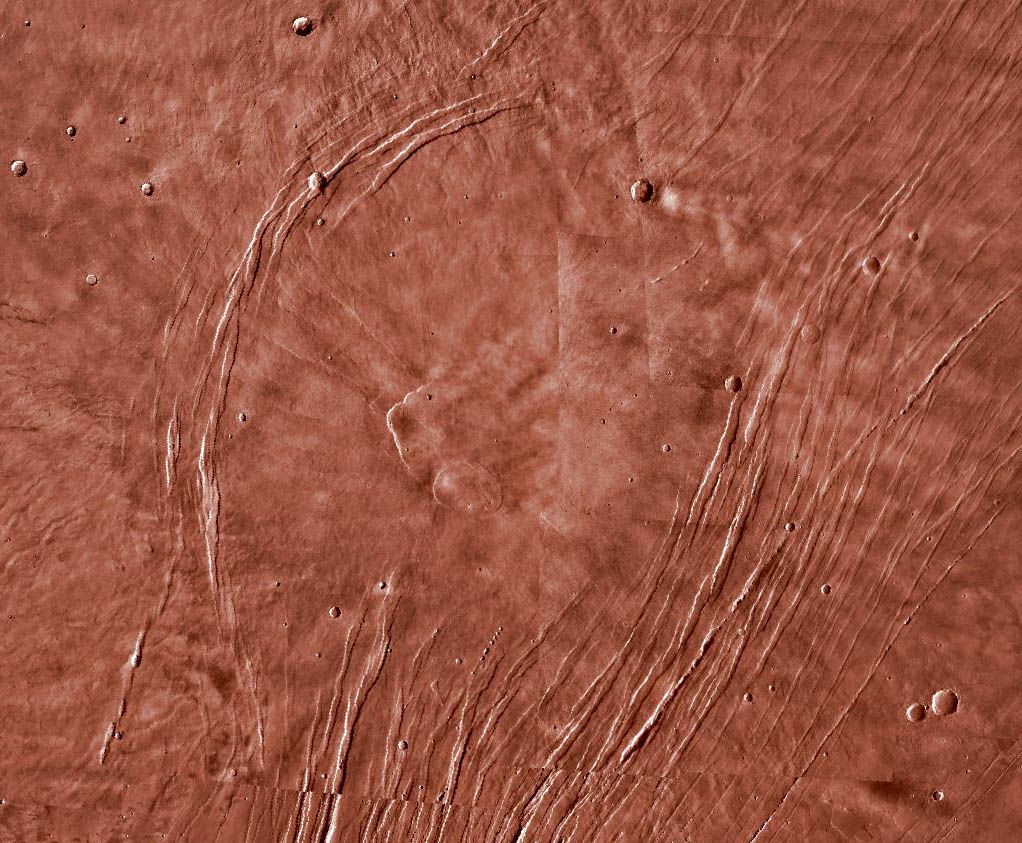
Cracks along a giant Martian volcano, possibly above a magma chamber, might be spewing magmatic gases into the atmosphere, according to a new study. The fissures might host environments akin to Earth’s hydrothermal vents, where life on our planet may have emerged November 6, 2026 12:13 p.m. The gas may have been spewed from cracks at the edges of the shield volcano Alba Mons. JMARS / Arizona State University via Wikimedia Commons under CC-BY-3.0 Volcanic activity shaped the Red Planet for hundreds of millions of years. But today, researchers aren’t sure whether our neighbor has retained some of that volcanic feistiness or if it is truly dead inside. In a study published November 4 in the journal Science Advances, scientists suggest that magma is, indeed, still on the move beneath the surface of Mars. Their evidence comes from unexpected gas detection in the planet’s atmosphere, which may have been spewed from fresh cracks on its Alba Mons volcano. If confirmed, their findings could shape how researchers search for signs of extraterrestrial life on Mars. It’s not the first time researchers have found possible hints of ongoing volcanic activity on the Red Planet. NASA’s InSight lander has previously detected marsquakes whose rumblings indicated potentially active subsurface fluid. “Some folks think it’s magma; others think it’s water,” Tracy Gregg, a planetary volcanologist at the University at Buffalo, who didn’t participate in the study, tells National Geographic’s Robin George Andrews. “I think it might be both.” Did you know? Tallest mountain Mars’ shield volcano Olympus Mons is the tallest mountain in the solar system. It’s around 4.5 times the height of Mount Everest. The new work provides the strongest evidence yet discovered of gases released by dormant Martian volcanoes, complementing Insight’s data, lead author Alexander Trokhimovskiy, a planetary scientist at the Space Research Institute at the Russian Academy of Sciences, tells Live Science’s Elizabeth Howell. The gas in question is hydrogen chloride, a stinky substance that can come from volcanoes on Earth. In 2021, the ExoMars Trace Gas Orbiter (TGO), a collaboration between the European Space Agency and Russia’s Roscosmos, recorded unexpected spikes of the smelly gas above Mars’ northern hemisphere during its early summer. Usually, atmospheric hydrogen chloride peaks in the northern hemisphere’s winter and then almost disappears over the summer. The researchers found that the gassy deviation happened during multiple Mars years, each of which is nearly as long as two Earth years. What’s more, it always occurred in the early summer and over volcanic fissures on the edges of Alba Mons, a giant shield volcano spanning roughly the area of the contiguous United States. Researchers suspect a dormant magma chamber could be hiding below the Alba Mons volcano. MEX / HRSC global color mosaic, ESA / DLR / FU Berlin, G. Michael. Inset: Blended MOLA-HRSC digital elevation model, Fergason et al 2018 Images snapped by TGO’s high-resolution camera revealed new, narrow cracks. The photos also showed color changes on Mars’ surface, which the researchers suspect are related. Trokhimovskiy and colleagues propose that these cracks, which are blocked by ice during the winter, might emit hydrogen chloride in early summer. The strange coloring near the fissures could be caused by deposits left by substances in the gases that cool as they reach the surface, which happens around volcanic gas vents on Earth. Furthermore, the research indicates that this process is linked to a dormant magma chamber underground. “Looking at the spatial distribution of the seeping, it became instantly obvious to me that there was something volcanic behind it, but it had to be demonstrated,” study co-author Daniel Mège, a planetary scientist at the Space Research Center of the Polish Academy of Sciences, says in a statement. “A huge part of the work consisted of examining all the possible chemical processes going on in the Martian atmosphere. We needed to be rigorous, critical and creative to explain the presence of hydrogen chloride.” The white discoloration on the Alba Mons volcano might be deposits left by magmatic gases as they rise out of vents. ESA / TGO / CaSSIS More broadly, the findings indicate that Mars’ interior might still be hot enough to host magma activity, Trokhimovskiy tells Reuters’ Will Dunham. They also suggest that scientists searching for extraterrestrial life should home in on these fissures. “As rising magma moves through the crust, it can encounter, melt and heat underground water, creating environments shielded from the harsh surface conditions,” Trokhimovskiy tells the outlet. “Such active hydrothermal systems may provide the energy sources and favorable conditions needed to support microbial life. This makes warm subsurface environments one of the most promising targets in the search for life on Mars.” That would be consistent with life as we know it. On Earth, the chemistry that kicked off life may have occurred in hot, mineral-filled hydrothermal vents on the ocean floor. You Might Also Like Get the latest stories in your inbox every weekday. More about: Chemistry Geology Mars New Research Volcanoes
Strange Gas in Mars' Atmosphere Hints the Red Planet Is Still Volcanically Active—and Points to Places to Search for Alien Life
Full Article
Original Source
Read the full article at Smithsonianmag →KhanList aggregates and links to publicly available news content. We do not host full articles from third-party sources. Always verify important information with original sources.