
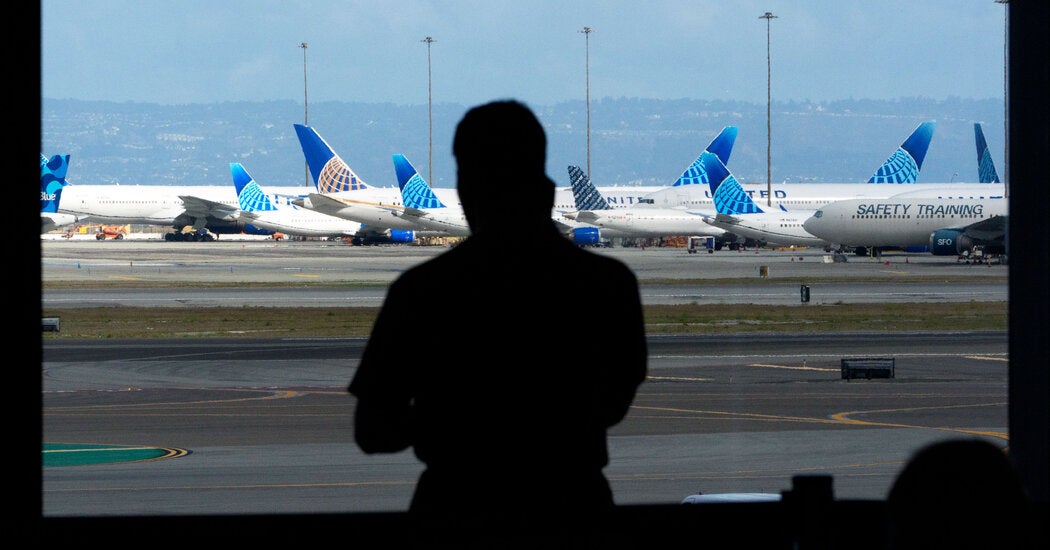
LatestHere’s the latest.Federal officials said the cascading communications failures that forced the government to shut down flights across the United States on Friday started with a contractor upgrading air traffic control equipment, replacing copper wire with fiber optic cable.The upgrade set off communications failures across the facilities that manage the national air space, the officials said. Alarmed at the scope of the problem, the Federal Aviation Administration decided to issue a rare nationwide ground stop for several hours.Speaking at news conference in Washington, Transportation Secretary Sean Duffy said that the specific problem with the upgrade, which took place in what he called a “remote” facility, was not yet known. The contractor, L3Harris, has worked for the Federal Aviation Administration for decades, he said.Mr. Duffy said his agency was trying to determine whether the problem had been caused by the contractor’s incompetence or faulty equipment. “We haven’t determined what the fault was,” he said. He added, “We’re going to hold people accountable.”The F.A.A. administrator, Bryan Bedford, said there was no evidence the communication problems had stemmed from a cyberattack or the use of artificial intelligence.Mr. Bedford said that he expected the system to be back to normal by Sunday night. “The worst is behind us,” he said.But even though the system came back online Friday evening, the effects of the shutdown were vast and continued on Saturday.Travelers across the United States were still facing delays and cancellations on Saturday as airlines and airports struggled to recover from the ground stop.At least 3,000 flights scheduled for Saturday were canceled, according to Cirium, an aviation data firm. At Chicago O’Hare International Airport, a ground stop was issued for United Airlines flights.Mr. Duffy again called on lawmakers to fully fund upgrades that he said were needed to prevent similar failures. To upgrade aging air traffic facilities and technology, he said, he wanted another $50 billion from the Republican-controlled Congress, which last year approved $12.5 billion for the project.Here’s what else to know:If your flight is canceled: You are entitled to a refund if your flight is canceled in the United States, regardless of the reason, or if a flight is significantly delayed or changed and you decide not to take it. Here are other travel tips that might be helpful. Read more ›Handling the chaos: Radio transmissions between air traffic controllers and pilots at major airports offered a peek at how they navigated the ground stop. Read more ›Rare halt: Friday’s nationwide ground stop was only the third that the F.A.A. has issued this century. It ranks as the second-longest, after the stop issued in the wake of the terrorist attacks on Sept. 11, 2001. There was a shorter one on Jan. 11, 2023, because of an outage in the F.A.A.’s safety-alert system. Read more ›Democrats’ response: Representative Hakeem Jeffries of New York, the House’s top-ranking Democrat, said the stop was “the latest in a series of unacceptable air travel incidents” under the Trump administration. He added that Americans deserved timely answers about how and why it happened.Stranded by planes, travelers turned to trains and automobiles.ImageThe ground stop on flights called by the Federal Aviation Administration on Friday stranded thousands of travelers in airports across the country.Credit...Erin Schaff/The New York TimesWith more than 9,000 flights in the United States canceled Friday and 5,000 more shelved on Saturday, some travelers decided to take matters into their own hands by booking trains, cars and even moving vans.But those attempts weren’t without frustration. Flooded by a surge, Amtrak’s website and app were both down on Friday, causing many travelers to have issues booking train travel.Amtrak did not confirm the booking outages, but a spokesman said that the rail company was “seeing increased demand for travel across our network.”The race to nab a rental car was competitive, with long lines at airport rental car counters and scarce inventory on online travel apps. At Hartsfield-Jackson International Airport and O’Hare International Airport, rental car companies including Hertz, Enterprise and Avis, turned away customers to wanted to rent cars for one-way trips. And some travelers said that rental car companies didn’t honor their reservations.On Saturday morning, Hunter Cavell, 39, arrived at an Enterprise car rental location in the University Heights neighborhood of Washington after his flight to Jacksonville, Fla., was canceled Friday. He found a line of disgruntled customers who, like him, had reservations. There were no cars available.Jessica Whitney was returning to Los Angeles from a work trip in Las Vegas Friday afternoon when the government grounded air traffic. Watching her Delta flight get delayed every half-hour, she and her co-worker decided to rent a car instead of waiting for their flight to get canceled. When she opened her company’s corporate travel booking app, there was one rental car nearby. She pounced to book it, but it was already gone.So for $281, she booked a U-Haul truck, the kind people typically use when they are moving homes.“The U-Haul agent thought it was hilarious,” said Ms. Whitney, 32. With their bags still stuck in Las Vegas, the back of the truck was empty. The duo spent the more than four-hour car ride home listening to the radio and gazing at the desert.“It was better than staying in Vegas for another night for sure,” Ms. Whitney said. “When you’re at the end of a Vegas trip, you don’t want to stay another night.”Other travelers with less flexibility opted to hire drivers.Their flight to Jacksonville canceled, longtime friends Ann Bruns, 79, and Janice Simpson, 78, hired a driver to take them on the six-hour trip from Atlanta to Amelia Island in Florida, where they hoped to catch a cruise ship setting sail on Sunday.Their luggage had already been loaded onto the plane bound for Jacksonville, and it was anyone’s guess when it might arrive. “We’re about to go on a cruise ship with no clothes,” Ms. Simpson said.Other travelers said they had spent hours refreshing Amtrak’s app and website to grab spots on trains. After Claudia Davis’s flight from Ronald Reagan Washington National Airport to LaGuardia Airport was canceled Friday afternoon, she decided having an airline A.I. agent rebook her travel wasn’t worth the hassle. But booking a seat on a train home to New York took her until 2 a.m. and involved many error messages and an hourlong wait to reach an Amtrak representative by phone.“I knew that since I was in a big city that there were so many ways to get home,” said Ms. Davis, 56, who lives in Manhattan. “I wouldn’t roll the dice after what happened yesterday in getting a new plane reservation.”Though the three-and-a-half-hour train ride is more than double the flight time from Washington to New York, Ms. Davis said she had no real complaints. She whizzed by Newark’s airport.Sean Keenan and Robert Chiarito contributed reporting.AdvertisementSKIP ADVERTISEMENTAs of 3:30 p.m. Eastern, more than 22 percent of total departures scheduled for Saturday — or 5,000 flights — had been canceled, according to Cirium, an aviation data firm. Across U.S. airports, Kennedy International Airport stood out with the highest percentage of canceled flights today, at more than 14 percent.As the air travel crisis has unfolded, Trump has kept out of sight.ImagePresident Trump has been mostly silent after the F.A.A. ground stop, which affected travelers across the country on Friday. Credit...Doug Mills/The New York TimesWith flights grounded for nearly five hours Friday evening, Americans heard from the homeland security secretary. They heard from the transportation secretary. They did not hear from President Trump.At least not about the nationwide ground stop, the first major crisis the federal government has faced since the midterm elections. The halt grounded or delayed some 10,000 flights from coast to coast and confirmed what experts have been warning for years: that the nation’s flight safety system is perilously fragile.Instead, the president, who remained behind the scenes at the White House, posted messages to social media that night on other topics.“MAKE OUR ENTERTAINMENT INDUSTRY GREAT AGAIN!” he wrote on Truth Social, in the middle of the crisis, calling for tax incentives to lure movie production back to the United States.The absence of Mr. Trump, who has made few public appearances since Democrats swept the midterms, seemed notable enough that Markwayne Mullin, the homeland security secretary, sought to assure the nation in the heat of the crisis on Friday night that the president was fully engaged, if not in his more common spot in front of the cameras.“This is what President Trump does,” Mr. Mullin said in a news conference. “He puts leaders in place, and he allows them to lead. They even ask, you know, why is the president not talking? It’s because he’s allowed Secretary Duffy and us to go out there and explain to you what took place.” He was referring to Sean Duffy, the transportation secretary, who appeared beside Mr. Mullin on Friday night.By Saturday morning, Mr. Trump still hadn’t commented on the ground stop. Instead, he began attacking Gov. Gavin Newsom of California, a Democrat and political rival, over his commutation of death penalty sentences for more than 500 inmates, an action the governor took more than a week ago.It is an old strategy in politics to let underlings be the bearers of bad news. Mr. Trump’s decision not to engage in public on a crisis with cascading effects across the country comes as Democrats in Congress have already vowed to investigate the administration’s handling of the shutdown.With Mr. Trump steering clear of the topic on Friday night, Mr. Mullin and Mr. Duffy appeared at times to contradict each other as they tried to explain the breakdown that affected tens of thousands of people.Transportation Department officials, in particular, were caught off guard when Mr. Mullin told reporters that the meltdown had occurred because new technology upgrades had “overwhelmed the older system,” according to two people familiar with the matter.At the time, department officials had not made a determination of what precisely had overloaded the antiquated system and caused the meltdown to spiral across the country. Mr. Duffy also tried to gently redirect after Mr. Mullin’s remarks, stressing that old equipment, not new technology, was what had overloaded and failed. On Saturday, Mr. Duffy told reporters that a routine router replacement in a remote area had triggered the nationwide outages but officials could not yet say whether it had been because of a faulty part or a contractor error.In a statement on Saturday, Mr. Duffy said: “We’re deeply grateful for Secretary Mullin and his team’s partnership as we worked through this challenging time.”When asked where Mr. Trump was during the ground stop, the officials defended the president and heaped praise on him.“Well, the two of us have talked to him,” Mr. Duffy said. “He’s in. I’ve talked to him on the phone. I’ve talked to him in the Oval. So has Markwayne.”As the agency leaders addressed the media, Stephen Miller, the newly installed White House chief of staff, and Steven Cheung, the communications director, watched off to the side.Asked for comment, the White House referred to the comments of Mr. Duffy and Mr. Mullin.ImageTransportation Secretary Sean Duffy’s explanation of the stoppage on Friday at times appeared to conflict with Homeland Security Secretary Markwayne Mullin’s account. Credit...Tierney L. Cross for The New York TimesMr. Duffy said Congress was to blame for the ground stop because the legislative branch had failed to fund updated technology for the Federal Aviation Administration. Lawmakers have privately questioned how efficiently the F.A.A. has spent money already appropriated, congressional aides say, and Democrats say the administration has prioritized issues like deportations over air safety.“I want $50 billion,” Mr. Duffy said. “President Trump is a builder. He’s going to build this network and deliver for the American people.”He added: “And when Secretary Duffy said he’s the greatest president we’ve had. You’ve never had a builder and a leader like President Trump lead this nation, have a vision and put the team together.”Ever since Republicans were routed in the midterm elections, Mr. Trump has been keeping somewhat of a lower profile. Before the midterms, he embarked on a blitz of rallies across the country in which he spoke to the public nearly every night.This week, he appeared in public sparingly: once at an impromptu appearance with the U.F.C. president Dana White as a follow-up to a post that Mr. Trump acknowledged was an attempt to distract from bad news cycles, and at a speech on Veterans Day.Former Representative Marjorie Taylor Greene, Republican of Georgia, who was once a close ally of the president’s, noted that Mr. Trump has never been shy in putting his full focus on his construction projects, such as the attempted repairs to the Lincoln Memorial Reflecting Pool. But she noted that he seemed unengaged during the F.A.A. crisis.“Trump constantly railed about fixing the reflection pool so much that he used the last day before massively losing the midterms to give a speech in front of the reflection pool bragging about he fixed the reflection pool,” she wrote on social media. But in a crisis that led to Mr. Duffy’s call for billions to upgrade air traffic systems, she wrote, “President Trump doesn’t even issue so much as a Truth Social post.”She added: “While everyone was freaking out thinking we are under some sort of attack, Trump didn’t even bother to address the nation.”On Saturday afternoon, Mr. Trump finally publicly acknowledged the matter, but only obliquely and through another’s words. He posted a quote attributed to Senator John Kennedy, Republican of Louisiana, that appeared to reference a desire for more funding for the F.A.A.: “The FAA Funding should be a stand alone Bill — We should get Democrat support for that!”With the crisis largely over, though with many flights still canceled and disruption rife, the president posted again about the need for tax credits for the movie industry.Maggie Haberman, Karoun Demirjian and Kate Kelly contributed reporting.The contractor L3Harris was behind the upgrade that led to the ground stop.ImageL3Harris is a defense company that owns and operates essential communications infrastructure used by the Federal Aviation Administration.Credit...Chris Jung/NurPhoto, via Getty ImagesThe hourslong halt to departing flights across the country on Friday started with routine maintenance on air traffic control equipment at a remote site, federal officials said on Saturday.That work was being carried out by L3Harris Technologies, a little-known defense contractor that owns and operates essential communications infrastructure used by the Federal Aviation Administration.Transportation Secretary Sean Duffy stopped short of saying that the company was at fault, but he vowed to investigate whether it bears responsibility.“What did L3Harris do? Did they make mistakes yesterday?” he said at a news conference on Saturday. “They own this network. They’re our prime contractor. I can’t go somewhere else. They own it. Or was it a faulty router? And we’re going to find that out. And frankly, we’re going to hold people accountable.”In a statement on Saturday, L3Harris said that it was supporting the F.A.A. investigation into what had happened and that it “takes the nationwide ground stop and its impact on travelers, airlines and air traffic operations seriously.”The company was formed in 2019, the result of a merger of two defense contractors. It employed about 45,000 people at the start of this year and is based in Florida.About 75 percent of its revenue comes from U.S. government contracts, many of them for the military. In 2025, the company was selected to retrofit a Boeing 747 donated by Qatar to be used as the interim Air Force One. L3Harris has generated more than $1 billion in annual profits since 2020.The company also does a lot of work for the F.A.A., including maintaining networks that facilitate communications between air traffic controllers and pilots and receive plane location signals.L3Harris owns the equipment used to transmit voice communications and data to and from air traffic control facilities, remote radar sites and weather stations, a network known as the F.A.A. Telecommunications Infrastructure. The company is in the midst of upgrading the copper wires used in that network to high-speed fiber optic cable across more than 4,400 sites, with over 70 percent of those lines already replaced.Federal officials said on Saturday that they had halted departing flights a day earlier because of a communications disruption set off by a copper-to-fiber upgrade at a remote site, which they did not identify. A newly installed router began firing more than a thousand connection requests every few seconds, which disrupted voice communications and radar feeds. Ultimately, it took technicians 45 minutes to identify the problem.The F.A.A. is trying to build a modern replacement to its telecommunications network with other partners, including AT&T and Verizon, over the next few years, Secretary Duffy said on Saturday. “Until I can build that, I’m stuck with L3Harris,” he said.AdvertisementSKIP ADVERTISEMENTDemocrats push back on Duffy’s demand for $50 billion to upgrade air traffic systems.ImageSean Duffy, the transportation secretary, requested $50 billion from Congress to overhaul the American air traffic system.Credit...Eric Lee/ReutersSean Duffy, the transportation secretary, on Friday requested $50 billion for a “complete overhaul” of the aging air traffic control system, laying much of the blame on Congress after flights across the nation were halted for hours.Mr. Duffy’s demand thrust the funding issue to the forefront of the final days of Republican control on Capitol Hill.Speaker Mike Johnson told Fox News on Saturday morning that he would seek to add more funding for the Federal Aviation Administration into an “aggressive legislative package” he planned to put forth in the lame-duck session of Congress.Democrats said the Trump administration had plenty of money it could put toward improving an outdated air traffic control system — funds it was using instead for Immigration and Customs Enforcement. They said Congress needed to begin investigating the failures of the Trump administration.Last year, Congress approved $12.5 billion to help pay for upgrades to the air traffic communications system. Republican lawmakers have introduced the Modern Skies Act in the House and Senate, a bill that would authorize another $30 billion in upgrades.That bill seeks to allocate $10.1 billon for air traffic control modernization, $10 billion for control towers and airport improvements, and another $10 billion for an aging terminal pilot program.But the bill has no Democratic co-sponsors. And on Friday night, Democrats said the airport crisis was caused by how the Trump administration had allocated money and overseen the F.A.A.Senator Chuck Schumer, Democrat of New York and the minority leader, said that Mr. Duffy’s request for another $50 billion was alarming, given that Republicans had “showered ICE with billions in funding.”He added that “if this administration is serious about aviation safety, it should stop making excuses and work with Congress to put taxpayer dollars where they’re actually needed.”Representative Hakeem Jeffries, Democrat of New York and the minority leader, blamed the breakdown on the Trump administration.“From Day 1, instead of taking responsibility, MAGA extremists have fired and scapegoated hard-working federal employees whose job it is to keep our skies safe, particularly women and people of color,” he said.House Democrats promised an investigation next year into how air traffic was brought to a standstill. “Preserve all documents and emails,” Democrats on the committee overseeing homeland security and the Transportation Security Administration wrote online. “Oversight is coming.”Senator Tammy Duckworth of Illinois, the senior Democrat on the subcommittee overseeing aviation, demanded a thorough investigation into the F.A.A.Mr. Johnson, however, said that “we don’t really need any investigation to understand we need further investment.”At a news conference on Friday night, Mr. Duffy said the issues were not partisan.“It’s not Democrat, it’s not Republican. It’s American,” he said. “Give us the money to fix it.”At the Detroit airport — long one of my favorites because of the bright red tram and, more recently, a chance run-in with the former N.B.A. star Jalen Rose — travelers have packed the food courts and bars as they wait for flights, delayed or otherwise.The televisions next to the airport outpost of Buddy’s, which lays claim to inventing Detroit-style pizza, are playing the Saturday afternoon slate of college football games, including, of course, the University of Michigan’s matchup with Oregon.On Saturday afternoon, San Francisco International Airport still showed the effects of a ground stop called by the Federal Aviation Administration on Friday. Crowds were moderate, travelers were sleeping in gates and hallways of the airport, and the screens showed many delays and cancellations.ImageCredit...Erin Schaff/The New York TimesAdvertisementSKIP ADVERTISEMENTHow some flights were exempt from the ground stop.ImageDespite widespread cancellations across the country on Friday, some flights were able to depart.Credit...Justin L. Stewart for The New York TimesThousands of passengers scrambled to update their travel plans on Saturday as air traffic slowly unsnarled after a nationwide ground stop on Friday, but a number of travelers had already arrived at their destinations on flights left unaffected by the order.Dozens of international flights took to the skies even as airports across the United States coped with only the third nationwide ground stop issued by the Federal Aviation Administration this century. Certain flights were also permitted to depart from the West Coast to Hawaii during the stoppage.Here’s why some air travel was allowed to proceed even as flight systems were hampered.Some international flights were able to depart.More than 8,200 flights were canceled nationwide on Friday — over 31 percent of those scheduled — according to Cirium, an aviation data firm.But more than 60 flights bound for overseas left the United States during the stoppage, according to Flightradar24, an aviation tracking site.There are 21 air traffic control facilities, 20 in the contiguous United States and one in Alaska, that oversee swaths of regions throughout the country, according to the F.A.A.As some of those centers recovered, flights were “allowed to depart through coordination with the Air Traffic Control System Command Center,” the F.A.A. said in an advisory less than two hours after the ground stop was ordered.Flights departing for Europe from the Midwest or the East Coast can communicate with the Canadian authorities, said Dan Bubb, a former commercial pilot and an aviation history professor at the University of Las Vegas, Nevada.Additionally, air traffic over the open ocean is less congested compared with that of the contiguous United States, he said.Nick Daniels, the president of the National Air Traffic Controllers Association, said that for planes traveling such a large distance over oceanic airspace, “they have process procedures, different standards of separations, than what we do to run the volume of air traffic” in the lower 48 states.What about domestic flights to Hawaii or Alaska?At 3 p.m. Pacific Standard Time on Friday, about two hours before the nationwide ground stop was lifted, San Francisco International Airport said that Pacific-bound flights, including to Hawaii and Asia, had been cleared for departure.Why were passengers flying west so fortunate?Those pilots generally will talk to one of the regional centers until reaching cruising altitude, Dr. Bubb said.Centers handling air traffic headed to Hawaii or Asia are outside the contiguous United States, and therefore could avoid long delays from the ground stop, he said. At a certain altitude, a pilot could swap communications with California controllers for those in Hawaii or Alaska, he added.Flights within Alaska, those from the West Coast to Hawaii and international flights from Honolulu were also exempt from the ground stop, Alaska Airlines said in statement.Areas like Alaska, Guam and Hawaii are far enough removed that they can remain stable even as systems are affected in the contiguous United States, Mr. Daniels said.“If they would have seen any kind of risk in the system there as well, then they would have reacted the same to reduce the capacity,” he added.Can medical aircraft fly during a ground stop?Generally, yes.During ground stops and delays, emergency and medical aircraft are given clearance to take off.Life Flight Network, a medical transport service, said in a social media post on Friday that “EMS aircraft are exempt from this restriction,” and its services were operating normally.“Above all is medevac and law enforcement,” Mr. Daniels said. “They get a priority movement throughout the system, and we move other aircraft out of their way, versus, they need to get in line with everyone else.”Communications continued despite the stoppage.Pilots and controllers have many tools to communicate, Dr. Bubb said.Pilots can talk to one another, their companies and ground control through different messaging systems even if one fails.“There are redundant systems where pilots can talk to each other, and we can sequence ourselves, but we follow the instructions that we were given by air traffic control,” Dr. Bubb said.At about 11 a.m., inside the Tom Bradley international terminal at Los Angeles International Airport, the check-in area flight boards showed no delays, and things appeared to be moving smoothly. L3Harris, the federal contractor that was updating air traffic control equipment prior to the nationwide outage, said in a statement that it took the nationwide ground stop seriously. The contractor said it had completed more than 70 percent of the planned airspace communications conversion from legacy copper wires to a fiber optic system. The company added it was supporting the F.A.A. in its investigation.ImageCredit...Eric Lee/ReutersAdvertisementSKIP ADVERTISEMENTThe National Football League said this weekend’s games would go forward as planned, but that the league had “adjusted its officiating assignments” by “reassigning officials to games within driving distance of their hometowns,” Brian McCarthy, a spokesman, wrote in an email.As the effects of Friday’s ground stop continue to ripple outward, Princess Cruises said it would delay departure times for three ships set to leave from U.S. ports on Saturday to allow passengers extra time to account for travel delays. The postponed sail times would not affect cruise itineraries, a spokesperson wrote in an email.A travel nightmare continues for stranded passengers awaiting flights.ImageTravelers across the United States spent Friday night sleeping in airport hallways after the Federal Aviation Administration halted all flights earlier in the day.Credit...Cliff Owen/Associated PressTravelers across the United States on Saturday morning were still feeling the frustrating, plan-ruining aftershocks of the ground stop that halted air travel for hours on Friday.“I’ve been right here for 20 hours,” said Jasmine Harp, a passenger at Kennedy International Airport in New York. “I have not showered, I have not slept. It’s torture.”Ms. Harp, 25, was going on 48 hours of travel, trying to get home to Detroit after spending a week in Paris for her birthday.ImageJasmine Harp was going on 48 hours of travel on Saturday morning as she tried to get home to Detroit after a week in Paris.Credit...Miles Cohen for The New York TimesShe had just sat down in her airplane seat on Friday when the pilot told passengers to deplane. A few hours later, the flight was canceled. She described a mad dash to the baggage claim, where passengers worked to secure their luggage.“They just dumped everybody’s bags off all at once,” she said. “It was chaotic.”To make matters worse, Ms. Harp had left the gate area but still had to wait for her rebooked flight, which was to depart at 3 p.m. the next day. That meant no restaurants, no shops and, most uncomfortably, no seats. She found a luggage counter to perch on.“I wish they would let me in the lounge,” she said Saturday morning, as she broke out some trail mix that she had rationed throughout the night.Antonio Alemán, 39, whose transfer to Lima, Peru, was canceled late on Friday, spent an uncomfortable night at the same airport. The airline, Latam, rebooked him on a flight for Tuesday. “I don’t know where I will stay until then,” he said.ImageAntonio Alemán’s flight from Kennedy International Airport in New York to Lima, Peru, was canceled late on Friday. The airline, Latam, rebooked him on a flight for Tuesday.Credit...Miles Cohen for The New York TimesFurther south, the scene at Hartsfield-Jackson Atlanta International Airport looked, at first glance, as if it might have been a typical Saturday morning, with passengers checking bags and waiting at security checkpoints.A closer inspection, however, revealed travelers sleeping in the airport’s quiet corners, departure screens speckled with cancellation and delay notices, and backups at customer service desks.Barefoot and sprawled out on the carpeted floor in Hartsfield-Jackson’s central atrium, Glory Agunbiade, 16, and her mother, Itanola Agunbiade, 56, had managed to steal four or five hours of sleep after their Friday flight to Indianapolis was canceled.From their makeshift campsite — they each used their bags as pillows — the pair bickered over how the federal government had handled Friday’s ground stop. While the elder Ms. Agunbiade saw the decision to halt flights as a necessary precaution and said it was “not anybody’s fault,” her teenage daughter was more frustrated.“It’s like all we know is that the problem was about communication,” the younger Ms. Agunbiade said. “I feel like we’re entitled to more information.”In Chicago, Pedro and Aorbys Vasquez were resting at O’Hare International Airport on Saturday, more than 12 hours after their connecting flight to Paris was supposed to leave. Their original flight was delayed six times before it was finally canceled. By that point, they could not find an available hotel room.The couple slept in seats with nothing more than neck pillows to comfort them. Their new flight is scheduled for 6:45 p.m., 24 hours after they were originally scheduled to depart.Looking at the bright side of an experience he called exhausting, Vasquez joked, “at least we shouldn’t have a problem sleeping on our flight.”Robert Chiarito and Sean Keenan contributed reporting.AdvertisementSKIP ADVERTISEMENTRandy Near, 58, a home inspector from Washington State, was furious on Saturday as he waited with a pile of luggage, while his 24-year-old son Charlie stood in the line at Terminal 3 at Los Angeles International Airport with dozens of people, hoping to get them on the next flight home to Seattle. He hadn’t slept in 36 hours.“Look, our entire infrastructure, from the highway system to the F.A.A., is a joke,” he said. “You go to any other Western country, and they have Wi-Fi, fiber optics, good freeways, good bridges, and we are here living in the freaking dark ages and being force-fed this lie that we are somehow the greatest country in the world.”“Both parties pay a lot of lip service to bills that support infrastructure in this country, and as soon as soon as they get elected, that sort of stuff gets forgotten,” he added. The repair that triggered the air traffic meltdown was expected to be ‘routine.’ImageSecretary of Transportation Sean Duffy said the nationwide air space shutdown was a result of an upgrade that went wrong.Credit...Aaron Schwartz/Agence France-Presse — Getty ImagesThe communications failures that prompted Federal Aviation Administration officials to issue a nationwide ground stop started when L3 Harris, a contractor managing the agency’s telecoms network, made a standard upgrade at a remote air traffic location, federal officials said Saturday.The contractor was conducting work on Friday that was needed to replace aging analog copper wire with more modern fiber optic cable, Sean Duffy, the transportation secretary, told reporters. The “routine” task was being done at a location remote and small enough that officials assumed a Friday afternoon upgrade would pose no meaningful disruption to the air traffic, he said.That presumption proved wrong, as the changeover from copper to fiber started flooding the system with levels of data it could not handle, triggering a cascade of communications failures across the air traffic facilities that manage the national air space. Officials, alarmed at the scope of the problems, decided to issue a rare nationwide ground stop for hours.As of Saturday morning, administration officials still have not determined whether L3 Harris or shoddy equipment was at fault.“What we’re working to determine was whether we had incompetence, meaning it was user error or installer error from L3 Harris, or did they install a faulty router?” Mr. Duffy told reporters. “We haven’t determined what the fault was.”Representatives for L3 Harris did not immediately return email and phone requests for comment on Saturday.L3 Harris has been managing the F.A.A.’s effort to shift its antiquated communications system of analog copper lines to a nationwide network of fiber optic cable. Earlier this month, the company boasted that they had completed such upgrades at 70 percent of air traffic control facilities, a figure that F.A.A. administrator Bryan Bedford echoed at Saturday’s news conference.Such upgrades — which Mr. Bedford characterized as “sustainment,” not modernization — are vital to ensure that the air traffic control system can operate safely, he and Mr. Duffy told reporters.Officials were sure, Mr. Duffy said, that they had identified the origin of the problem; for instance, when they isolated the location and took it offline, the system’s functionality was restored. There was no evidence that nefarious activity, or the agency’s recent efforts to outfit its air traffic control facilities with assistive A.I. technology, had played a role in triggering Friday’s problems, he and Mr. Bedford added.But the episode raises serious questions about how well the F.A.A. understands the potential vulnerabilities of their existing network as it makes patches and upgrades to antiquated technology.The routers in air traffic control facilities, which became overloaded with over 1,000 connection attempts every four to five seconds, were mostly manufactured in 2001, Mr. Duffy said, and were out of service by 2006.“Was it a faulty installation? Was it a faulty configuration? Or was it just a bad piece of faulty technology?” Mr. Bedford said, without offering a conclusion.He added that officials would have to reassess their protocols, and “pivot” in the future to avoid causing similar sweeping problems when upgrading equipment.Traffic at Los Angeles International Airport was robust on Saturday, with travelers being dropped off curbside. Airplanes appeared to be taking off and landing at a slower pace than on a normal day. Inside Terminal 3, Delta check-in counters were jammed with travelers dropping off bags. The departures and arrivals screens showed several canceled flights, but a majority of flights were listed as boarding, at the gate or on time.ImageCredit...Vik Jolly for The New York TimesAdvertisementSKIP ADVERTISEMENTHere’s why it could take days for flights to return to normal.ImageTravelers at George Bush Intercontinental Airport in Houston on Saturday, the day after a nationwide ground stop snarled air travel.Credit...Jason Fochtman/Houston Chronicle, via Associated PressThe near-total shutdown of the nation’s airspace ended on Friday evening, but its ripple effects continued into Saturday as airlines canceled thousands of flights.By Saturday morning, almost 15 percent of the day’s flights had been scrapped, and the number was still climbing. The recovery will most likely last for days as airlines work to juggle their schedules, rebook passengers and reposition planes.Aviation functions like a relay race. To work well, many things have to align in the same place at the same time, including the availability of planes, crews and an open airport gate.On Friday, thousands of planes were pulled from the air, filling up limited space on the ground. Many returned to the airports they had just left, according to Cirium, an aviation data firm. Jets at crowded airports weren’t allowed to depart and sat idle while flight crews quickly hit their legal working limits.Pilots are generally limited to eight or nine hours of flying and a total shift length of 9 to 14 hours, though union contracts and airline policies often shrink those windows. Flight attendants are also governed by limits on the length of their shift. Both must receive lengthy breaks in between shifts, too. For instance, a pilot who was scheduled to fly from New York to Miami on Friday night could easily have timed out while waiting for the ground stop to end. That would have left the airline struggling to find replacement pilots not only for the flight from New York, but also for the flight that pilot was scheduled to operate out of Miami on Saturday. Multiply that by hundreds and airline schedules can quickly implode.Take N865DN, the tail number for a Boeing 737 operated by Delta Air Lines. It started Friday flying from Charleston, S.C., to Atlanta. From there, it made round trip flights to Louisville, Ky., and Norfolk, Va., returning to Atlanta, according to Flightradar24, a flight-tracking service.The plane was supposed to fly on to Savannah, Ga., back to Atlanta, and then to Chicago, where it would start the day on Saturday. But it never made those last three flights.Delta rebuilt its Saturday plan, with the plane scheduled to fly from Atlanta to Spokane, Wash., and on to Salt Lake City and Raleigh-Durham, N.C.For minor disruptions, airlines can play catch-up by restarting flights and trying to make up for lost time. But bigger disruptions, such as the one that occurred Friday, often require resetting the network by proactively canceling many flights.At long last, the line to pick up luggage checked for Friday flights is shrinking, baggage claim carousels are whirling, and departure screens are becoming slightly less colorful. The Atlanta airport is starting to look like its old self.The balcony in Hartsfield-Jackson’s central atrium remains a sort of campsite for weary travelers whose flights have been delayed or canceled. Some bought neck pillows and blankets downstairs. Others claimed the airport’s complimentary wheelchairs. Most slept on their luggage.ImageCredit...Sean Keenan for The New York TimesAdvertisementSKIP ADVERTISEMENTThe security line at O’Hare’s Terminal One, from which United Airlines operates, was virtually nonexistent Saturday at 10:50 a.m. local time. Possibly because most United Airlines flights appear to be delayed or canceled.ImageCredit...Robert Chiarito for The New York TimesThe F.A.A. has not extended a ground stop for United Airlines flights at Chicago O’Hare International Airport, which was scheduled to end at 11 a.m. Eastern, according to an agency alert. About 13 percent of the 616 United flights scheduled to depart from the airport have been canceled as of 11:20 a.m., according to Cirium, an aviation data firm. United is headquartered in Chicago.As of 11:30 a.m. Eastern, over 3,900 flights — or about 17 percent of total departures scheduled for Saturday — have been canceled nationwide, according to Cirium, an aviation data firm.Sean Duffy, the transportation secretary, repeatedly stressed throughout his news conference that he would choose safety over inconvenience, acknowledging that passengers will miss weddings, birthday parties and work trips this weekend.VideoCreditCredit...ReutersAdvertisementSKIP ADVERTISEMENTSean Duffy, the transportation secretary, has now twice mentioned that college football games have been disrupted by the fight cancellations and delays caused by Friday’s ground stop. Bryan Bedford, the F.A.A. administator, said no air traffic facilities went entirely dark, but the F.A.A. received reports of certain frequencies going in and out. The issue popped up in more than 10 facilities. That’s when the F.A.A. realized something larger was going on and ordered a national ground stop.ImageCredit...Eric Lee/ReutersSean Duffy, the transportation secretary, said his agency was able to isolate the location where the faulty upgrade work was done and take it offline. “We feel very comfortable that was the root cause,” Duffy said. “It wasn’t a foreign actor.” He said what happened Friday raised questions for the contractor, L3 Harris, about what went wrong. “We’re going to hold people accountable,” he said.The F.A.A. administrator, Bryan Bedford, said his agency had ruled out the possibility of a cyberattack as the cause. “We’ve all concluded it’s not a cyber issue,” he said.AdvertisementSKIP ADVERTISEMENTThe nationwide ground stop highlights chronic vulnerabilities in the air traffic system.ImageRonald Reagan Washington National Airport in Arlington, Va., after the F.A.A. grounded all flights nationwide on Friday.Credit...Alex Kent/The New York TimesThe ground stop that brought air travel across the country to a halt Friday evening highlighted persistent weaknesses in the Federal Aviation Administration’s aging air traffic control infrastructure, which has had several disruptive failures in recent months.Two months ago, a circuit failure and severed fiber optic cable caused crippling ground stops and delays at airports along the East Coast. Smaller outages unfolded in October at Raleigh-Durham International Airport in North Carolina and George Bush Intercontinental Airport in Houston, when contractors accidentally cut into fiber line.The Friday ground stop, which was only the third the F.A.A. has issued this century, eclipsed the fallout of previous air traffic communications equipment failures. Officials said it was prompted by efforts to replace an outdated router, which caused circuits in the national air traffic network to become overloaded and fail, interrupting communication lines between air traffic controllers and pilots.By Saturday, thousands of flights had been canceled, and airports were still crowded with stranded travelers. The recovery will most likely take days, as airlines rebook passengers and reposition planes.Friday’s breakdown, and the earlier episodes, have underscored the structural vulnerabilities that hamper controllers’ ability to safely manage flight traffic, even after improvements. And they have raised questions about whether federal authorities have done enough to create backup systems to prevent disruptive or catastrophic failures.Friday’s incident touched off a blame game in Washington. Sean Duffy, the transportation secretary, accused Congress of failing to pony up for systemwide upgrades.“How many more times does this have to happen for Congress to give the money to fix it?” he asked reporters at the White House.He demanded that lawmakers approve $50 billion in emergency funds for the project, tens of billions more than he had previously requested. He did not explain how the money would be spent, but said that his department had been forced to pursue insufficient patchwork upgrades.Last year, Congress gave the F.A.A. $12.5 billion to fuel its air traffic modernization plan. But according to a September report from the Government Accountability Office, the F.A.A. was juggling 11,389 modernization projects that had not been integrated, predicting that a lack of better coordination would “increase the likelihood of F.A.A. repeating its history of cost overruns, delays and unmet performance targets.”Congressional aides say that lawmakers in both parties have also expressed skepticism about Mr. Duffy’s use of the appropriated money, including whether it is being spent efficiently.For decades, air traffic communications have relied on a system that runs on analog copper wire, floppy disks and alphabetical keyboards so old that the F.A.A. has difficulty sourcing spare parts. Congress approved its first tranche of modernization funds after faulty equipment caused a series of outages in traffic control facilities, including the one serving Newark Liberty International Airport, leading to alarming losses of radar and other communications capabilities.Earlier this month, L3 Harris, the primary telecommunications contractor tasked with managing the system upgrades, said on its website that it had converted about 70 percent of the copper line to fiber optic cable. And last week, the F.A.A. announced it would begin to phase out floppy disks.In a statement, L3 Harris said that it was supporting the F.A.A. in its investigation of what led to Friday’s meltdown, and that it “takes the nationwide ground stop and its impact on travelers, airlines and air traffic operations seriously.”The disruptions in recent weeks have also revealed that even the upgrades the F.A.A. has made have sometimes had serious vulnerabilities.In September, when a circuit at a regional air traffic facility failed, operators had no backup options beyond the fiber line, 600 feet of which they discovered had been severed by a construction crew in New Jersey working on an Amtrak project. More than 430 flights were canceled before the system was fixed several hours later.A similar incident occurred in October at Raleigh-Durham International Airport, when a plumbing contractor accidentally severed a fiber line. The airport was forced to issue a ground stop for several hours. A day later, officials were forced to issue a ground stop at George Bush Intercontinental Airport, when another contractor inadvertently severed a fiber line.Bryan Bedford, the F.A.A. administrator, told reporters at the time that the fiber line upgrades were not enough to save the system from failure. And the F.A.A. had yet to incorporate the sort of cloud services that could provide additional redundancies.“There’s no backup to the backup,” he told reporters at a Saturday news conference.Since last year, Mr. Duffy’s requests for air traffic funding have crept up. After Congress approved $12.5 billion in air traffic modernization last year — $7.75 billion of which was dedicated to telecommunications and radar upgrades — Mr. Duffy said publicly that he would need another $19 to $20 billion to complete the work.But earlier this year, he began asking lawmakers to approve $30 billion in additional spending, only a third of which would be dedicated exclusively to air traffic control modernization. Under legislation shaped by his thinking, $10 billion would go toward airport beautification projects, while another $10 billion would go to general improvements in towers, terminals and airports. The Senate and House versions of it do not have any cosponsors.On Saturday, Mr. Bedford told reporters that the F.A.A. likely needed an infusion of “about $10.1 billion to finish modernization.” He added that the agency had committed about 38 percent of the $12.5 billion that Congress provided last year. That pace, he said, was in keeping with the agency’s plans to complete funded projects by the end of 2028.He did not endorse Mr. Duffy’s call for $50 billion in funding, or attempt to itemize what the full amount could pay for. He also did not echo the secretary’s insistence that Congress provide that windfall before the end of the year.Mr. Duffy’s request on Friday that Congress approve emergency funding reflected a looming political reality for the Trump administration. In January, when Democrats assume control of the House and Senate, it may be more difficult for the administration to secure new funding.Late Friday night, Representative Hakeem Jeffries of New York, the Democratic minority leader, made clear that he did not accept Mr. Duffy’s argument that inadequate congressional funding was to blame for incidents like Friday’s meltdown.The ground stop, he said, was “the latest in a series of unacceptable air travel incidents under the Trump administration’s failed leadership.”“What we saw was instability, and we couldn’t explain the instability,” the F.A.A. administrator, Bryan Bedford, said. “That’s when we made the decision to ground stop out of an abundance of caution.”VideoCreditCredit...Reuters“We’re making transition not because we want to spend money, but because it is safer and more resilient,” Bedford said, answering a question about changing from copper wire to fiber optic cable.AdvertisementSKIP ADVERTISEMENTThe F.A.A. administrator, Bryan Bedford, stressed that the problems were caused by an equipment issue with zero evidence of an A.I. issue.ImageCredit...Aaron Schwartz/Agence France-Presse — Getty ImagesAdvertisementSKIP ADVERTISEMENTAdvertisementSKIP ADVERTISEMENTAdvertisementSKIP ADVERTISEMENTAdvertisementSKIP ADVERTISEMENTAdvertisementSKIP ADVERTISEMENT
Stranded by planes, travelers turned to trains and automobiles.
Full Article
Original Source
Read the full article at Nytimes →KhanList aggregates and links to publicly available news content. We do not host full articles from third-party sources. Always verify important information with original sources.