
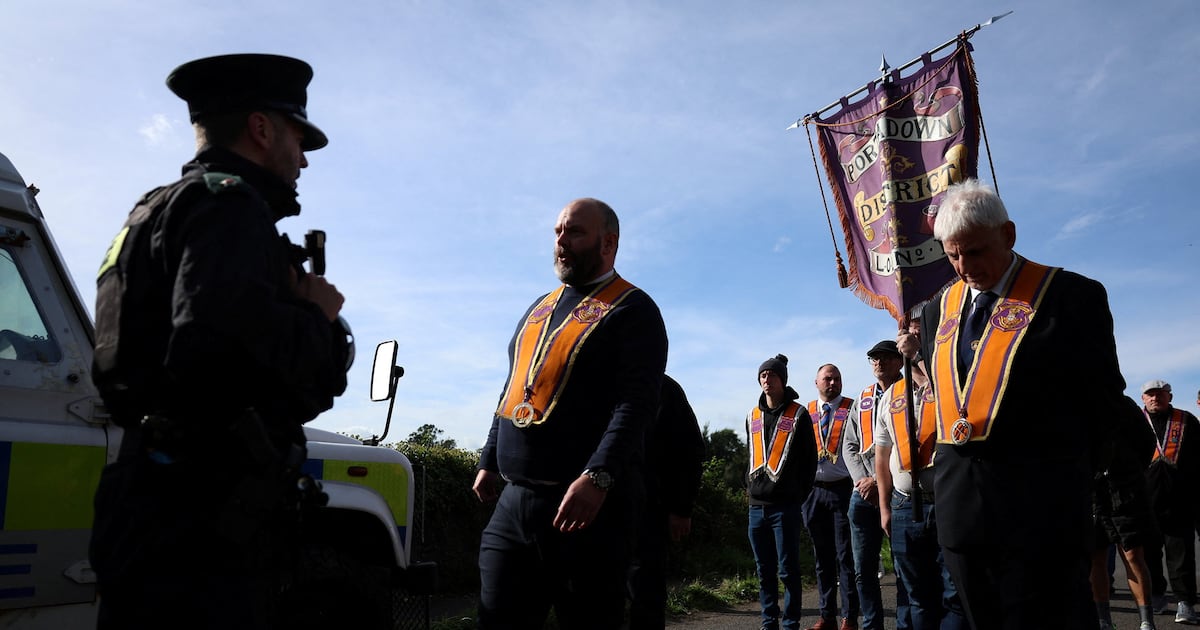
From outside parliament buildings, Stormont looks solid; inside, it feels precarious.Indeed, going by the language in the chamber, things could hardly be worse. There had been a “total abdication of leadership,” said the Deputy First Minister, the DUP’s Emma Little-Pengelly, of her partner at the head of government in Northern Ireland, Michelle O’Neill of Sinn Féin.“Michelle O’Neill not only broke the law, but encouraged others to do so,” Little-Pengelly told the Assembly on Monday afternoon.“Michelle O’Neill decided to follow the law of the mob and not the law of the land, and that matters,” she said. READ MOREO’Neill, and indeed her Sinn Féin colleagues, did not remain quiet. O’Neill was proud to protest with the residents of Garvaghy Road who “have suffered generations of sectarian domination, intimidation and violence”, she told the Assembly.“Why do the Orange Order, why do the DUP, why does unionism in general want to railroad over the rights of these people?” she asked.This is a dangerous moment for Northern Ireland, and not just because of the potential for violence, though this has been – thankfully – averted thus far.It is dangerous because Drumcree has exposed the sectarian fault line that continues to run right through the middle of Northern politics, and indeed society.It is dangerous because it has demonstrated what was widely held even before the events of last weekend: that for all the talk of reconciliation in Northern Ireland, there has been precious little of it in reality. [ Northern Ireland is staring into the abyss. The peace process is at its weakest since 1998Opens in new window ]In this divided society, Stormont was the compromise that allowed the sharing of power across that sectarian fault line, but it has proved an imperfect one.In the last 10 years alone, it has suffered two lengthy suspensions, from 2017-20 and 2022-24; if it is to fall again, the extent of the division the Drumcree dispute has exposed will make it even harder to restore, and make the calls for an alternative – be it direct rule or a united Ireland – all the louder.Yet we are not at that point – or not yet, anyway. At a press conference in Stormont’s Great Hall later on Monday, the DUP leader Gavin Robinson was just as scathing as Little-Pengelly about Sinn Féin, and indeed O’Neill.But, for all his party’s “fundamental problem with individuals who have taken a pledge of office to uphold the law” but acted in “an illegal way”, he was equally clear he was not about to bring down the Assembly. Instead, he referred to a “range of actions” to be taken, including complaints to the Standards Commissioner, calls for censure, motions of no confidence, and “a clear requirement for the Chief Constable to investigate and to prosecute anyone who has broken the law”.At the risk of stating the obvious, these will all take a while, perhaps giving time for tempers to cool. [ DUP says ‘no business as usual’ at Stormont amid simmering Drumcree tensionsOpens in new window ]If the Assembly does fall, as it stands the DUP does not want to be the party that pulls the trigger, and therefore take the blame; Sinn Féin does not want the Assembly to come down, but, if it does, it too has no desire to be seen as responsible for its collapse.So, Stormont, never strong, staggers on; on the Garvaghy Road, the stalemate still stands. Presumably, any resolution must come through dialogue; Northern Secretary Chris Bryant, met the Orange Order, the Garvaghy Road Residents Association, and the political parties on Monday, but there is as yet no obvious path forward.It remains a dangerous moment for Northern Ireland; it remains far from clear how, or indeed, when, it will be resolved, and just how far-reaching its consequences will be.
Stormont staggers on, but this is a dangerous moment for Northern Ireland
Full Article
Original Source
Read the full article at Irishtimes →KhanList aggregates and links to publicly available news content. We do not host full articles from third-party sources. Always verify important information with original sources.