
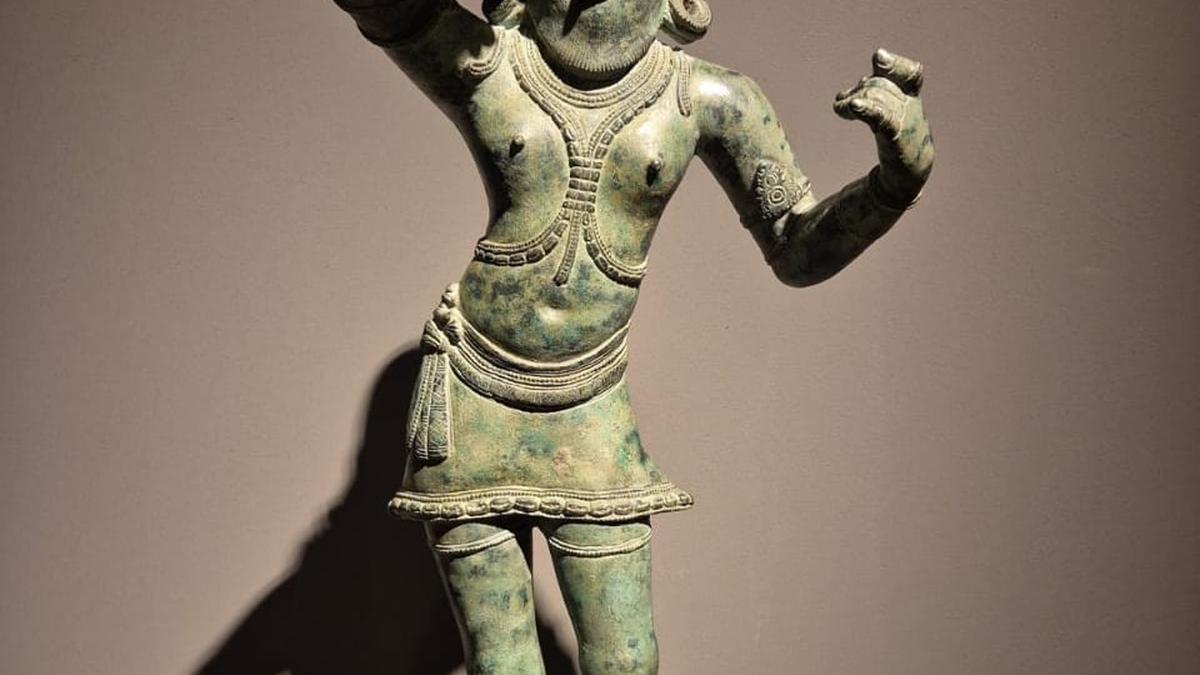
The 11th-Century Chola bronze idol of Kannappa Nayanar. | Photo Credit: Special arrangement A stolen 11th-Century Chola bronze idol of Kannappa Nayanar, looted from a temple in Tamil Nadu and later spotted at a prestigious European art fair, has returned to India from the Netherlands following an international investigation that combined archival police records, photographic evidence and artificial intelligence.The bronze was repatriated last week along with a collection of 11th-Century Chola-era royal charter plates voluntarily relinquished by Leiden University Library. The recovery followed coordinated efforts by the Tamil Nadu Idol Wing CID, the Archaeological Survey of India (ASI), Dutch authorities, India Pride Project (IPP), and the Association for Research into Crimes against Art (ARCA).The case posed a particular challenge because the idol was stolen before the encrustations on it could be removed after its discovery in a buried hoard during renovation work at Arulmigu Agneeswarar Temple in Tiruppugazhur, Nagapattinam district. It resurfaced years later in a clean condition at The European Fine Art Fair (TEFAF) in Maastricht, the Netherlands.The breakthrough came in March 2025, when ARCA experts Stefano Alessandrini and Ibrahim Bulut photographed the bronze displayed at the stand of Marcel Nies Oriental Art. They shared the images with their colleague, who alerted S. Vijay Kumar, co-founder of IPP, an organisation that traces stolen Indian cultural objects and campaigns for their repatriation.They alerted the Idol Wing CID through IPP’s network. Additional Superintendent of Police Balamurugan located the original First Information Report (FIR) documenting the theft from the temple, establishing a crucial link between the sculpture displayed in Europe and the missing idol.The next challenge was to establish that both photographs depicted the same object. The original discovery images showed the bronze covered in encrustations, whereas the sculpture at TEFAF had been cleaned.Mr. Kumar used IPP’s proprietary AI tool, Ekalavya, to digitally remove the encrustations from the discovery photographs. This enabled the team to compare the sculpture’s contours, proportions, and other physical features with the images taken at the art fair. Image and histogram comparisons revealed strong correspondences, providing evidence to support the identification.The findings, along with the original FIR and supporting documentation, were shared with the Idol Wing CID and Dutch authorities. Idol Wing CID, subsequently coordinated with the ASI in New Delhi to initiate proceedings with the Dutch authorities. On March 23, 2025, Dutch police seized the bronze following a request from Indian authorities.The ensuing investigation led to the dealer voluntarily relinquishing the sculpture, clearing the way for its return. The repatriation was not accompanied by a formal public announcement from the Dutch authorities.The 11th-Century bronze depicts Thinnan, revered as Kannappa Nayanar, one of the 63 saints of Saivism. According to the 12th-Century Periya Puranam, Kannappa demonstrated his devotion to Lord Shiva by offering his own eyes. The idol was among 27 bronze images unearthed during excavation for an Appar Mandapa at the temple. The circumstances in which the hoard was buried remain uncertain. Published - October 27, 2026 11:17 pm IST
Stolen Chola-era bronze idol of Kannappa Nayanar repatriated from Netherlands
Full Article
Original Source
Read the full article at Thehindu →KhanList aggregates and links to publicly available news content. We do not host full articles from third-party sources. Always verify important information with original sources.