
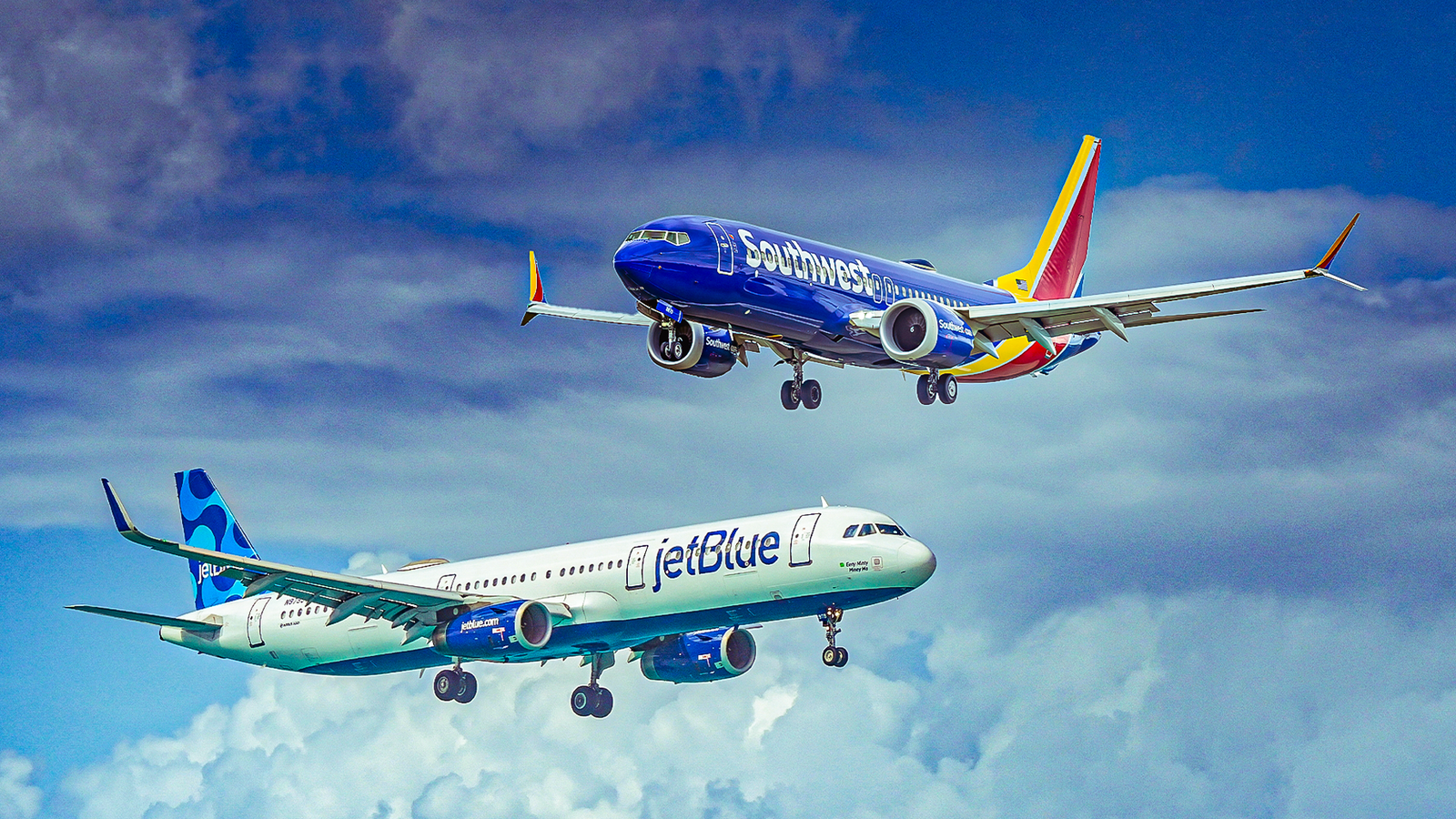
JetBlue and Southwest Airlines are two of the most unique low-cost carriers in the United States, largely because neither is exactly 'low-cost'. JetBlue pioneered the implementation of seatback screens and free Wi-Fi throughout its entire fleet, while also introducing lie-flat business class seats and transatlantic flights, none of which is 'low-cost'. Southwest Airlines, meanwhile, has built a reputation on excellent service and generous customer policies (which have changed recently), which again doesn't fit the image of a budget airline. Today, both airlines can comfortably be classified as 'hybrid carriers', blending elements of the low-cost carrier business model with elements of a full-service airline passenger experience. They are generally well-liked by customers, some of whom have actively preferred them over the US's three legacy airlines over the years. However, they've had to make adjustments to their passenger experience and business model to make money post-COVID, as the market has shifted dramatically. Premium Seating Options Credit: Markus Mainka I Shutterstock In January 2026, Southwest Airlines completed its fleetwide retrofit of extra legroom seats. The 737-700s now offer 42 extra legroom seats, while the 737-800s and 737 MAX 8s now have 48 extra legroom seats. This was a major development for Southwest since the airline has long only sold standard economy seats as its primary seating product. However, this was still the airline simply aligning itself with the rest of the industry, as offering a large number of extra-legroom economy seats is now standard practice in the US. JetBlue had been offering extra-legroom seats since 2008, which was rebranded from Even More Legroom to Even More Space in 2011, and then to EvenMore in 2025. In 2014, meanwhile, the airline launched Mint, a lie-flat business class cabin intended to directly tackle the legacy airlines on premium transcontinental routes, and some passengers have come to prefer Mint over American, Delta, or United. JetBlue now also operates transatlantic flights using the Airbus A321LR with a newer version of Mint. The airline will soon debut BlueFirst, a domestic first class cabin with recliners. It will launch in December and will be retrofitted onto every non-Mint aircraft within the airline's fleet. In addition, JetBlue operates two 'BlueHouse' lounges for Mint passengers, elite cardholders, and TrueBlue Mosaic 4 members. Southwest is rumored to be planning a domestic first class, but this has not been confirmed. Southwest also doesn't operate long-distance routes, though it will launch a lounge network for elite cardholders in late 2027. Features & Policies Credit: Wangkun Jia I Shutterstock Southwest was previously known for its unique open-seating policy and generous two-complimentary-bags policy. However, Southwest discontinued both policies because they left money on the table. While this was controversial with loyal flyers, Southwest was, again, aligning itself with the rest of the US airline industry. Inside the plane, the cabins are fairly basic, with standard legroom, no screens, and no power ports on some aircraft. Its extra legroom seats, however, have better pitch than most competing products. JetBlue, on the other hand, has comparable policies to other airlines, but has differentiated itself with the onboard experience. It has long offered significantly better pitch in economy, while its extra legroom seats also have more legroom than competing products. All aircraft had seatback screens before it was fashionable, while the airline has offered free Wi-Fi since 2013. In addition, the airline is fairly generous with snacks while offering larger meals, whereas Southwest's catering is very minimal. JetBlue has made changes to update its interiors in recent years, as the carrier has incorporated technological improvements while also cutting seat pitch. The BlueFirst retrofits will see it cut economy legroom down to the industry standard of 30 inches (76.2 centimeters). Southwest is currently embarking on a fleetwide retrofit project to add USB-C ports, while also adding larger overhead bins and mood lighting to most aircraft. Network & Market Relevance Credit: Ryken Papy I Shutterstock JetBlue is a massive airline. It operates over 300 aircraft out of large hubs in New York, Boston, Fort Lauderdale, Orlando, and San Juan, and the size of its overall operations is comparable to many large foreign airlines. However, the airline is mainly relevant to travelers located within these markets, particularly in the Northeast. On the West Coast, JetBlue has a very small presence, and its Northeast operations face stiff competition from Delta Air Lines in particular, while the Florida operations are traditionally low-yielding with heavy competition. Southwest Airlines does not operate any long-range or premium transcontinental flights like JetBlue, but the Dallas-based airline is a titan in the domestic network. It has 13 operating bases scattered throughout the country, often using secondary airports in major markets. Southwest operates massive schedules to its spoke airports and is the leading airline in many of its destination markets, often offering larger, more desirable schedule options than the legacy carriers. Southwest Airlines' Operating Bases Atlanta Hartsfield-Jackson International Airport (ATL) Las Vegas Harry Reid International Airport (LAS) Austin Bergstrom International Airport (AUS) Los Angeles International Airport (LAX) Baltimore/Washington International Thurgood Marshall Airport (BWI) Nashville International Airport (BNA) Chicago Midway International Airport (MDW) Oakland San Francisco Bay Airport (OAK) Dallas Love Field (DAL) Orlando International Airport (MCO) Denver International Airport (DEN) Phoenix Sky Harbor International Airport (PHX) Houston Hobby Airport (HOU) Southwest isn't quite as large in the Northeast, which contains several large business markets, but throughout the country, Southwest is otherwise a compelling choice in almost all cases. The airline carries nearly as many passengers on domestic flights as American Airlines, Delta Air Lines, or United Airlines. This is an especially notable achievement because Southwest does not operate a regional division or a long-haul network. Instead, the entire operation is short-to-medium-length services within North America using 737s. While JetBlue's market presence in the Northeast is strong, it lacks relevance in much of the US as a whole, and it's had difficulty competing against the legacy carriers in its Northeast hubs. With fewer spokes served out of New York and Boston than Delta, the airline has a much harder time convincing customers to choose it over the competition. While many find the experience of flying with JetBlue very pleasant, this doesn't effectively compensate for weaker schedules or a smaller network. How Southwest Is Evolving Today Credit: Leena Robinson I Shutterstock After the airline's financials deteriorated post-COVID, Elliott Investment Management took a major stake in the airline and began using its influence to push for significant change. This has taken several forms, and not all of these have been negative. Southwest is modernizing its IT systems, while the introduction of overnight flights improves aircraft utilization. In addition, while some miss the open-seating policy, many passengers prefer a more conventional system where seats can be selected or are assigned by the airline. The airline has introduced extra legroom seats as well as seat assignment fees, and checked luggage now costs extra. While the new fees haven't gone over well, they significantly increase revenue and are standard practice within the industry. The extra legroom seats are a genuinely desirable premium option, and the passenger experience is not much different from before. Meanwhile, Southwest has also made network adjustments to concentrate more heavily on its operating bases with less competition. Long-haul flying and premium products have become quite lucrative in recent years due to growing demand. Southwest has not announced a first class cabin, but leadership has suggested that this may come. In addition, the carrier is reported to be exploring widebodies to develop a long-haul network. While these moves are not confirmed, they do align with the airline's general strategy to more closely emulate American, Delta, and United. JetBlue's Survival In The Current Environment Credit: AV8 Photos I Shutterstock JetBlue has valuable assets, and there are routes where the carrier makes money, even if the network as a whole is a loss-leader. What's more, the airline is generally well-liked, and the seating products are strong, while the BlueFirst cabin should be popular. However, JetBlue simply lacks an appealing network in much of the country, and it's not earning a fare premium for the product that it's selling. Operational reliability has further hindered income, while competition has been difficult. The airline has been recording straight losses since COVID, and the current situation doesn't appear to be improving. Despite introducing its 'JetForward' turnaround plan, JetBlue has still been losing money. As such, it's been speculated by some, including founder and former CEO David Neeleman, that the carrier could be headed for Chapter 11 bankruptcy. The operating environment has generally been difficult for low-cost carriers, and JetBlue's increasing losses are making its future bleak. The most notable shift in recent years is arguably the airline's decision to offer a domestic first class cabin. However, these types of products have also been announced by Frontier and Allegiant Air, as this is increasingly becoming an expectation. JetBlue is also making network adjustments and focusing on improving operational reliability, but it's not significantly overhauling its network or commercial strategy. Whether this will save the carrier or if JetBlue will still eventually cease operations permanently remains to be seen.
Still Low-Cost? How Southwest Airlines & JetBlue Compare In 2026
Full Article
Original Source
Read the full article at Simpleflying →KhanList aggregates and links to publicly available news content. We do not host full articles from third-party sources. Always verify important information with original sources.