
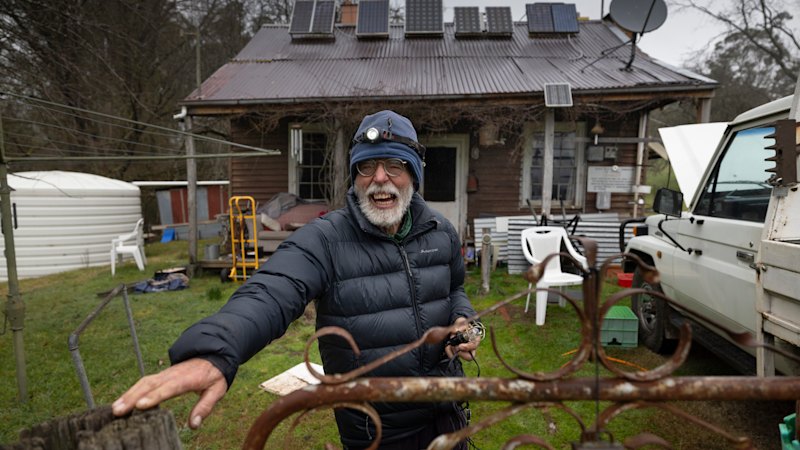
There is a little hut at the foot of the mountain, just minutes down the road from where Australia’s biggest-ever manhunt began.It was built more than a century ago in Victoria’s high country, so close to the Buckland River in Porepunkah that you can hear the water rushing past under the wind. Back then, that river still gave up lumps of gold like Easter eggs. But today, you might think the hut long abandoned, if not for the patchwork of solar panels wired along its roof. They were put there – using an elaborate “Batman-style” abseiling rig – by its reclusive yet nimble 73-year-old inhabitant, Ray Kompe.When we arrive, the former gold prospector has just hoisted a huge new lithium battery onto the roof. It weighs more than he does. “The neighbours did have to check I hadn’t done myself in,” grins Kompe. He emerges from behind his little hut’s screen door with a torch still aglow on his beanie and the sleepy look of a miner stumbling back into the light.Ray Kompe, who knew Dezi Freeman, at his off-the-grid hut in the Buckland Valley. “I’m a bit of a recluse these days,” he says.Jason SouthAlmost a year ago, on another misty day like this, it was the police who came checking on Kompe. They were looking for a man he once knew well. Kompe first met Desmond Filby down by this river in the 1980s, and began teaching the long-haired teenager bushcraft. Forty years on, Filby was living in his own solar-powered retreat, off-grid, just a few kilometres up the hill, but he had taken a new name: Dezi Freeman.It was those tactical police, with their big guns, who told Kompe that Freeman had shot and killed two police officers and injured another when they’d gone to his home to serve a warrant in a child sexual abuse investigation. Freeman, 56, had stolen a police pistol and vanished into the trees down by the Buckland River, and he was still on the run.It would be another seven months before police caught sight of him again – when he emerged, wrapped in a doona, from a shipping container at a remote hideout more than 100 kilometres away near the NSW border. After a three-hour standoff, Freeman dropped the doona to fire that stolen revolver and was shot dead by the tactical snipers calling for his surrender.“And to think I taught Dezi how to survive out here …” sighs Kompe.I’ve come to see Kompe because I’m trying to understand how someone could survive in the wild here – or at least how they could be smuggled out of it under the noses of what felt to locals at times like half the state’s police force. But then there’s so much more to understand about what happened in Porepunkah than that, especially for the families still mourning and the remote community still divided by the violence at its door.Inside Kompe’s hut, we squeeze past a bicycle in the hall and a shower in the kitchen. He apologises for the mess while his white chihuahua Luna darts around our ankles. Kompe watched the police comb through it all a year ago – the start of hundreds of raids on properties across the high country in search of Freeman and those who helped him. They flew a tiny drone “the size of two cigarette packets” straight through his place, politely weaving between towers of books and cassette tapes, into cupboards. Officers even shone a light down into the outside dunny. No Freeman.“Well, he wouldn’t be welcome here any more,” says Kompe. For decades, he’d put up with his fixations, his rants against the government, as they explored the bush and its hidden mineshafts and waterfalls together. But the idealistic teenager who loved photography and attended hippie festivals had undeniably grown into a bitter and angry man. Even before the pandemic, he’d become a fanatical adherent of the pseudo-law peddled by so-called “sovereign citizens”, those who don’t recognise the authority of government – who drive under fake licence plates and change their names to Freeman (free man).Well before COVID, though, Kompe had had enough of Dezi. “He fell in with that conspiracy crowd. He was watching these violent WWII videos … of Japanese torture. Sickening stuff. I just thought: ‘Why am I here with this weirdo?’ ”The night Freeman murdered seasoned local detective Neal Thompson, 59, and 35-year-old rising star, Vadim de Waart-Hottart, snow fell on Mount Buffalo. A battering blizzard of rain and lightning howled down the spine of the tourist road as scores of heavily armed police scoured the forest for the fugitive.Those who knew the two officers killed – including local police not authorised to speak publicly ahead of an inquest into the deaths – say problems between police and the “cookers” in the hills had been brewing before the shooting. “But we didn’t know what we were walking into,” says an officer who was there when it happened.Neal Thompson (left) and Vadim de Waart-Hottart (pictured with a painting done for him by someone he helped through a mental health crisis) were remembered as adventurous and kind. “Thommo” was known for his silly Macgyver fixes out bush, but singular focus on the job. And both he and de Waart-Hottart (“the romantic”) were still adored as family by their former partners.Detective Thompson, known as “Thommo”, knew this country well, and how treacherous it can be beyond the tourist bubble of Bright. This is not the Australian bush as seen in dusty, outback noir: stray from the path and the scrub is thick and wet, threaded with blackberries and secret tunnels. Riverbanks can suddenly burst and turn whole clearings into marshlands.Thompson also knew Freeman. He’d gone along with the other nine officers serving the warrant that day because it was hoped that he might be able to reason with the conspiracy theorist. He’d spoken of Freeman in the weeks prior, Thompson’s best friends Andrew “Crouchy” Crouch and Dirk Wendt tell me over a beer back in Melbourne. “Thommo was thinking: ‘We’ll sort it. I’ll talk him down again,’ ” says Crouch. “I didn’t realise then how big a stronghold that area’s become for them.”Them meaning the “cookers”, the sovereign citizens – especially the ones who hate being called sovereign citizens. “You know, the nutjobs,” says Wendt.When I arrive in Bright on the first night of the town’s popular winter festival, my accommodation host explains: “People come here for the peace. But some people come here to hide. Especially out there. Who are you here with again?”Thommo and Crouchy were supposed to retire together. Two cops working at opposite ends of Victoria, they’d grown up together in Bendigo, and now they’d lined up their final shifts to fall within days of each other. Thommo always had to be first through the door, “like a bull at the gate”, Crouch says, so, of course, Thommo was retiring first, too. A party was planned that Friday, though Thommo was worried his station in Wangaratta would do a guard of honour “or some nonsense”, and had a sly idea to nip off to the pub early.Secretly, though, he was chuffed. And a little overwhelmed. He’d joined the force barely out of his teens and he liked the swagger it gave him around town. He liked helping people. He still wore the same long, black detective’s coat he’d always worn, chasing crooks through wheatfields, crashing police cars, as if he’d rocketed straight out of a 1980s cop drama. His favourite crook in town called him “The Don”.“He was finding it harder than I expected, harder than I did, giving it up,” says Crouch. “But we had real adventures planned for retirement.”Instead, that Tuesday, Crouchy heard news of the Porepunkah killings over the police radios. Thommo, his best friend since he was 12, the cop who was always first through the door, had been shot dead. Crouch’s unit, the dog squad, was called up to the high country to hunt for the killer.As a surprise for Thompson’s upcoming retirement, his station had made special beer stubbies: Thommo immortalised as ‘The Don’ from The Godfather. At Wangaratta police station in those early days, there were so many flowers piled in the entryway, the doors could barely close, says Senior Sergeant Luke Vogels. People brought slabs of beer too, though sadly, policy dictated the tinnies had to be turned away. Nothing like this had ever really happened before.A permanent memorial is now being hewn out of rock outside the station for Thompson alongside de Waart-Hottart – the “gentle giant” from Belgium who had been excited to explore the Alpine wilds on his new secondment from Melbourne. A female officer, who narrowly escaped the shooting herself when the homemade shotgun Freeman turned on her jammed, has been fundraising with her son for a similar memorial outside the Bright station, ahead of Victoria Police commemorations on August 26.“We’ll have to clear all this out soon,” says Vogels, staring at the photographs of Thompson and de Waart-Hottart still on display on the little white table in the foyer, children’s drawings pinned to the wall behind. “We’re going to do something special for them.”The lobby was packed full of flowers and tributes for de Waart-Hottart and Thompson at the Wangaratta police station in the weeks after the shooting.Joe ArmaoIt rained for days after the Porepunkah murders, every day for nearly a fortnight. But, on September 5, the day of de Waart-Hottart’s funeral, the sun broke through the stained-glass windows of the police academy chapel in Melbourne, as the young constable was being laid to rest. His mother Carolina smiled, raising her hands to the light. She’d told those gathered at the funeral that her son would live on in nature, and now here he was, her Vadim, making everyone smile again.This March, his parents returned to Australia and to the same police chapel to commemorate the Russell Street bombings that killed another young officer in Melbourne 40 years ago. Beside them was Police Chief Commissioner Mike Bush, as he had been during Vadim’s funeral.He couldn’t tell them then, but, while they gathered, officers were analysing surprise new intelligence about the whereabouts of their son’s killer. Detectives had thought Freeman already dead – months of searching had failed to turn up a single, useful lead. Now suddenly they had one, and it led to a remote property in the state’s north.De Waart-Hottart’s mother and brother at his funeral (left), and Andrew Crouch helping carry Thompson’s coffin during his service days later in September 2025.Eddie Jim; Justin McManusThree days later, when Freeman was found there and shot dead, de Waart-Hottart’s parents were the first people Bush called. Today, police are piecing together how he got there, and who they believe helped him. Multiple people have been raided and arrested. No one has yet been charged.But “sov-cit” ideas are growing in these hills and beyond, locals say. All elections, from councils to federal parliament, have seen an increase in sov-cit protest votes. Even some of Thommo’s friends, people he got to know out hunting and fishing, would later turn out to be sympathetic to Freeman’s anti-government cause, as conspiracy theorists lionised the fugitive online. They called Freeman the modern-day Ned Kelly. Porepunkah is, after all, they said, just 80 kilometres from Glenrowan, where Kelly made his last stand against police 150-odd years ago.“This is still Kelly country,” says Freeman’s close friend, Bruce Evans, adjusting a velcro strap on his camouflage pants. It’s a common refrain.Bruce Evans says he misses his good mate Dezi Freeman, but adds: “I know he shot those cops.”Jason SouthIn Bright, where the hills cast shadows of green velvet, the murders split the community. Some rallied around Freeman’s Filipino wife Mali, well-liked but left homeless and adrift with their children after he fled. Others tied blue ribbons to lamp poles to honour the officers shot.Leanne Boyd, who once employed Mali at her popular cafe and helped fundraise supplies for her, says she fell somewhere in the middle. She was no fan of her friend Mali’s odd husband, but the strain of people pulling in both directions left her exhausted. Either Freeman was a monster or an outlaw hero. Either Mali was his Lady Macbeth accomplice or “a f---ing saint”, as one friend of Freeman’s hisses at me down the phoneline.It’s the morning rush at Boyd’s cafe and a pen wobbles in her long, blonde hair; a tremulous, load-bearing look about it. These days Mali is rarely seen around town, though prosecutors have dropped talk of charging her over the shootings. “Mali always asks, ‘What’s going on in the outside world?’ ” sighs Boyd. “She just wants peace. I think we’re all sick of thinking about it.”Leanne Boyd says “the kindness came from everywhere at first” as locals rallied around police – and Freeman’s young family left behind – after the shootings.Jason SouthI understand. Four months ago, when Freeman was shot dead, I’d driven up this mountain and stood on this street and asked the same questions. One in a parade of journalists periodically crashing over the town like the tide and then retreating, with business cards tucked in the crooks of doors and letterboxes. Bright had been all bustling colour then, orange leaves trodden underfoot in the final hours of the Easter weekend. There was hope that, with Freeman gone, the tourism that powered the town would come roaring back to life.Some businesses are still recovering from the manhunt lockdown that choked off the rare, bumper snow season of 2025, even with government assistance grants. Boyd says she lost $28,000, back when her only customers were the undercover cops in town (“They dressed too well to be locals or ski bunnies”).“Magic town”: tourists and locals enjoy the start of Winter Fest in Bright in late July.Jason SouthStill, today there is fake snow on the air, and fairy-lights overhead and the town is once again heaving with out-of-towners for the winter festival. Over Boyd’s shoulder, I watch a couple struggling to fit armfuls of hire skis – and their gigantic, grinning Samoyed – into the back of a hatchback.Only the year before the shooting, the property that borders the farm where it happened was taken over by a film crew for production of Netflix movie War Machine. “People with guns were running around then, too, fighting imaginary aliens,” says local Gary Monshing. “So we’ve had a bit on around here.”Gary’s daughter Georgia and her partner Ben now run the family ski gear shop in Porepunkah. It’s one of many competing ski shops on the tourist road – at least two of them guarded by near-identical border collies – and the Monshings are exactly the kind of genuine, postcard-friendly people that make tourism agencies breathless to remind the public that, yes, Bright really is the same honey-gold snow town it’s always been, thank you very much.Georgia Monshing and Ben Kaye (pictured with their daughter Milla) didn’t want to complain about the manhunt lockdown choking off business (though they made a good trade in snowchains for police cars), but say they are relieved the area’s now bouncing back.Jason SouthBut while many locals are eager not to be defined by the tragedy, others seem just as eager to stress that they don’t believe “the official story”. Some trust police even less than before. And the question of who helped Freeman on the run – and who might have helped turn him in – is still there too, on the air.When Freeman was killed in March, his eldest son posted a plea online for people not to celebrate. “That’s still my father,” Koah wrote.Josh Roose, a researcher who advises police and governments on extremism cases, calls the high country “strange country”, where the modern, online phenomenon of sov-cits collides with old bush mythology of the outlaw. You’ll find people in rural poverty, off-grid in makeshift shelters or huts like Kompe – once living rough by the river and still hesitant to use the heating until after dark, until it’s really cold – while, next door, luxury Airbnbs sit empty half the year.As police hunted Freeman, drones buzzed in the night, but properties were too vast to properly surveil, and phone taps quiet. (“Everyone knew they were listening,” says Boyd.) Some locals even refused to serve police coffee, Roose recalls. “It’s a closed shop up there. They might get tourists but the locals are the locals. That’s their defining borderline between us and them.”The thing to remember about the Freeman case, Roose tells me, is that “Dezi was not only deeply embedded in a network of anti-government types” – though he was, he was up to his neck in them the way you can find yourself up to your neck in blackberries in the scrub. But Freeman was also “just embedded in his local community in a way most people don’t understand”.When the sun sets behind the mountain, an underground network of two-way radios crackle to life. Among those listening is Bright blacksmith (and one-time bikie) Stephen Mallett. As the head of Australia’s main “doomsday prepper” Facebook community, he’s met many of those at the other end of the line. Sometimes it’s someone on the roads needing help. Sometimes it’s someone like Freeman. Mallett knew him before the shooting as another local preparing for catastrophe – whatever flavour of civil war, foreign invasion or asteroid collision you preferred. “But the day of the shootings,” says Mallett, “the radio waves all went dead.”He was one of the first of Freeman’s associates raided (and cleared of helping him). When he opened his door in the howling rain to find red lasers pointed at his chest, he considered racing for his back fence and the forest behind – that forest of old mines, forgotten huts and hidden waterfalls. Mallett is perhaps the 20th local to tell me that police, in their months of searching, didn’t cover even half of it. But Mallett didn’t run.Stephen Mallet, pictured with his dog Tucker.Eddie Jim“Nothing to hide. And I was afraid they’d shoot my dog,” he says as he shows me his camouflage “bug-out bag” or emergency pack. The thing to grab in case of apocalypse. He wouldn’t take the huge knives he makes, custom, for “hippie chicks” online if he was running. He’d pack light. And he’d keep moving, through the pine plantations, the wineries, stealing off fruit trees or going up the waters Freeman used to kayak, which all rush north to the Murray River, near where he was discovered. “They’d never find you.”Friends remember Freeman pointing out his prepper stashes on the mountain and disappearing into its trees for weeks at a time to hunt. Beth Knights says he knew how to live off the land even back in their 20s, when they met at the hippie festivals in these hills, cooking over campfires and swimming naked in the river. He still went by his family name Filby then, and his hair was long. There was no electricity for a bush-doof rave, but there was a magic idealism on the air; people coming together in little tribes.Freeman wasn’t like the city folk with whom Knights hitched a ride from Melbourne. He was a local, “with a thick, bogan accent”, but warm and fun and generous then. He knew how to build a fire break, and he’d catch fish with his hands from the river, the water coursing past his legs. Life went rushing on, of course, as it does, and dragged them apart. Knights, today a TV writer in Castlemaine, wonders what dragged Freeman under. A particular conspiracy? A personal tragedy?Dezi Freeman (right) at a Rainbow Gathering hippie festival in the hills in the 1990s.She remembers a bitterness in Freeman when she saw him again, at a music festival in the 2000s. “Or maybe it was just sadness. It’s like he couldn’t fit anywhere. He only made sense out there.” Something about him left an impression, though. “I always wanted to know where he ended up. I was just horrified when I realised it was him.”For the Filbys, Freeman’s ravings had been a problem without a satisfying explanation for years. He lived off welfare support while hating the government; he made fun of “flat-earther” conspiracists, while his own biblical delusions intensified. Freeman had been deeply affected by a series of deaths in his family, though most of the Filbys left were estranged from him by the shootings, including nephews Luke and Joe. Luke remembers his uncle destroying cassettes of Metallica, once his favourite band, because he’d declared them satanic. “Dez was always the oddball uncle,” says Joe. But he was also the uncle who took a young Joe hiking when he was depressed in his teens and offered support. “We never saw anything like this coming. It’s been devastating.”Around the time of COVID, Freeman’s attempts to arrest a local magistrate and help privately prosecute then-premier Daniel Andrews made him infamous.But by August 2025, he was facing serious allegations of child sexual abuse, and his brother and wife finally convinced him to see a psychologist. He had an appointment booked on the day of the shooting. He never made it.The track that leads to the Porepunkah property where Freeman shot dead the police officers.Eddie JimTen minutes out of town, the old, converted bus where the Freemans lived is still there. It sits in one corner of a sprawling chestnut farm, next to the Buckland River. Under the tarp of Freeman’s makeshift kitchen, he hung a sign for the Buckland and a picture of the Virgin Mary.You can see the property from the hills near the airfield, but it’s easy to miss the turn-off – a narrow gravel track through a tunnel of forest with a metal gate at the end. Exclusion zone, warns a handwritten, cardboard sign. No trespass. There is a strange, fairy-tale feeling to the trees here; lit gold in the sunlight, but, as the sky darkens, they lean too close.The converted bus and living space where the Freemans lived, in one corner of the Swift farm.Jason SouthFreeman’s landlords, Andrew and Rebecca Swift, still live behind this gate, in a red-roofed farmhouse with their daughters. Others live here too, “a little community”, according to neighbours and friends. But few people get past the gate.Freeman made it himself, an elaborate early-warning system of security codes and solar-powered cameras, with more hidden throughout the trees. He always had eyes in the bush, locals say. He’d construct elaborate “hides” from which to watch his neighbours, strap cameras to his chest and don camouflage suits that made him look like Chewbacca. When child services and police surrounded the bus more than once in the years before the shooting – out of concern for the Freeman children – their approach was picked up by this ring of CCTV.The Swifts aren’t answering the phone, but the gate’s warnings grow more strident the further I read. Offenders will be prosecuted and fined a minimum of ten thousand dollars.They’re well-liked in town, the Swifts, though fiercely private. Rebecca in particular is known for her anti-government views. The Freemans moved onto their farm four years ago, after a string of fallings-out between Freeman and his former landlords had left them homeless. People speak of Freeman’s terrifying temper, of his obsession with guns and a mysterious marijuana crop that sprung up at one property in Myrtleford. Most of all, Freeman hated female cops. But the shootings in August caught the Swifts by surprise. “They’re peaceful people,” says friend Bruce Evans.Police had decided a specialist sniper squad wasn’t needed that day to serve the warrant, hoping to keep Freeman calm. Instead, they sent 10 officers, including two of their best: Thompson the veteran and de Waart-Hottart, formerly of the city’s public order response unit.In Andrew Swift’s own account of what unfolded when Freeman barricaded himself in the bus with Mali and their toddler – as told to a YouTuber who runs wellness festivals, not “the mainstream media” – Swift says he never heard Freeman warn police he had a gun.Freeman shot Thompson first as the detective climbed in through the bus window. Then de Waart-Hottart.A preliminary hearing for the upcoming inquest heard that Freeman stole de Waart-Hottart’s gun and used it to shoot Thompson a second time, where he lay on the ground. “Can you hear us Thommo?” called one of the other officers now taking cover. “F---ing scum, die in hell,” said Freeman.At Thommo’s favourite cafe, run by close friend Anita Cook, a plaque by one bench now reads “Neal’s corner”. “He was kind of the man in my life that I depended on,” says Cook, who saw Thompson as usual when he stopped by before work the day of the shooting. “He’d always sneak in early to surprise me. I’ve only just stopped looking up expecting to see him.”Jason SouthRoose gave expert testimony at the inquest into the 2022 Wieambilla shootings – when Christian extremists murdered two police officers and a neighbour at a remote Queensland property. That should have been a routine missing-person check. But, like Freeman, the Train family hated police, and called them “devils”.Since the Porepunkah shootings, Freeman’s image has started appearing on posters at far-right rallies throughout Australian cities. Yet, in the regions where these ideologies are also brewing, mental health services and other supports remain painfully thin, says Roose – a knife’s edge. “We have to wake up to this as a serious threat.”Sunday in Bright, and under the soaring timber beams of the Our Lady of the Snows church, Father Tony Shallue is delivering a sermon on the dangers of misinformation. The Freemans came here most Sundays, including two days before the shooting, though Father Tony worried about Freeman’s strange slide into doomsday fanaticism, his ravings about the Antichrist.“In this world of information, not all of it is wisdom,” the priest tells his flock now. It’s a sermon so on theme I wonder if my cover is already blown, having just strolled in off the street to find the congregation in a late Mass. The singing had drawn me in. A black dog is tied up out front.Father Tony briefly pauses his sermon warning of technology coming between people to wrestle with a malfunctioning microphone. But it’s not all bad, he continues, if it brings us together.The main farmhouse at the Porepunkah property where the shooting happened, pictured during the manhunt.Joe ArmaoWe check back on Ray Kompe at his hut, where the only real technology is the solar panels and the gadgets he fashions himself. Kompe apologises again for the mess, but the closer I look, the more I sense an order to the clutter. His dog’s vet records hang, neatly labelled, on one wall. On another are framed drawings from his neighbours’ children, the neighbours who check on him.People tried to check on Freeman, when they knew something had taken him under. Others seemed happy to draw him deeper and deeper into the whirlpool of pseudo law and conspiracies.In the past year, Kompe says he’s lost interest in making gadgets entirely, though he’s not sure why. “Everyone’s just on their phones now,” he offers, half-heartedly, but he’s looking across the field, towards the hill where the boy he knew as Desmond Filby shot three men.“I mean, the world doesn’t ever really go away, does it?”Get the best of Good Weekend delivered to your inbox every Saturday morning. Sign up for our newsletter.Read more from Good Weekend magazine:Liane Moriarty’s new book is nearly here – but first, she wants women to read these three sentences‘Never seen so many grown men cry’: The everyday Aussies who can’t afford another disasterThe mystery death of the original ‘gymfluencer’: Inside the tragic final days of Zyzz
‘Still Kelly country’: Life in Porepunkah after Dezi Freeman, as locals pick up the pieces
Full Article
Original Source
Read the full article at Smh →KhanList aggregates and links to publicly available news content. We do not host full articles from third-party sources. Always verify important information with original sources.