
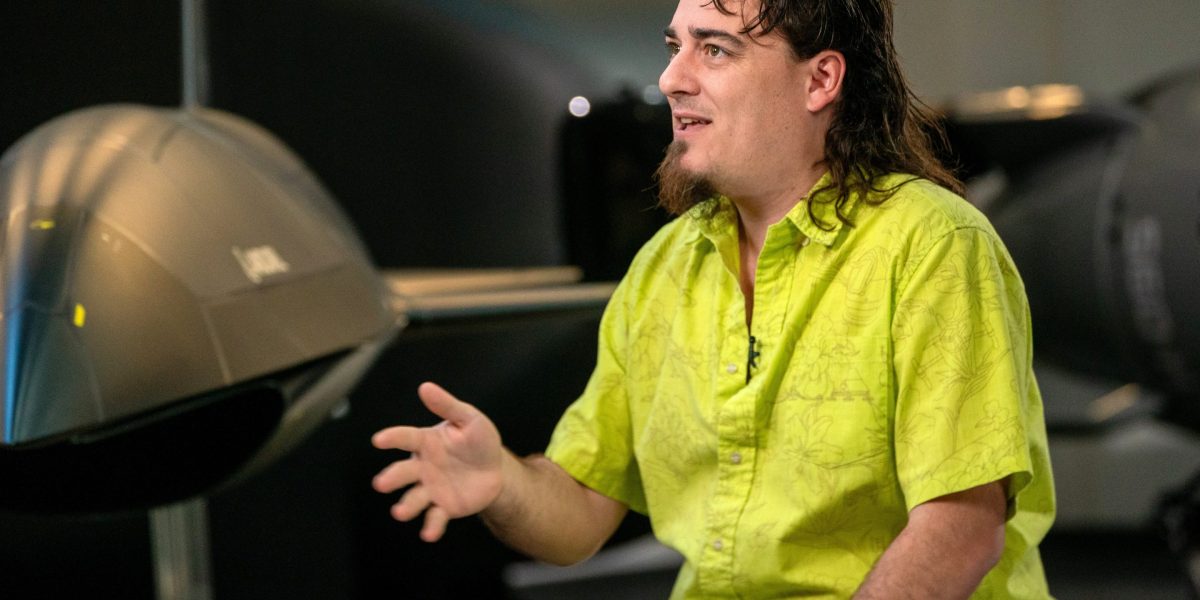
Palmer Luckey has a complaint about the iPhone, and he took it to Steve Jobs’s biographer. “Steve Jobs ruined everything with the iPhone,” Luckey, the Oculus inventor and Anduril cofounder, tells Walter Isaacson in an episode of Isaacson’s podcast The Builders airing Tuesday, an excerpt of which was shared exclusively with Fortune. “We’re still suffering the impacts of his incredible product design.” Luckey, worth an estimated $5.9 billion according to Forbes, offered an argument about skill: the iPhone made technology so easy to learn that there’s nothing left to get good at, and every product since has copied it. Luckey founded Oculus in 2012, and Facebook bought it in 2014 for more than $2 billion. He left in 2017 to found Anduril, a defense company last valued at $61 billion. Last year, Anduril and Meta teamed up to build augmented- and virtual-reality gear for the U.S. Army, and Luckey recently partnered with the dire wolf and woolly mammoth-cloning entrepreneur Ben Lamm to breed genetically engineered clone dogs for military use, via a company called Warhound. The 10-minute ceiling Isaacson opened with a theory that the greatest advances in tech come at the human-machine interface, from Doug Engelbart’s mouse through the graphical interface and Jobs, “maybe culminating with Neuralink and chips in our brain.” Before the iPhone, Luckey responded, “there was an understanding that technology was something that could multiply your output.” He pointed to Jobs’s own line about the computer as a “bicycle for the mind.” But the iPhone turned out to be a self-operating bicycle of sorts, problematically so, in Luckey’s opinion. “The problem with the iPhone is that it simplified everything to a degree where, yes, you could learn to use it in less than a minute,” Luckey said. In his telling, you learn everything it can do in about 10 minutes, and then you hit the ceiling on skill and productivity. He held up an unlikely alternative. “A keyboard requires weeks or months of consistent, focused training in order to be able to achieve a high rate of speed, a high rate of accuracy,” he said, down to the key macros for running Excel. The payoff: “I get a superhuman input device where I can put words into the computer as fast as I can speak wordlessly and with an extremely high level of accuracy.” Everything became the iPhone “The problem is that everything has become the iPhone,” he said. “Every application is now the iPhone. Every product is the iPhone. Every virtual reality headset is the iPhone.” Products are built to be learned in one minute and mastered in 10, and “there is no provision made for the man who will spend 1,000 hours, 10,000 hours, 50,000 hours learning his art.” The number will sound familiar. Malcolm Gladwell made the “10,000-hour rule” famous in Outliers in 2008, the year after the iPhone went on sale. It came from a 1993 study by psychologist Anders Ericsson of violin students at a Berlin music academy, where the best had averaged about 10,000 hours of practice by age 20. Ericsson spent years objecting to the slogan. The number was an average, he wrote with coauthor Robert Pool, and “there is nothing special or magical about ten thousand hours.” What mattered was deliberate practice: focused training at the edge of what you can do, something like Luckey’s keyboard. Other studies are dubious of the idea that practice makes perfect. A 2014 meta-analysis of 88 studies led by Brooke Macnamara, then at Princeton, found practice accounted for about 12% of differences in performance overall, and less than 1% in professions. There is hard evidence for the shape of what Luckey describes, and it comes from the newest interface, not the iPhone. A study by economists Erik Brynjolfsson, Danielle Li and Lindsey Raymond tracked 5,179 customer support agents given a generative AI assistant. The number of issues resolved per hour rose 14% on average, including 34% for novice and low-skilled workers, but with “minimal impact on experienced and highly skilled workers.” The iPhone bargain applied to work suggests that the beginner gets much better fast, and the expert gains little. Luckey doesn’t mention AI in the podcast excerpt, but he takes the same shot at brain-computer interfaces like Neuralink. “Everybody wants a magical human-to-computer interface where you can use it and you don’t have to train, you don’t have to learn,” he said. “Do we need to use this wondrous technology to have a different way of clicking a few buttons and operating an iPhone interface?” All of these warnings recall Solow’s Productivity Paradox, or the famous observation from Robert Solow in 1987 that “you can see the computer age everywhere but in the productivity statistics.” U.S. labor productivity grew 3.3% a year from 1997 to 2005, then 1.4% a year from 2005 to 2018, according to the Bureau of Labor Statistics. BLS estimates the slowdown cost $10.9 trillion in lost output, or about $95,000 per worker. The iPhone can’t take the blame on that evidence. University of Chicago economist Chad Syverson dates the slowdown to 2004, three years before the iPhone. He found it hit dozens of countries regardless of how heavily they used information technology, and that the value of free digital goods the statistics miss covers less than a third of the gap. The 2008 financial crisis also falls inside the period. Why easy won The reason products went the iPhone’s way is the money. A device anyone can master in 10 minutes can reach billions of people, and it remains Apple’s biggest business: the iPhone brought in $254.1 billion of the company’s $478.8 billion in revenue in fiscal 2026, which ended in September, according to Apple. That’s up from $209.6 billion a year earlier. Workplace versions of the bargain are older than the iPhone. In 1974’s Labor and Monopoly Capital, Harry Braverman argued managers cut the skill out of jobs as a strategy of control, and the iPhone sold a version of that bargain to consumers. Luckey’s own customer may test his theory. Anduril says it won a $159 million Army prototyping contract to build augmented-reality systems with Meta for the Soldier Borne Mission Command program, successor to Microsoft’s troubled IVAS headset, and it is developing its own EagleEye headset on its own dime. The Army isn’t expected to move its top choice into production until 2028, if it picks one at all. Soldiers train for a living, about as close to the 10,000-hour user as anyone. But MIT Technology Review reported that the vision has them speaking to the interface in plain language, with eye movements and taps eventually replacing speech. RAND’s Jonathan Wong told the outlet the system has “got to be pretty seamless.” Luckey was kinder to Apple three years ago. When the Vision Pro was unveiled in 2023, he said Apple “did basically everything right,” according to Road to VR. He said he’s “got some ideas” for interfaces that take years to master, and didn’t say what they are. “I’m hoping it comes back around someday,” he told Isaacson. The Builders is produced by Kaleidoscope and distributed by iHeartPodcasts.
‘Steve Jobs ruined everything with the iPhone’: Tech billionaire Palmer Luckey gets real on what really killed the 10,000-hour rule
Full Article
Original Source
Read the full article at Fortune →KhanList aggregates and links to publicly available news content. We do not host full articles from third-party sources. Always verify important information with original sources.