
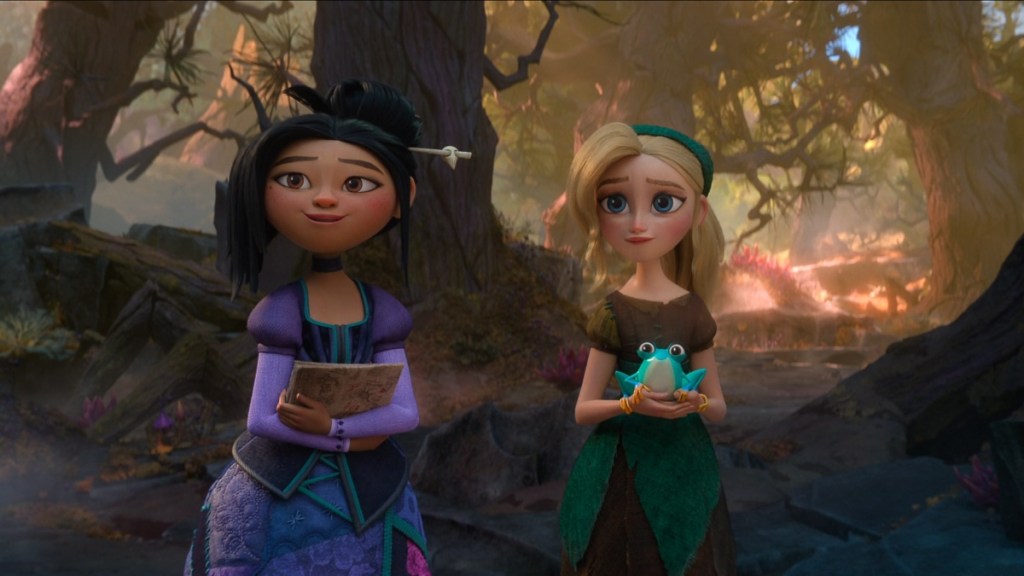
For Alyce Tzue, reimagining Cinderella meant giving its stepsisters the chance to shape their own happily-ever-after. Netflix’s animated adventure film Steps, co-directed with John Ripa, casts Lilith (Ali Wong) and Margot (Stephanie Hsu) as Asian immigrants in a French-inspired fairytale kingdom, where questions of belonging and privilege shape their search for happiness. Meanwhile, Cinderella (Amanda Seyfried) must also learn to confront her own societal complacency and dismantle stereotypes that her inherently kind nature unintentionally upholds. Here with Deadline, Tzue discusses the film’s unique visual style, reworking a traditional fairytale and bringing in new “punk rock” dimensions. DEADLINE: How did you collaborate with the writers to develop this inclusive reimagining of Cinderella? Watch on Deadline ALYCE TZUE: It began when Riki Lindhome and Kate Micucci had the idea for the stepsisters’ perspective and pitched it to Amy Poehler’s company, Paper Kite, which then brought it to Netflix. When I came on board, I made the stepsisters Asian immigrants to a fairytale world. We started with these pillars and bigger concepts that we wanted to honor. One was these outsider sisters who don’t fit into the box of what you would traditionally see as a protagonist getting their happily-ever-after. That does involve race, but also the traditional feminine archetype that’s super soft-spoken and polite, sings to animals, is pretty, and has that face shape you see in every animated movie. We wanted them to find their unique happily-ever-after. There was another idea where we wanted to speak about magic as privilege. Of course, Cinderella has gone through a lot of hardship, but you can also ask, “Well, other people in this world have gone through hardship, too. Why is it this one girl who’s elevated above everyone else and has a fairy godmother, a magic dress and all of that?” That was another concept we wanted to speak to. RELATED: Director Of Netflix’s ‘Cinderella’ Reimagining Welcomes Movie Going Straight To Streaming — Annecy Steps Netflix DEADLINE: I want to talk more about the Asian immigrant aspect. From a cultural aspect, what did you want to showcase the most? TZUE: I grew up in a small town in Jersey, and I was the only Asian kid in my class. It was a very homogenous white community. I was not only the artist, quiet and nerdy, but I also just felt different. Back then, you couldn’t really quite put it into words. You just felt like, “OK, the stories I had to tell and the way that I dress and the way that I understand the world is just different.” I wanted the stepsisters to be these immigrants to a fairytale world who don’t fit the archetype, and the kingdom is full of conformists. The writers and my directing partner, John Ripa, really pushed toward the idea of a blended family where things might seem great at first, but then the world gets in the way. The world treats difference with fear. Lilith embraces her culture in the beginning, but then when she’s rejected, especially after she shares this very deeply cultural story about the snake lady, she rejects her culture as well. You see very little cultural influence in her costumes in the middle of the movie, but then, through the love of both her sisters, she learns self-acceptance, and you actually see the snake motif return at the end. It reflects my own journey of, “OK, I’m rejected, so I reject parts of myself.” Then, as an adult, there’s this embracing of my roots and my culture again. One way is through this movie, to show how beautiful it is. DEADLINE: There are a lot of distinct animation and personality styles happening between Lilith, Margot and Cinderella. How did you go about developing this? TZUE: We always knew that the character styles would be really, really distinct. We wanted to make Cinderella our own, but she’s definitely inspired by classic princesses, whether from Disney or from a lot of the fairytales we had read about. We loved the French version of Cinderella by Charles Perrault, so her style is very French, and the kingdom is very French-inspired. Lilith and Margot are both contemporary. We wanted the world to be stuck in a historical period to represent, “Oh, these are the old fairytales.” Lilith is inspired by punk rock like Emei, a Chinese American artist who wrote “The Understudy” with Justin Tranter and Olivia Rodrigo, who we have as a needle drop. Margot is also super eccentric and contemporary in that way. She geeks out on frogs, but she probably would’ve liked manga if it had existed back then. These sisters were really fun because we wanted them to be super relatable from the get-go. RELATED: All The Songs In Netflix’s ‘Steps’: Olivia Rodrigo To Amanda Seyfried DEADLINE: What was the biggest creative challenge in terms of putting the movie together? TZUE: The creative challenge, honestly, was how much to include from the canon and how much to break the Cinderella story. One canon moment that gave us so much trouble is actually the stepfather’s death. For Cinderella to be orphaned, you have to kill off the father, but to show them getting together, you have to show the father. The interesting thing is that, from this story’s perspective, you want to be with Lilith the whole time. You want to sympathize with her; you want to show how the world is rejecting her. But the moment you kill off Cinderella’s father, you shift your sympathies toward her. How do you stay mad at Cinderella when her dad just died? That montage, when you see the girls go from being kids to adults, starts right after Lilith is shut in the storm drain and ends when she becomes an adult. You wouldn’t believe how many times we swapped those events around. There were 20 different versions of that at every screening. It’s kind of surprising, a little puzzle piece that you have to treat with a sort of lightness so it doesn’t shift perspective too much. Steps Netflix DEADLINE: That’s interesting to me, because I was wondering how you would put it together. He dies, and then the stepmom is supposed to be “evil,” but it doesn’t go that way at all. I would have figured that that whole part of the story would be the hardest. TZUE: Right, she’s not evil, she’s just depressed. We actually did have iterations that explored the stepmother being evil because that’s canon, but it really took a lot of the spotlight away from the sisters. Then you have to dive into, “Oh, it’s because of the mom’s influence that the stepsisters treat Cinderella this way.” That took a lot of real estate and time from the film. To get Lilith driving the story, I think we needed to focus on her and Cinderella. DEADLINE: What was your favorite moment from the film that made you say: “I can’t believe we did it”? TZUE: The ending. You know what all the emotions are driving to. I have a personal proof of whether or not a moment is good enough, especially something as important as the ending. If I find myself actually jumping up and down and dancing around the house like, hallelujah, this huge breakthrough moment, if I have a physical, emotional reaction like that, then I’m like, “OK, we got something.” I’m talking about going back in time to the storm drain. And then even after that, the ripple effect of kindness. What that real act of kindness enables the world to do, and where that leads, is a huge breakthrough for us. If we didn’t have that anchor, I think things would still shift for longer. We would still be trying to find the right ending. RELATED: ‘Steps’ Voice Cast Guide: Who Voices Who In The Netflix Animated Fairytale Retelling? DEADLINE: Let’s get into the cast. You have a stacked cast. Let’s talk about Ali Wong and Stephanie Hsu and then Amanda Seyfried. TZUE: Let me start with Ali, she’s been attached for a long while. She was the first one to join, and it was a no-brainer. We knew that Lilith had to have a spiky exterior, be hilarious and witty, and have a contemporary flavor. Ali Wong was our dream casting, so we went out to her and her only. She brought so much commentary on society and a mature take on a character who’s kind of like, “I hate this kingdom. I can see that they’re biased against me, and I totally get it. I’m going to make jokes about how the prince has been engaged to his fifth cousin since he was born.” Then we have Amanda Seyfried, who is just incredible. We valued her so much because she takes on roles and immediately humanizes them. It’s hard for her to take on a role and make it one-dimensional. With Cinderella, especially as a legendary, iconic fairy-tale character, we needed someone who could give her many layers and allow us to sympathize with her as a fully human person. That involves her trauma, her own walls, and her people-pleasing. I thought Amanda delivered amazingly on that front. And Stephanie Hsu can do it all. She’s so versatile, and I want her in more comedic roles because Margot is such a boisterous, effusive wild child. Stephanie had a lot of fun with it. DEADLINE: Young Mazino’s character is a cute, emo troll. Can you talk about his journey into the story? TZUE: Once we broke the Cinderella story, we wanted to have a lot of fun with the idea that we had broken out of the constraints of traditional storytelling and were in a fantasy world outside the kingdom. We asked, “What other fairytale tropes could we play with?” The trolls under the bridge were interesting, and we wanted to have more action in the movie. So because of that, we have this society of trolls that don’t belong in either world, sort of like Lilith. We asked, “Can we make a character who resonates with her predicament, in that he also has emotional walls? Can you physicalize it? Can it be a literal mech that he’s in, like, ‘Oh, I don’t belong, so I’m going to protect myself in an actual mechanical creature’?” That’s where Gef came along. We also wanted to make him super unattractive in his troll society, but beauty’s in the eye of the beholder. For humans, he’s super hunky and hot. We have so many talented writers. In the writers’ room, we were spitballing, and people laughed a lot at the idea of a super-hot troll. That’s where we got Gef from, and Young Mazino was perfect because Ali recommended him. We needed someone who had deadpan humor and a deep, monotone voice. Steps Netflix DEADLINE: And you’ve got Daniel Radcliffe as well. You mentioned earlier that it was a challenge of where to stay or stray from the Cinderella lore. How did you all decide to create The Prince? TZUE: The Prince is a great opportunity to poke fun at some of the holes in the original story. One of the biggest ones was, “Well, how do you dance with a girl so close and then completely forget what she looks like, so much so that you have to fit a slipper on every woman’s foot in the kingdom?” That’s why we play with the idea of face blindness. We knew we had to make him a little dumb, so we needed an actor who earns your sympathy above all else. The Prince is so charming and really shows you that he’s trying his best, but isn’t the sharpest tool in the toolbox. We were so lucky to get Daniel Radcliffe. He’s very picky with his roles, but he knocks it out of the park. DEADLINE: What were some directorial inspirations you drew from, either in style or in how you shaped the story? TZUE: We pulled inspiration from quite a few live-action films. I personally love Joe Wright’s Pride and Prejudice. He tackles the intimacy of sisters so well. Some of those closer camera angles when the sisters are bonding, the rack focuses from one girl to the other, a lot of the lighting on the streets—anything that feels romantic. We also drew from movies like Little Women by Greta Gerwig and Marie Antoinette by Sofia Coppola, which was a big one as well, because she infused the Rococo era with a lot of contemporary flavor and made the whole movie feel so delicious, from the pastries and colors to the pastels. We wanted to go maximalist, and that movie gave us a lot of inspiration.
‘Steps’ Director Alyce Tzue On “Punk Rock” Inspirations For ‘Cinderella’ Reimagining
Full Article
Original Source
Read the full article at Deadline →KhanList aggregates and links to publicly available news content. We do not host full articles from third-party sources. Always verify important information with original sources.