
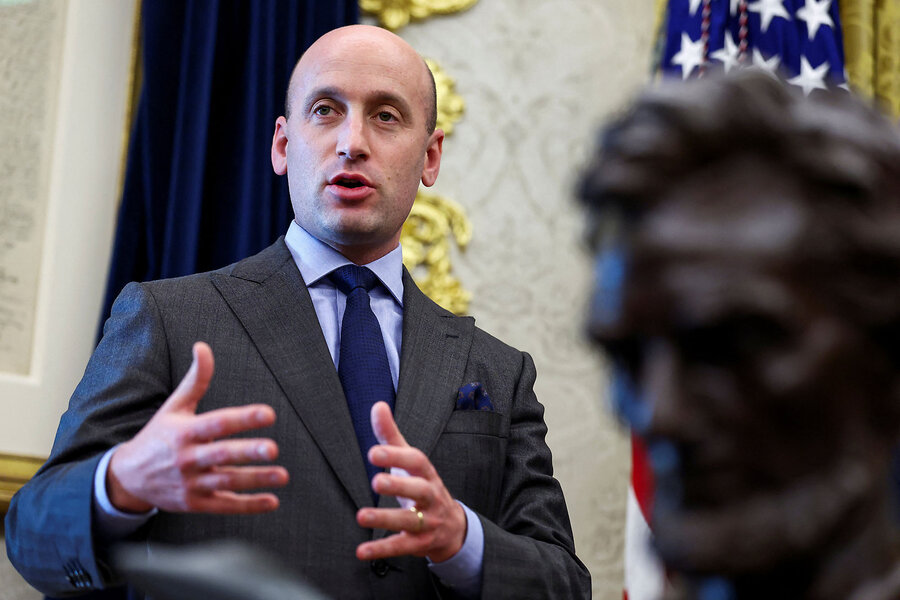
Washington | Nov. 12, 2026, 4:50 p.m. ET | 5 min read Since Stephen Miller was a teenager, he has built a reputation as a hard-liner on immigration.“Everyone and their parents should speak English – or get out of the country,” Mr. Miller used to say at California’s Santa Monica High in the early 2000s, recalled his classmate Kesha Ram – daughter of an Indian immigrant – in an interview with the Monitor in 2019.Today, Mr. Miller is President Donald Trump’s right-hand man, newly promoted as White House chief of staff in place of the more low-key Susie Wiles. His remit is broad, covering both policy and politics. On policy, he’s tasked with carrying out the president’s “America First” agenda on immigration, tariffs, foreign policy, and cutting the federal workforce. Politically, Mr. Miller is reportedly focused on rebuilding the MAGA brand, after the midterm election rout, and bringing working-class voters, including men and Black and Latino voters, back into the fold. But he remains best known as the architect of Mr. Trump’s aggressive actions on immigration in his first and second terms, involving mass deportations, family separation, and raids by federal officers that, at times, turned deadly.In a social media post early Thursday, Mr. Trump’s once-regular talk of “caravans,” groups of migrants heading from Mexico toward the U.S. southern border, came roaring back.“Here we go again!” the president wrote. “... the INVASION of our Country is taking place again.” Jacquelyn Martin/APStephen Miller, White House chief of staff, listens as President Donald Trump announces action to help farmers and ranchers, Sept. 4, 2026, in the Oval Office, in Washington. For a hot minute, right after the Nov. 3 elections, the possibility of bipartisan cooperation between the Trump White House and the new Democratic majorities in Congress seemed to be on the table. In interviews, President Trump suggested a more conciliatory approach, in keeping with the historical precedents of divided government. Presidents Bill Clinton, George W. Bush, and Barack Obama all achieved bipartisan compromises with Congress after brutal midterm defeats. “We’ll, you know, look forward to working with them,” Mr. Trump told The New York Times on election night, speaking of the Democrats. Later in the week, he said on CBS’s “60 Minutes” that he’d “love to do something on immigration,” calling his administration’s deportation policy “too tough.” He even discussed striking a deal with Democrats to allow unauthorized migrants who have committed no crime to stay in the U.S.Such talk of collaboration already feels distant.The appointment of Mr. Miller is “Trump doubling down,” says John Kenneth White, a professor emeritus of politics at Catholic University. “This is a pattern with him when he has lost financially or he’s lost politically, as in 2020.”Today, Dr. White adds, it means that voters’ midterm messages – ending the Iran war, curbing immigration officers, addressing inflation, dealing with corruption – “that’s all by the board with him. The message has failed to deliver.”The Trump administration has already sent a pointed warning. Early this week, the White House counsel told the likely incoming Democratic chair of the House Oversight Committee, California Rep. Robert Garcia, that aggressive investigations into the Trump administration “may cross the line into blatant criminality.” Legal experts questioned that assertion, based on precedent. Top Democrats, too, have laid down markers. At a news conference on Monday, House Democratic leader Hakeem Jeffries called Mr. Miller “a stone cold racist” and said he had “zero interest” in working with him. Senate Democratic leader Chuck Schumer called Mr. Miller “incompetent, dangerous, and brutally nasty.”President Miller?It is possible that Mr. Trump will focus less and less on the business of governing, and turn his attention increasingly to his real estate projects – from the White House ballroom and triumphal arch to the Lincoln Memorial Reflecting Pool and the John F. Kennedy Center for the Performing Arts.It may have been telling that Mr. Trump delivered his final speech of the fall campaign at the Reflecting Pool and, the day after the disastrous (for him) midterms, gave extended public remarks at the ballroom site – without mentioning the election results. He said he finds construction projects “relaxing.” Jonathan Ernst/ReutersPresident Donald Trump holds a model of an arch monument during a ballroom dinner in the East Room at the White House in Washington, Oct. 15, 2025. Mr. Miller, meanwhile, has been laser-focused on policy – and planning for what seemed increasingly inevitable: a Democratic takeover of Congress. He reportedly spent the weeks before Election Day working with White House Budget Director Russell Vought figuring out an agenda for the final two years that relies on executive action, allowing the administration to bypass Congress. Mr. Vought, who knows how the federal budget works as well as anybody, is about to become even more important in Trump world.To some observers, Mr. Miller could in many ways effectively become president, with the ability his position affords him to influence decisions and control the flow of information reaching Mr. Trump. Past, powerful chiefs of staff include James Baker, who served Presidents Ronald Reagan and George W. Bush and is often lauded for his ability to execute the president’s agenda while also challenging what he felt were bad ideas.But Chris Whipple, an expert on White House chiefs of staff, doesn’t see another James Baker in the making. Unlike Mr. Baker, “a cool pragmatist who could push back on the president’s half-baked ideas,” he writes in Vanity Fair, Mr. Miller is the opposite.Mr. Whipple warns of another risk – that a newly empowered Mr. Miller falls prey to a common problem among those who have occupied the West Wing corner office: They succumb to groupthink and lose sight of the big picture. “But in Trump’s West Wing this phenomenon is exponentially magnified,” he writes. The risks Mr. Whipple describes are profound. Mr. Miller “believes in a Hobbesian world, he has stated, ‘that is governed by strength, that is governed by force, that is governed by power,’” writes Mr. Whipple, whose interviews with Ms. Wiles last year garnered attention. “Now he’ll be the last person in the room when Trump makes life-and-death decisions about law and order and war and peace.” Rod Lamkey, Jr./APOffice of Management and Budget Director Russell Vought (center, left) and Stephen Miller (center, right) arrive at the White House Correspondents' Association dinner in Washington, July 24, 2026. Mr. Miller has reportedly worked with Mr. Vought to draft an agenda for the final two years of President Donald Trump's term that relies on executive action, allowing the administration to bypass Congress. A key limiting factor on the potential of Mr. Miller's overreach could be Mr. Trump himself. If the president senses that his chief of staff is effectively taking over, becoming a quasi-chief executive, Mr. Trump could well rein him in. Mr. Miller’s youth – he’s in his early 40s – could also work against him.Some who know Mr. Miller speak well of him, a family man with four children whose wife, Katie Miller, is a former White House aide. Reince Priebus, an establishment Republican and Mr. Trump’s first chief of staff, calls him “actually a sweet person.”“I’ve been in hundreds of meetings with him,” Mr. Priebus said last week on Fox News. “I have never seen him unprepared. He’s talkative. He listens.”To others, Mr. Miller is a throwback to the president’s early-career mentor and fixer, Roy Cohn. Deepen your worldviewwith Monitor Highlights.Politics with respectGet political stories with respectful analysis.There‘s a world of new ideas in everyBooks newsletter.There‘s more to life, enrich yours withCulture & Learning weekly.Follow humanity‘s discoveries withScience & Nature stories in your inbox.Gain a spiritual perspectivefrom the stories in your inbox.Want to understand the deeper impact of critical events? Learn the Monitor‘s insight.Already a subscriber? Log in to hide ads. “More closely than anyone else in Mr. Trump’s administration, [Mr. Miller] follows Mr. Cohn’s playbook of aggressive, unapologetic defiance,” write Kai Bird and Susan Goldmark, authors of a new biography on Mr. Cohn, in The New York Times.And, they add, Mr. Miller – like Mr. Cohn – evinces the quality Mr. Trump values most: “absolute loyalty.” ALREADY A SUBSCRIBER? LoginReal news can be honest, hopeful, credible, constructive.The Christian Science Monitor was founded in 1908 to lift the standard of journalism and uplift humanity. We aim to “speak the truth in love.” Our goal is not to tell you what to think, but to give you the essential knowledge and understanding to come to your own intelligent conclusions. Join us in this mission by subscribing.
Stephen Miller landed his dream job. How far can he push Trump’s executive power?
Full Article
Original Source
Read the full article at Csmonitor →KhanList aggregates and links to publicly available news content. We do not host full articles from third-party sources. Always verify important information with original sources.