
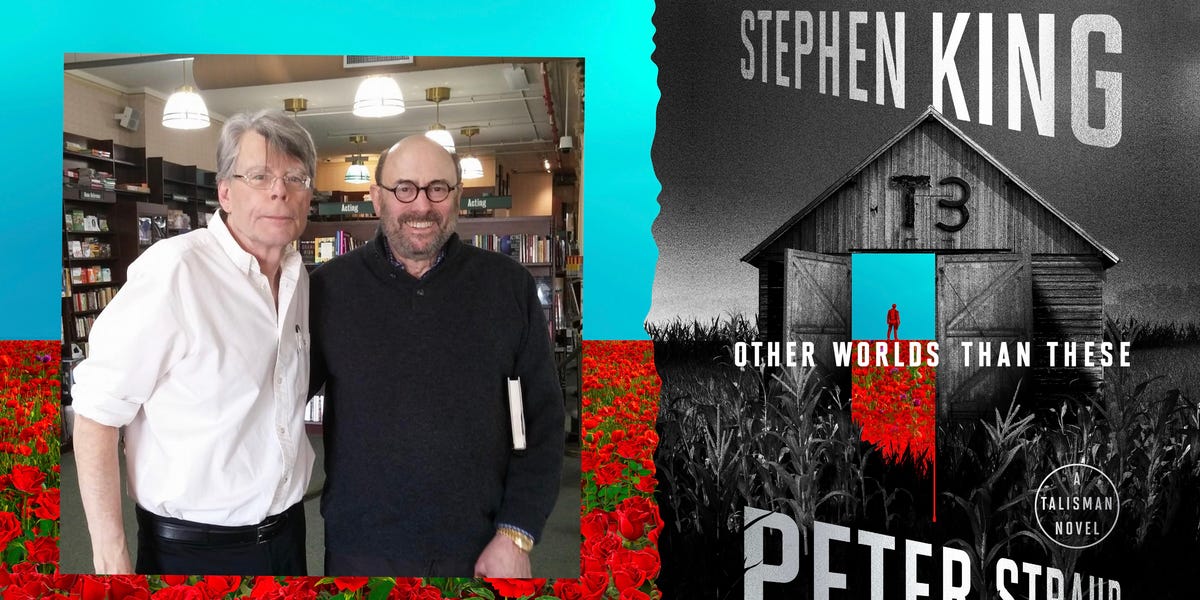
Every product was carefully curated by an Esquire editor. We may earn a commission from these links. Here’s how we test products and why you should trust us.Simon & Schuster8 min readOther Worlds Than These is haunted by old friends, some very far gone, and it made me think about my own.This new book is the final chapter in The Talisman trilogy that Stephen King and Peter Straub began 42 years ago, and a bittersweet trail of empty spaces can be found throughout the pages of this otherwise hard-charging odyssey. Among the missing is Straub himself, who died in 2022.His name on the cover of the new book is not just a tribute. Straub came up with a concept for Other Worlds Than These and emailed the ideas to King back in 2013. They didn’t move fast enough back then, so King had to head off alone to finish the journey, doing his best to remember his old friend and collaborator’s voice. Maybe that’s why the novel weaves its adventure so seamlessly with heartache.I read the novel by alternating between a physical book and the audio version, which is narrated by Patton Oswalt with just the right note of wry fatalism. It felt a little like shifting back and forth between two similar but distinct worlds, which is the unique power of the central character, Jack Sawyer. In the first book, he was just a twelve-year-old boy who discovers he can “flip” between his life in contemporary America and a parallel dimension full of magic and monsters called The Territories.The 1984 novel was about Jack venturing across these two lands in search of a miraculous orb that can heal his dying mother. In Straub and King’s follow-up novel, 2001’s Black House, Sawyer was all grown up and working as a Wisconsin homicide detective, pursuing a serial killer who serves a malevolent being from this mystical realm. Other Worlds Than These follows a middle-aged Jack as he tries to stop a death cult that tears through the Territories, absorbing the young and laying waste to everyone else in its path. Its blood sacrifices are designed to open The Gullet, a kind of sentient black hole that will consume their world, then move on to our own. Jack pushes forward even though he has almost no one left in either of them.As part of this review, I reached out to Oswalt himself to see if he saw the same things I did in this book: a memento mori about growing up, and growing old, and moving on without some of the people who were with you on the path when you started out.“What was surreal for me reading this was I remember reading The Talisman when I was twelve or thirteen. I remember it very vividly. That's when I first was introduced to Stephen King and it was almost like I can recite a lot of his early stuff from memory,” Oswalt told me. “This book really addresses how sometimes it's your childhood memories that stay the most vivid. The ones you have when you're in your twenties and thirties, maybe don't stay with you as strong as those. Those are the ones that stay with you for life. And he really captured that feeling.”Same. Very much the same.I’m not an objective reader of King’s work. Like the countless others who grew up turning his pages, I feel an emotional attachment to his storytelling—but it actually goes beyond him. Those novels are reminders of the friends and loved ones who shared them with me, and the long-ago times and faraway places where I first read them. I’ve also interviewed King many times over the years, and currently co-host The Kingcast podcast, where we discuss his stories with other people (and sometimes King himself). But honestly, that’s also why it’s so thrilling to see that the guy still has his fastball.Even at age seventy-nine, even after roughly seventy novels and two hundred short stories, he is still pushing himself, still experimenting, and still pulling from his own life to give us a story that is simultaneously an escape from real life and an insightful reminder of what matters. In Other Worlds Than These, Jack is fifty-seven—but a hard fifty-seven, battered by a lifetime of straddling two universes and still damaged by a near-mortal gunshot wound he experienced the last time we saw him a quarter century ago. He’s still trying his best too, determined to right the wrongs he can, but deeply missing the friends, family, and colleagues who have left his heart full of holes.I first picked up The Talisman when I was about the same age as the main character. Jack Sawyer and I have aged together. I guess we are the lucky ones. As I turned the pages of Other Worlds Than These, or listened to Oswalt’s voice in my ear, I thought often of my childhood friend Ethan Wells, who never got to grow up, let alone grow old.People come and go as the years pass, but books—just like songs and movies—are reminders of what has slipped over the horizon.Ethan died in 1993, four months after his sixteenth birthday. He was driving home from work one rainy evening when his car hydroplaned on the wet road and slammed into a tree. We had known each other since we were babies. Our mothers were best friends, and so were we. His mom was a Stephen King fan, and as I got into his books, I remember coveting the first edition hardbacks of The Shining and The Stand that stood together on the bookshelf in their TV room. When he and I were around thirteen, Ethan’s mom gave me her paperback copy of The Talisman to read.I wish I still had it, not that the book itself was rare or special. She must have dropped it into a pool or the ocean at one point, because the back half of the paperback looked like it was swollen with wasp stings. The spine curled in on itself like a candy cane until the back edge of the book almost touched the middle. As I read it, The Talisman was disintegrating, with pages falling out as I went. I never gave it back. There was nothing left to return.Whenever the older, graying Jack of Other Worlds Than These thinks back to his brave, fearsome friend Wolf from the first book, his now long-gone ailing mother, his wise old mentor Speedy Parker, or his estranged childhood friend Richard Sloat, I would think of Ethan. I would think of Ethan’s mom, who’s still here, and his dad, who is not. I would think of that quicker-picker-upper paperback, and the epic story that lives on in my memory even though the pages dropped away to nothingness.The new novel itself isn’t melancholy or ponderous. It’s a roller-coaster ride, but among its stomach-dropping powers is the ability to make the world of the past reach out its hand to the present. Are there passages that could be better clarified or tightened? Sure. I wish a couple of the new supporting players were more finely drawn when they are first introduced, so they could stand out better against the vivid images of those who are missing. But there are many more new figures who spring right to life, including a mafia enforcer who is drawn into the fairy-tale world and a mystic with eyes tattooed on her hands who walks the line between fraud and prophet.A number of set pieces throughout the book stand right alongside King’s most unforgettable moments. One particular scene in Other Worlds Than These blends explosive violence with dry humor as a pair of cops are languidly ending their shift while listening to Yacht Rock, only to be roused from their stupor by two thrill-killing teens who unleash fiery havoc in the center of a small Nebraska town. In another, Jack rescues a woman stranded on top of a water tower that is teetering and near collapse into the ashes of a town below. Try not to physically shudder during the later sequence involving a downpour of grape-sized spiders. You cannot put this book down, or stop listening to Oswalt read, until these sequences end and the characters themselves get a moment to breathe.I would have loved to talk about this book with a fifty-year-old Ethan. Instead, I reached out to the only other person I knew who had read Other Worlds Than These, which is what led me to reach out to Patton Oswalt himself.Oswalt has been a lifelong voracious reader of King’s work, and he was personally name-dropped in a scene from King’s 2019 novel The Institute. (Uncle Steve loves a pop-culture Easter egg.) King has also said Oswalt was an inspiration for the jester character Payton Orville in the new book.We both saw something similar beneath the surface of Other Worlds Than These. “It is a metaphor for when you're aging and you're like, ‘Okay, this is where people start dropping off of the boat,’” Oswalt says. “‘This is where people start falling off of the truck, and I just gotta keep driving forward because they wouldn't want me to stop. They would want me to go as far as I can.’ That is, I think, a shared experience that everyone has in life.”Jack Sawyer doesn’t leave anyone behind. He carries all his old loves with him, every step of the way. “Parts of your past will go forward with you,” Oswalt notes.In Black House, King and Straub began blending King’s mythology from his Dark Tower novels into the Talisman lore, which means realities are stacked on top of realities. The very title Other Worlds Than These comes from a line spoken by a doomed character in King’s The Gunslinger: “Go then. There are other worlds than these.”I’m not sure I believe that, but it’s a comforting thing to imagine. As King explored in a much later story, “The Life of Chuck,” the people we meet, the experiences we have, the stories we both hear and experience in reality, exist within our memories as worlds unto themselves. We carry an entire universe within us, and sometimes we just have to stop and marvel at it.King’s love of a pop-culture reference comes up repeatedly in the back third of Other Worlds Than These, when Jack leads a caravan over crumbling roads and collapsing bridges, enduring predatory beasts, mutant zombies, and brainwashed killers along the way. He keeps thinking of a movie remake he saw as a kid at Westwood’s Village Theater in Los Angeles, and the original French thriller that inspired it.“It was really interesting that he used the structure of The Wages of Fear and Sorcerer, which are about four men trying to run from their past,” Oswalt says. “They have to go forward into a future that will kill them at every step. He slowly puts together remembering those movies. First it's just this line of dialogue—like, Why do I know that?—which is how we oftentimes do remember things. Stephen King, he's in the business of noticing things. And so I think he's noticing how he's aging and how he's remembering things.”That also shows how the stories we experience serve as signposts along the way. King’s novels certainly are that for so many people. People come and go as the years pass, but books—just like songs and movies—are reminders of what has slipped over the horizon.In King’s afterword to Other Worlds Than These, he thanks all of his Constant Readers, “some of whom started as children and are now getting gray.” Looking in the mirror, that’s pretty much right in my case. Such changes can be dispiriting, but then I think of my own old friend, frozen in my memory, forever a teenager.I was surprised by how emotional this new book was for me, and all I can hope is that other King readers feel the same. I was grateful to Straub for proposing this idea, grateful that King is still out there telling stories. He brought The Talisman trilogy home. Brought us home.
Stephen King and Peter Straub’s Other Worlds Than These Will Break Your Heart
Full Article
Original Source
Read the full article at Esquire →KhanList aggregates and links to publicly available news content. We do not host full articles from third-party sources. Always verify important information with original sources.