
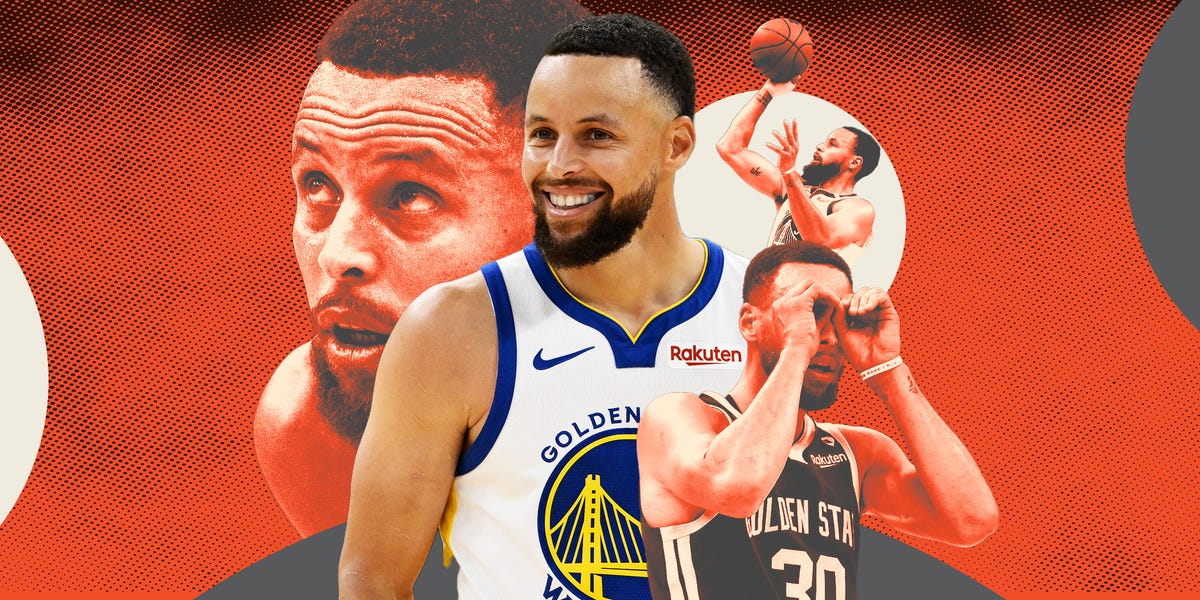
Getty Images; Jason Speakman, Men's Health Illustration6 min readSTEPH CURRY HAS built a career around seeing details on the basketball court before almost anyone else does. He tracks defenders, finds teammates through closing windows and judges distance with enough precision to turn a shot from 30 feet into something that can feel almost routine.For years, though, Curry didn’t realize he wasn’t actually seeing clearly.About eight years ago, Curry was diagnosed with keratoconus (also known as KC), a rare, progressive eye disease that can cause blurry and distorted vision. Now, he’s partnering with Glaukos, a medical company focused on eye health, to raise awareness of the condition using his own experience to encourage earlier recognition of its warning signs and more regular eye screenings.“The only reason I went to go get checked is because a friend of mine was watching a game and saw me on TV just squinting the entire time the camera was on me,” Curry told Men’s Health. His friend suggested he get his eyes checked.Until then, Curry had simply found ways to operate around what he could and couldn’t see.“I was compensating so much to get around that blurred vision and whatever that reality was,” he said.Once his vision was properly corrected, Curry suddenly had a reference point for just how different the world could look. He jokes that for the first two weeks, he became “the most annoying person in the room,” constantly pointing out details he hadn’t been able to see before.“I was like, ‘This is what everything’s supposed to look like?’” he says. He remembers noticing something as ordinary as dust particles floating in a room. “It was definitely an incredible transformation for me.”For one of basketball’s most precise shooters, the implications are difficult to separate from his profession. Curry believes addressing his vision has likely supported his longevity and performance on the court. His experience also exposed something that extends well beyond basketball: The body can become exceptionally good at compensating for a problem you don’t yet realize is there.The Cost of CompensationCurry acknowledges that the mentality that helped him become an elite athlete may have also contributed to how long he accepted his changing vision. Athletes are conditioned to adjust. Something hurts, they modify. Something feels different, they find a workaround. There is almost always another practice, game or season demanding their attention.“It’s part of my stubbornness in why it took so long to actually get screened,” Curry says.Once he had a diagnosis, however, the process felt more familiar. Get assessed. Understand what is happening. Learn the protocol. Follow it. The difference with KC is that there isn’t necessarily a finish line. Because the condition can progress, Curry says he now gets his eyes checked every six months to monitor it and make sure it remains stable.“You don’t really know where it is,” he says. “It’s very vulnerable in those moments when you’re getting feedback about your health and where you’re at because there’s a lot of trust involved, obviously, but it’s an important process to take care of yourself.”Keratoconus commonly emerges during adolescence or early adulthood. Blurry or distorted vision and frequent prescription changes can be warning signs, while having a family history of KC can also increase risk. The condition can progress over time, which makes identifying it and working with an eye care professional earlier especially important.Curry was approaching 30 when he learned what was happening with his own eyes.“It was a loud moment for me,” he says. “This was something that I didn’t know about, didn’t see coming, and thankfully, I got the right answers.”That experience is part of what led Curry to partner with Glaukos on its Could It Be KC? campaign, an effort focused on helping people recognize potential signs of keratoconus and start conversations with their eye care providers. Curry is also bringing his experience to a younger audience through a new picture book, Eye on the Ball, inspired by his own journey with the condition.For Curry, the message is less about convincing people to look for a specific diagnosis than making eye health something people think about before a problem becomes impossible to ignore.“Just that it’s okay if it’s a part of your normal yearly checklist of things that you’re taking care of and prioritizing,” he says.Now a father of four, Curry says it’s a conversation he and his wife, Ayesha, have brought into their own home. “It should be normalized,” he says.Rethinking the WorkThe willingness to pay closer attention to his body has become increasingly important as Curry prepares for his 18th NBA season at age 38. The standard hasn’t changed—but the way he reaches it has.“Ten years ago, I could just roll the ball out, not stretch, go work out for an hour and a half, probably not put any ice on, sleep for six hours and be fine the next day,” Curry says.He doesn’t have the same margin for error as he did when he was younger, and he isn’t pretending otherwise. His training is now more data-driven, with greater attention paid to monitoring output and prioritizing sleep and recovery. Instead of relying on marathon sessions, Curry follows a philosophy he calls “little bits more often.”“There’s never really an off switch, but I’m never really doing the six-hour gauntlets that I used to,” he says.Doing less at once doesn’t mean Curry expects less of himself. He has spent most of his life building the physical capacity required to play basketball at this level. At this stage of his career, the challenge is maintaining that capacity without repeatedly digging himself into a hole he has to climb back out of.“You can’t ever let yourself get too far away from what prime looks like because it’s super hard to get it back at this age,” he says.That has required Curry to expand his definition of training. A productive day isn’t necessarily measured by how exhausted he feels when it ends. Sometimes another hour in the gym is useful. Other times, the better performance decision is watching film, eating differently or sleeping.“I think the healthy part of that is there should be a little insecurity, like, ‘I could have done more,’” Curry says. “If you’re not asking that, it’s part of your competitiveness or that kind of undying drive to always find a way to get better because there’s always something you could be doing.”The questions haven’t stopped. They’ve changed.“Should I watch film? Should I go take a nap? Or could I have eaten better?” he says. “All those good cycles of questions always should be going on if you really care about optimizing your performance.”Knowing When to Pay AttentionVision now belongs in that equation, too.Keratoconus can be particularly difficult to recognize in someone who has never known another way of seeing. A young athlete squinting at the scoreboard, struggling with blurry or distorted images or repeatedly needing a new prescription may not know those changes are worth investigating. Curry didn’t.There are also disparities in who develops KC. Research has found higher rates of the condition among Black and Hispanic populations, adding another dimension to Curry’s push to get information about the disease in front of young people and their families. Still, Curry is careful not to suggest that correcting a vision problem is some hidden athletic advantage.“I’m not telling anybody you’re going to score more points per game if you can see more clearly,” he says.The lesson he took from his own experience is more basic: You can’t address something you don’t know is happening. Regular comprehensive eye exams create an opportunity to identify changes, ask questions and determine with an eye care professional whether additional evaluation or treatment is needed.Curry knows what could have happened had he continued treating blurred vision as his normal.“I can only imagine the regret or the frustration or bitterness I’d have had I not gotten checked,” he says.It’s a perspective that fits naturally into the way he now thinks about longevity. Nearly two decades into his NBA career, Curry still believes a certain amount of dissatisfaction fuels improvement. There is always something else he could do. Experience, however, has taught him that maximizing performance doesn’t just mean doing more, but rather knowing what his body needs, recognizing what deserves attention, and understanding when he has done enough.“There is a threshold that you understand over time based on the process that makes you feel the most prepared,” Curry says. “I think that’s an individual answer for everybody, but only you can look yourself in the mirror and say, ‘I hit that threshold,’ and I’m still curious and wondering what I could add to the program to get better.”Curry’s keratoconus is currently stable, and he continues to have his eyes checked every six months. Now, he hopes talking about the condition can help someone else recognize what he couldn’t. After all, Curry didn’t seek out an eye exam because he suddenly realized his vision had changed. It took a friend watching him squint on TV to see what he couldn’t.Danielle Bitts, NASM CWC and CPT, is a journalist with over a decade of experience within health and fitness. She’s the former VP of Brand and Editor-In-Chief of Bodybuilding.com, was a founding creative producer for the Spartan Race media team, and is now the Founder of Perfect Days Collective, an experiential wellness brand focused on human evolution. Danielle’s completed three 70.3 Ironmans, 1 marathon and over 14 half marathons. She’s a former Division 1 athlete and has competed in Taekwondo, Olympic weightlifting, CrossFit, long distance swimming and has summited Mt. Whitney as well as completed the Salcantay trail in Peru.
Steph Curry Wants You to Get Your Eyes Checked
Full Article
Original Source
Read the full article at Menshealth →KhanList aggregates and links to publicly available news content. We do not host full articles from third-party sources. Always verify important information with original sources.