
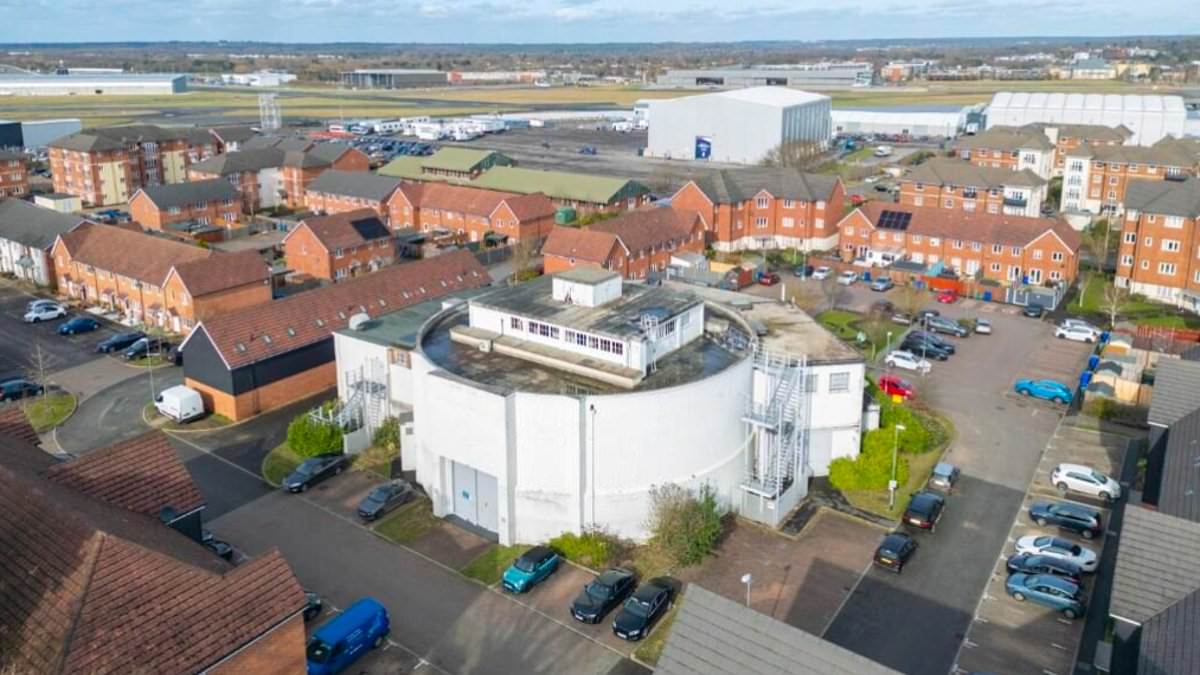
If you've got a spare £750,000 burning a hole in your pocket, you could become the proud owner of Britain's strangest property.Nestled on a sleepy side street just outside Farnborough Airport, you can find the former Royal Air Force Institute of Aviation Medicine.With over 30 rooms and sprawling over 189,013 square feet (17,560 square metres) of floor space, this might look like an absolute bargain.However, this Grade II* listed building is also hiding a feature that you won't find in any normal family home.Taking up almost the entire ground floor, this building is home to the Farnborough Centrifuge.This imposing piece of military-grade kit is the RAF's former 'spin machine' that was used to test the limits of the human body.After being decommissioned in 2019, the centrifuge was operated as a museum by the Farnborough Air Sciences Trust (FAST) until 2024.But now, for the first time in over 60 years, this unique property is being listed for sale. An abandoned RAF 'spin machine' used to push the limits of fighter pilot training is on sale for £750,000 The former Royal Airforce Institute of Aviation Medicine has over 30 rooms and sprawls over 189,013 square feet (17,560 square metres) of floor spaceThe Farnborough Centrifuge consists of a massive 62.5-ft-long (19m) steel arm with a simulated plane cockpit attached to either endDexters, the estate agents listing the strange property, describe the sale as 'a unique opportunity to purchase a piece of British aviation history'.The Farnborough Centrifuge consists of a massive 62.5-ft-long (19m) steel arm with a simulated plane cockpit attached to either end.When it was operational, the entire 40-ton contraption could spin at 54 revolutions per minute, accelerating the arms to a maximum speed of 115 miles per hour and generating a bone-splitting force up to 30G.However, this was capped at 63 miles per hour to create a more survivable 9G of force in the twin cockpits.This incredible piece of engineering is the only human centrifuge in the world designed and built by British engineers.It's also believed to be one of the oldest examples of a human centrifuge in the world, and almost unchanged from its original state.The only place you can find a similar device is in the Air Academy at RAF Cranwell in Lincolnshire, where a modern replacement for the Farnborough Centrifuge was built in 2019.The centrifuge was built between 1951 and 1955 for £350,000, as the next generations of fighter planes started to become faster and jet propulsion became a reality. This Grade II* listed building was operated as a museum by the Farnborough Air Sciences Trust (FAST) until 2024 The centrifuge was built between 1951 and 1955 for £350,000, and played a key role in developing the techniques and technologies used by modern fighter pilots What are G-Forces? A G-Force is a unit of acceleration which measures how much stronger acceleration feels compared to the normal pull of gravity.One G is the standard pull of gravity you experience while standing on the Earth's surface.Most people will start to 'grey out' at around five or six Gs. Peripheral vision fades to a tunnel as the heart fails to push blood into the head.Trained fighter pilots using straining techniques and an inflated G-suit can remain conscious up to nine Gs. Compared to the fighters of the Second World War, these new planes could accelerate faster, turn sharper, and exert a far greater level of G-Force on their pilots.When that force became too much, untrained pilots risked losing their vision or even blacking out during high-speed manoeuvres.The centrifuge was able to replicate those intense conditions from within the safety of the lab, with plenty of room for medical equipment and no risk of a fatal crash.Over the years, the team at the Farnborough Centrifuge contributed to crucial development in aircraft equipment, evolving from pressurised trousers and special breathing techniques to the pressurised masks used by pilots today.From the moment it turned on in May 1955 until its final rotation on March 4, 2019, the centrifuge completed an astonishing 122,133 runs.The site was even used to train astronaut Helen Sharman, the first Briton in space, who used the centrifuge to get ready for the intense forces of liftoff.After the site was officially decommissioned in 2019, it passed into the hands of its current owner, Raintree Developments Ltd.FAST then ran the site as a museum until 2024, explaining in a post on their website that 'the owner has terminated our agreementThe group added: 'Although we have been offered a new agreement, the owner has asked for a five-fold increase in rental payment which, as a small charity, FAST just cannot afford.'Now, after sitting unused for over two years, Raintree Development Ltd is looking for new owners. From the moment it turned on in May 1955 until its final rotation on March 4, 2029, the centrifuge completed an astonishing 122,133 runsA FAST spokesperson told the Daily Mail: 'As far as we (FAST) are concerned, we hope that a new owner can be found who will work with FAST to preserve the centrifuge machinery, renovate the building and allow the public once again to see this impressive example of 1950’s British engineering and learn of its contribution to aviation medicine.'However, anyone who thinks that this might make a wonderful new home should brace for disappointment.Due to the Grade II* listed status, converting the building into a residential home would require both full planning permission and Listed Building Consent from your local planning authority.Any changes that are seen as detrimental to the heritage assets, such as the centrifuge chamber and machinery, would likely be met with some serious red tape.
Step inside Britain's strangest property: Abandoned RAF 'spin machine' used to test the limits of the human body goes on sale for £750,000
Full Article
Original Source
Read the full article at Dailymail →KhanList aggregates and links to publicly available news content. We do not host full articles from third-party sources. Always verify important information with original sources.