
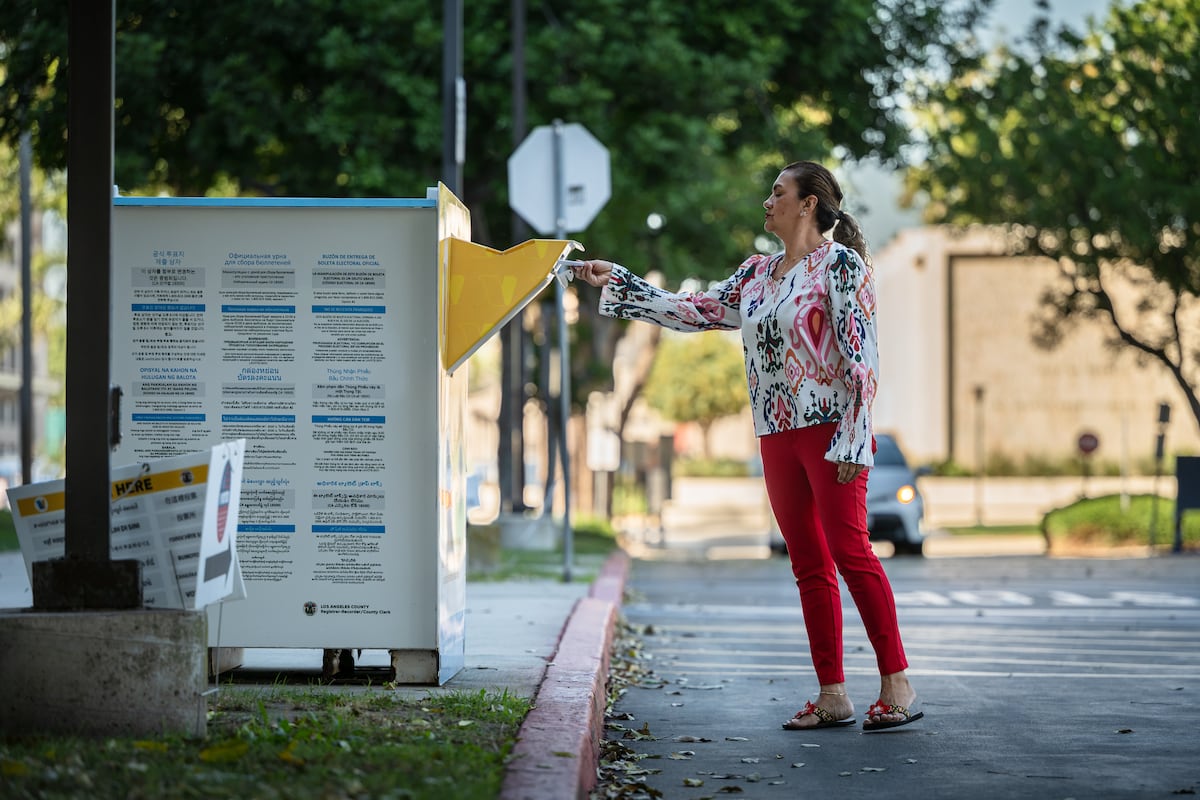
Lidia Sánchez, a Nicaraguan immigrant who arrived in California as a child, had two items on her agenda on a warm October morning: a routine doctor’s appointment and personally dropping off her ballot at an election office drop box in Los Angeles. She had always voted by mail, but this time she feared her ballot might not reach its destination and that her vote would not be counted.Her concerns echo those of many Democrats who have distrusted the Postal Service ever since U.S. President Donald Trump tried to use it to restrict voting rights.“That man is corrupt. What do you expect from him?” Sánchez says, referring to possible federal interference in the midterm elections. “He has his hands everywhere. I don’t trust him at all. Politics is dirty, but everyone kisses his behind,” says the retiree, who spent 33 years working for the social services department in Orange County, neighboring Los Angeles County.Sánchez got out of her car and slipped her ballot through the slot of an official election drop box, a metal container placed outside the headquarters of the county election authority in Norwalk, a suburb 17 miles southeast of Los Angeles. She says that if there is any safe place to leave a ballot, it has to be there.Voting early — without relying on the Postal Service as an intermediary — has become an increasingly common practice ahead of the midterms. In states where in-person early voting is already underway at designated polling locations, turnout has surged. As of October 20, 4.5 million voters had cast their ballots this way, equivalent to 65% of the 6.9 million who voted in person before Election Day in the 2022 midterms, according to the University of Florida’s Election Lab tracker.More than eight million voters had also already returned their ballots through drop boxes, election offices or the mail, although the available data do not break down the share accounted for by each method. In total, more than 12 million U.S. voters had cast their ballots by that point, according to the same university.Distrust of the Postal Service“You feel something isn’t right,” Gloria Tiscareño said after dropping off her ballot at a drop box outside the headquarters of the Los Angeles County election office.For the first time, she says she distrusts both the Postal Service and the federal government. She compares the feeling to walking into a store and realizing a security guard is following you because they suspect you might steal something.Born in California 71 years ago, Tiscareño has voted in every election since turning 18. But she believes this one is different from all the others and prefers to take precautions. “I’ve heard that Trump could seize ballots. I don’t blame people for thinking that. It’s because of everything that’s happening,” she says.The lack of trust in the Postal Service is evident. A late-September NPR/PBS News/Marist poll found that voters’ main concerns centered on the possibility that the agency might be unable, or unwilling, to deliver mailed ballots on time.Thirty-two percent of Democrats said they planned to vote by mail, compared with 12% of Republicans. Trump, who has also voted by mail himself, has spent years claiming, without evidence, that the method is “corrupt.” It is therefore hardly surprising that 70% of Republicans surveyed said they believed mail-in voting was vulnerable to fraud.Overall, about a quarter of respondents said they would use the Postal Service to return their ballot, down from the 31% who did so in the 2024 election, when Trump won re-election. Half of those polled said they preferred to cast their ballot in person on Election Day, November 3, despite the long lines expected at polling places.Though under heightened scrutiny, the Postal Service says it delivered more than 233 million pieces of election mail during the current fiscal year, with an on-time delivery rate of nearly 98%. “A lot of misinformation has circulated about the Postal Service’s role in the election process, which could have influenced public perception. Nevertheless, the Postal Service’s performance indicators speak for themselves,” the agency said in a statement.The distrust comes amid Trump’s efforts to exert greater influence over election procedures, which are administered by state and local governments. In March, Trump signed an executive order aimed at restricting mail-in voting, directing the Department of Homeland Security (DHS) and the Social Security Administration to compile lists of U.S. citizens eligible to vote in each state.The order also instructed the Postal Service to send ballots only to voters included on a federally approved list. It further required ballots to include envelopes and barcodes to ensure security and traceability. The Postal Service issued the new rules in August, but a month later the Supreme Court dealt a blow to Trump’s plan, ruling that there was not enough time to implement the changes before the midterm elections.Trump’s clashes with election authorities go back years. Last year, the Justice Department requested complete voter rolls from nearly every state, including sensitive information such as Social Security numbers, dates of birth and driver’s license numbers. The department argued that it needed to review the records to identify and remove noncitizens ineligible to vote, a conspiracy theory that federal law enforcement operations have failed to substantiate.“There is a lot of injustice”The Justice Department renewed its push last week by filing a lawsuit against election officials in California. It alleged that immigration authorities had identified more than 20,000 non-U.S. citizens on the state’s voter rolls. On Monday, at least 28 people from that group were charged with registering to vote and casting ballots. Yet even the investigation that led to the operation offers no certainties. “There may be some names on there who it turns out ultimately are citizens, we’re not perfect,” Deputy U.S. Attorney Trent McCotter acknowledged at a press conference.Before the legal dispute in California erupted, Colombian immigrant Teresa Burns had already dropped off her ballot at an election drop box near her home in Baldwin Park, a predominantly Hispanic suburb about 18 miles east of Los Angeles. She chose that location because the drop box was installed outside the local police station. At first, she worried that someone might steal her ballot, perhaps hoping to find a check inside. Later, her concerns expanded to include the controversial measures Trump has taken.“I’m very worried about the country’s electoral and political situation because of this president,” says Burns, 72, who emigrated to the United States four decades ago. Since she obtained U.S. citizenship — “back in the Stone Ages,” she jokes — she has always voted for Democrats. The day she dropped off her ballot, she took a break from caring for her ailing husband. Once again, she voted for Democrats, hoping the country will soon change course. Her pension, earned after several years working as a cashier for the pharmacy chain CVS, barely covers her expenses.Burns believes it is important that her vote counts in helping to “lift up” a country that, in her view, is mired in crisis. “Especially for marginalized people, those without papers,” she says. “When I see ICE raids, it brings me to tears, because what they are doing to our people is not fair. There is a lot of injustice,” she laments.Sign up for our weekly newsletter to get more English-language news coverage from EL PAÍS USA Edition
Steering clear of the Postal Service and delivering ballots in person: Voter fears ahead of the midterms
Full Article
Original Source
Read the full article at English →KhanList aggregates and links to publicly available news content. We do not host full articles from third-party sources. Always verify important information with original sources.