
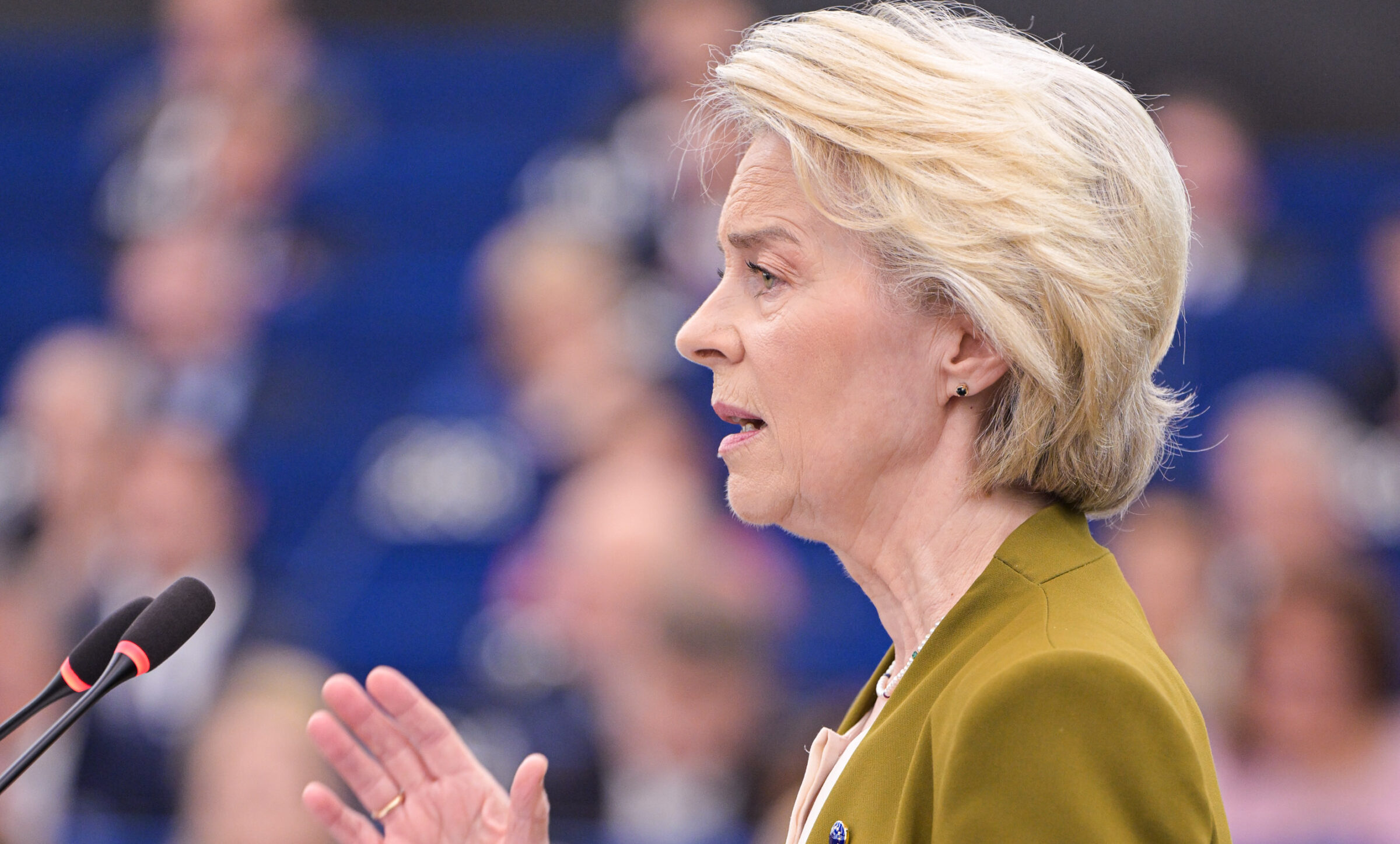
When Ursula von der Leyen delivers her State of the Union on Wednesday (16 September), there will be no shortage of crises demanding attention: Russia’s war against Ukraine, the erosion of the transatlantic relationship, China’s growing economic power, Europe’s competitiveness gap and the rise of political extremism. Europe has learned from recent shocks. It has reduced its energy dependence on Russia, strengthened its economic-security toolbox, begun rebuilding defence capabilities and paid greater attention to critical technologies and supply chains. But Brussels remains prey to a “progress illusion”, mistaking incremental steps forward for transformation on the scale the moment requires. Europe’s understanding of security still lags fundamentally behind the brutal shifts of the world around it. The interdependencies on which European prosperity was built can no longer be assumed to be benign. Three risks in particular now need to be addressed head-on. First: Financial havoc from the US Europe has spent the past decade thinking about dependencies in energy, technology, defence and critical supply chains. Yet one critical vulnerability has remained largely absent from the debate: finance. A dangerous fault line is emerging at the heart of the global financial system. US fiscal credibility can no longer be taken for granted: public debt is rising relentlessly, borrowing costs are increasing, questions over Federal Reserve independence are mounting, and the weaponisation of the dollar is encouraging diversification away from US assets. The International Monetary Fund itself warns that America’s rising debt and reliance on short-term borrowing represent a growing stability risk to the US and global economy. The danger is not simply a gradual erosion of dollar dominance. Confidence in the dollar-centred system could weaken faster than any alternative financial anchor can emerge turning a US fiscal shock into global financial turmoil. Today, Europe faces a three-way mismatch: a fragile international financial order; strategic challenges and investment needs that are increasingly European; and fiscal capacities that remain overwhelmingly national and constrained. Financial sovereignty must therefore become a core element of European security. Luckily, the building blocks already exist. The fiction that EU borrowing is temporary is increasingly detached from reality. Instead of inventing a new financing mechanism whenever crisis strikes, Europe should now turn this machinery into a permanent European Treasury capable of borrowing at scale to finance genuinely common investments. But a treasury solves only half the problem. Europe also needs to protect governments and markets against financial instability. Europe should transform the European Stability Mechanism it into a European Monetary Fund capable of supporting European sovereign-debt markets, creating also a deep pool of euro-denominated safe assets. Europe learned painfully that energy dependence can become geopolitical vulnerability. It should not need another crisis to learn the same lesson about finance. Second: Economic autonomy to deter both the US and China Economic security and competitiveness will undoubtedly be central to von der Leyen’s speech. Yet Europe now needs to move beyond resilience and de-risking towards deterrence. The EU is caught between a US increasingly willing to weaponise tariffs, market access and financial leverage, and a China systematically deploying state-backed industrial policy, overcapacity, export controls and chokepoints to build leverage over Europe’s economy. The question is no longer simply whether Europe can compete, but whether it can preserve the industrial and technological foundations of its political autonomy in a world of economic coercion and great-power rivalry. Europe does not lack economic power. Its weakness is its inability to translate that power into credible deterrence. It needs a doctrine of reactive assertiveness: openness and cooperation where possible, but clear red lines and prepared retaliation when European interests are threatened. That means mapping vulnerabilities, anticipating coercion, preparing escalation options and making clear what consequences particular actions will trigger. It also requires stronger economic-security governance and faster instruments, such as an automatic-trigger European counterpart to the US' Section 301. The objective is not protectionism or confrontation. It is to change the calculations of others. Washington, Beijing and others must know that coercing Europe comes at a cost. Third: taking on the algorithms Europe’s third vulnerability lies inside our democracies themselves. Von der Leyen is expected to address the impact of social media, particularly on children. That is welcome but, as too often, Europe risks treating the symptoms while leaving the underlying problem untouched. Our democratic-resilience debate focuses heavily on disinformation, foreign interference and illegal content. The deeper problem is the architecture of amplification itself. Recommender systems optimised for engagement privilege outrage, polarisation, conspiracy and extremism. Their cumulative effect is a public sphere so degraded that shared facts, democratic compromise and ultimately liberal democracy itself will progressively become impossible. Big Tech’s power over our information environment should be treated as a question of democratic sovereignty, not simply digital regulation. The tech bros are the Pied Pipers of our democracies’ demise. If Europe wants to defend democracy, it must act on the algorithms, not just the content. Europe should properly enforce the legislative arsenal it already possesses, starting with the Digital Services Act and GDPR, taking much more aggressive action against recommender systems and amplification models. These three risks point to the same conclusion: Europe’s understanding of security and preparedness have not kept pace with the ways in which power is now exercised. As the EU prepares its first new overarching security strategy in a decade, it must recognise that the boundaries between economic, financial, technological, democratic and traditional security are disappearing. Europe does not need to retreat from openness but it must learn to remain open without being defenceless. On Wednesday, von der Leyen must confront an uncomfortable truth: Europe is still dangerously unprepared for the world it is entering.
State of the Union: Three shocks Ursula von der Leyen isn’t prepared for
Full Article
Original Source
Read the full article at Euobserver →KhanList aggregates and links to publicly available news content. We do not host full articles from third-party sources. Always verify important information with original sources.