
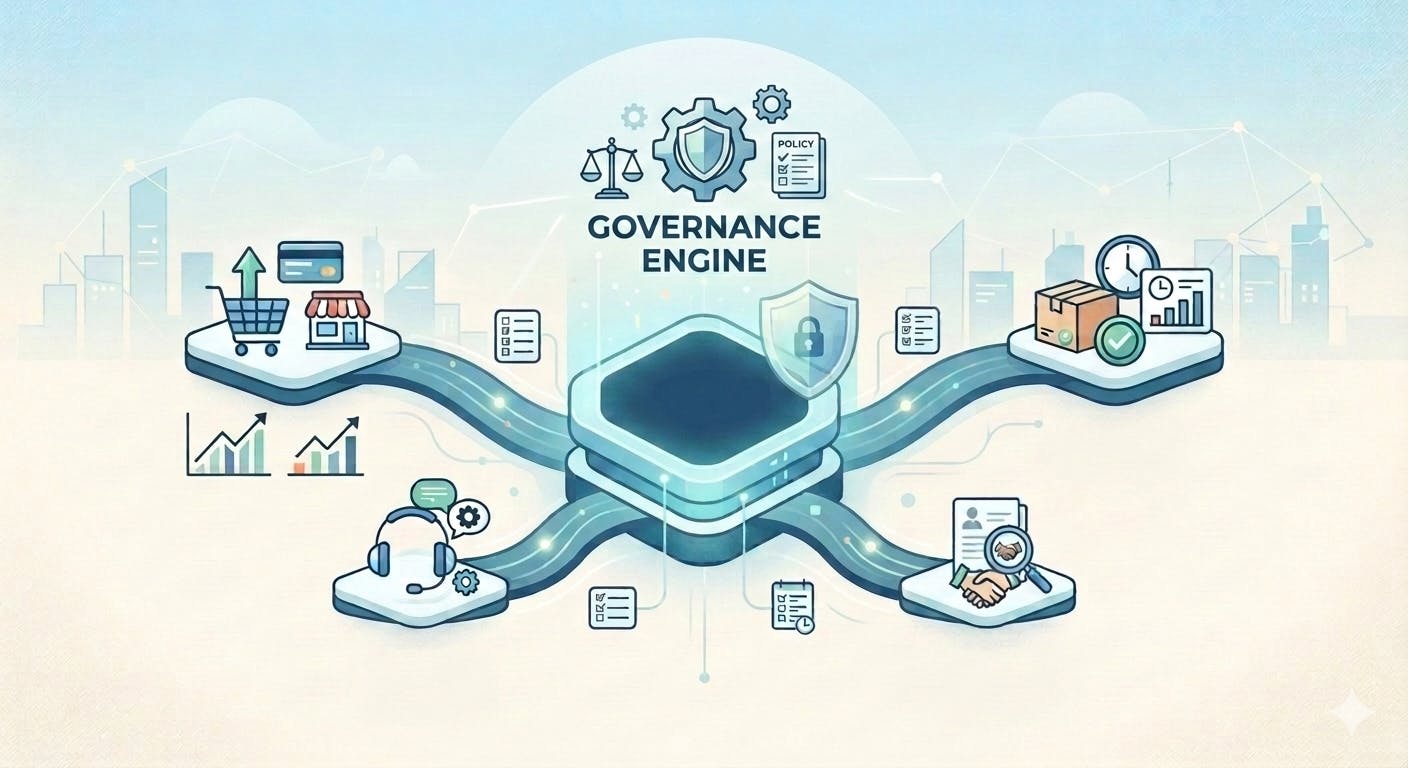
Welcome to HackerNoon’s Writing Prompts! Would you like to take a stab at answering some of these questions? The link for the template is HERE. 1. What is your company in 2–5 words? afka. One AI Brain that runs your company. Not a chatbot and not a pile of separate tools: one brain that plans, decides and acts across sales, support, recruiting and e-commerce, inside the systems a business already uses, with every risky action gated by code rather than by a prompt. 2. Why is now the time for your company to exist? Models crossed the line where multi-step work is reliable, but only if you wrap it in permissions and approvals. That second half is what everyone skipped. The bottleneck for an AI employee was never capability, it was trust: no owner hands a bot the refund button because a prompt promised to behave. So the timing is not "models got good." It is that models got good enough for the missing layer to be worth building, and the standard enterprises and regulators are converging on is being written right now rather than in five years. We build to that spec from day one instead of retrofitting it later, which is a thing you cannot do cheaply. Meanwhile a small business feels the labour cost immediately, has zero procurement friction, and can adopt in an afternoon. The technology matured on one side and the buyer was ready on the other. 3. What do you love about your team, and why are you the ones to solve this problem? I am the founder, and the honest answer is that the team is me and a fleet of agents that run our own company on the exact governance layer we sell. Our support, growth, quality and finance operations are agents with scoped identities, autonomy levels and an audit trail, gated the same way a customer's would be. When one of them files something wrong, I find out the same way a customer would. That is not a slogan, it is the fastest feedback loop I have ever worked in, and it is why one person shipped four vertical agents, five surfaces, voice, a governance core and billing in months. I have built and led a company past a hundred people before, so I know exactly what this replaces and what it does not. 4. If you weren’t building your startup, what would you be doing? I would be building another startup. That is the only honest answer. But I do not spend time on that question, because Plan B is to make Plan A work. 5. At the moment, how do you measure success? What are your metrics? Our north star is delivered artifacts per workspace per week. Not messages, not sessions, not tokens: finished work a human accepted. It is the leading indicator of both consumption and retention, and it is hard to fake. Around it we watch four things. Time from signup to the first completed task, in hours, because that is where products like this die. Autonomy share, meaning how much of a workspace's work runs unattended versus waiting for approval, because that number rising is the customer trusting us more. Override rate, meaning how often a human edits or rejects what the agent produced, because that is quality measured by the person paying. And gross margin per workspace, because a consumption product that cannot see its own margin per customer is flying blind. Internally there is a fifth: every agent version has to clear a written quality floor scored by an independent judge before it ships, and a calibrator watches for drift on real runs afterwards. If it drifts, the agent loses autonomy automatically. The failure mode of a bad day is "it asks you more often," never "it quietly does the wrong thing." 6. In a few sentences, what do you offer to whom? We give small and mid-sized businesses one deep AI agent per function: support, sales and revenue operations, recruiting, and e-commerce. Not a chatbot that drafts for one person, but a colleague that plans the work, runs it across the tools the company already uses, and delivers the finished artifact. It works where the team already works: chat, email, Slack, Teams, the web app, and the phone. Every agent has its own scoped identity, an autonomy level the owner sets per task type, an approval gate on anything that moves money or cannot be undone, and an append-only audit log. You buy control first and automation second. 7. What’s most exciting about your traction to date? I will be precise, because pre-launch traction is where founders get creative: we have zero paying customers today. We open in days. What is genuinely exciting is what is already measurable. The governance layer is not a diagram, it is code with tests: an action the system has never seen fails safe to a human instead of executing, and the time from a customer pressing pause to the agent provably having no capability to act is a number we measure and gate releases on rather than a claim we make. Billing is live and proven end to end on a real charge, not in a sandbox. And our own internal agents are running: the one watching support signal filed its first real finding on its own, a missing integration with 353 requests behind it in 30 days, and parked it for a human instead of acting on it. An agent that noticed something true, showed its evidence, and waited. That is the whole product in one event. 8. Where do you think your growth will be next year? Distribution, and I mean that as the answer rather than as a dodge. The graveyard is full of good products nobody found. Our growth next year comes from launch surfaces we work through one at a time, a creator and affiliate program that is already built into the product rather than planned, warmed outbound at a capacity I can count, marketplace listings where our buyers already are, and writing in public every week. What I will not do is give you a revenue curve. Our model deliberately leads with a different number: how many paying workspaces it takes to cover fixed cost, and how long the machine we actually have takes to get there. That number is a property of the business. A projection from zero is a story. 9. Tell us about your first paying customer and revenue expectations over the next year. We do not have one yet, and I would rather say that than dress up a pilot. The first paying customer will be a small operator drowning in a specific queue: an inbox, a resume pile, a support backlog. They will start with the agent in review mode, approving each action, and raise its autonomy task type by task type once they see it get things right. That progression is the product working. On revenue: I will publish real numbers when there are real numbers. What I can tell you is the shape. Plans start at fifty dollars a month against a US hire that costs sixty thousand and up, so we do not need a new budget line, only a fraction of an existing one. Revenue expands with consumption rather than with seats, so a customer who gets more value pays more without renegotiating anything. And the ladder is deliberately sublinear: the bigger plan is genuinely cheaper per unit of work, and going over your plan costs the entry rate rather than a penalty rate. Nobody meets a number invented to punish them. 10. What’s your biggest threat? Three, in order of how much they keep me up. Distribution. Not being found is how good products die, and it is the risk I am spending the most on. Someone shipping the governance layer credibly before we own the category. The models are a commodity we rent like everyone else. The defensible part is the control plane over non-human identity and the memory each customer's own operations generate, and neither is impossible for a well-funded team to build. And the quiet one, which is us fooling ourselves. Six times in one recent week a check in our own system passed or failed for the wrong reason: a security test that verified the wrong path, a guard that matched a shape instead of an effect, a quality score computed correctly on a budget that biased it. The number was right every time and meant something other than what we read it to mean. A company selling measurable trust that stops auditing its own measurements becomes exactly the thing it is selling against. So we write the failure down every time it happens. This startup founder interview template is based on HackerNoon Founder & CEO David Smooke’s ten questions for startup founders.
Startup Founder Interview: afka, The AI Employee Built to Run a Business, Not Just Chat With It
Full Article
Original Source
Read the full article at Hackernoon →KhanList aggregates and links to publicly available news content. We do not host full articles from third-party sources. Always verify important information with original sources.