
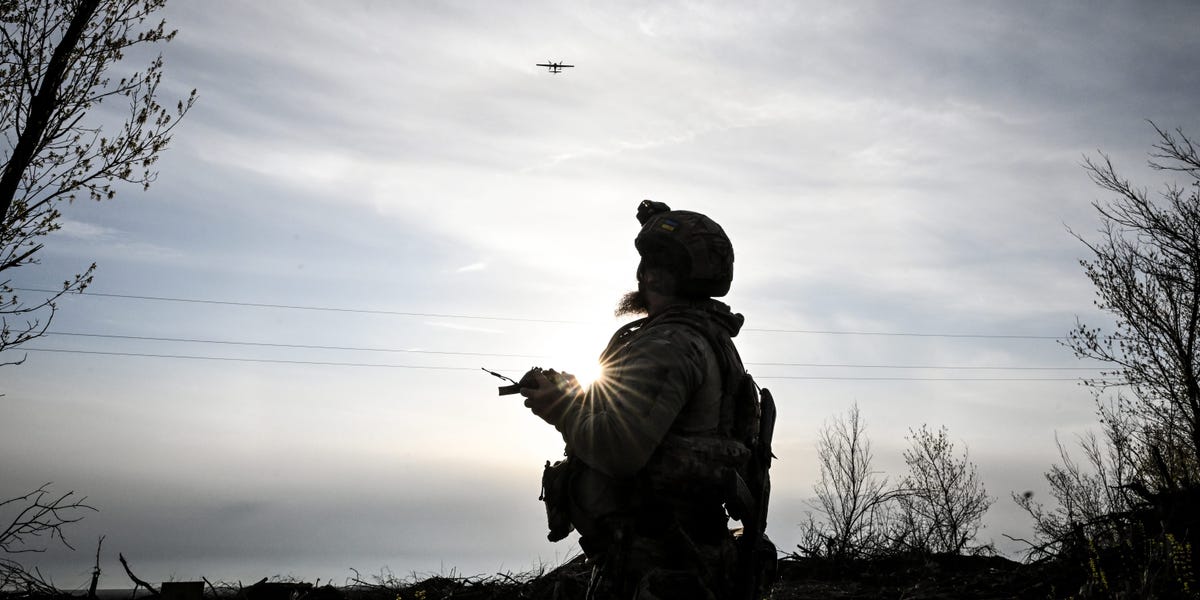
Starlink is a 'major card' for Ukraine, soldiers say, but surprise restrictions show the risks of overreliance The sudden disruption of Ukraine's military-grade Starlink access has exposed a key vulnerability. Dmytro Smolienko via Reuters Connect The sudden disruption to Ukraine's access to military-grade Starlink services this week shows the risks of overly relying on any single platform, particularly one beyond Kyiv's control, for mission-critical battlefield communications, Ukrainian soldiers, officials, and defense companies told Business Insider.With those risks front of mind, Ukrainians are working to diversify military-related communications platforms beyond Starlink.Ukrainian officials and soldiers were surprised on Wednesday by an unexpected disruption to Starshield, SpaceX's dedicated satellite network for military services. Defense ministry sources said speeds were restricted above 100 miles per hour, though some units experienced a loss of connectivity at speeds as low as 45 mph.Services appeared to have been at least partially restored by Thursday. The full extent of the disruption remains unclear, but the incident has left some Ukrainians feeling uneasy.Yehor Cherniev, deputy chairman of the Ukrainian parliament's national security, defense, and intelligence committee, told Business Insider that the disruption underscores the risks of relying on a single communications platform. He said Kyiv is working to diversify its sources, but declined to specify how.Yuriy, an officer with Ukraine's National Guard, told Business Insider that his units use Starshield to support drone operations, and several missions were spoiled during the disruption. He asked to be identified only by his first name for security purposes.Yuriy said that while Starlink services are useful, the disruption exposes their unreliability. He said he would try to find alternate communications systems.Alternatives to Starlink could be hard to find, though. Eutelsat, a large French satellite operator, saw its shares surge after this week's disruption, but Ukrainians say there is nothing else quite like what SpaceX offers."There is no working alternative to Starlink," said Dimko Zhluktenko, a soldier with Ukraine's 413th Unmanned Systems Regiment, calling it "an outstanding product." Ukrainian forces are heavily reliant on Starshield, particularly for drone operations. Ivan Antypenko/Suspilne Ukraine/JSC UA:PBC/Global Images Ukraine via Getty Images "No direct competitor comes close," he told Business Insider, adding that "Europe has nothing comparable at this level of battlefield readiness."SpaceX did not respond to requests for comment from Business Insider this week.Ukraine relies on Starlink for battlefield communications and drone warfare, a dependence that was underscored by the disruption. Defense ministry sources said the disruption complicated important drone operations, including mid-range strikes, air defense intercepts, and front-line logistics.Ukraine uses both Starshield and Starlink, SpaceX's commercial satellite internet service, to extend the reach of its drones, maintain stable communications in electronically contested environments, and conduct remote operations far beyond the front lines.Satellite connections allow operators to control drones and receive live video without relying on traditional radio links, which have limited ranges and are much more vulnerable to electronic warfare interference.The tech has been integrated into systems such as Perennial Autonomy's Hornet drones, as well as Ukrainian naval drones used to strike Russian targets in the Black Sea, among others.Many Ukrainian defense companies have integrated Starlink services into their broader infrastructure, even if their products don't necessarily depend on it for operations.Some firms, such as SkyFall, maker of the widely used P1-SUN interceptor drone, told Business Insider that they have developed their own communication methods or use alternative systems to avoid scenarios where a single technology outside Ukrainian control could become a significant point of failure, as it did this week."Depending on a single solution is very risky. Especially if you don't have full control over it," a spokesperson for Wild Hornets, the firm behind the popular Sting interceptor drone, told Business Insider. "Especially when it comes to something as critical on the battlefield as communications."The spokesperson said this is "exactly why our ecosystem is built around our own communications technology and is open to various solutions when it comes to internet connectivity." Ukrainian soldiers, officials, and defense firms say relying on one communications source is a risk. Pavlo Bahmut/Ukrinform/Sipa USA via Reuters Connect For anyone working with technologies that are dominated by a single provider, the risks are clear, said the head of hardware research and development at BlueBird Tech, a defense firm that makes drones and robots. They told Business Insider that Starlink has virtually no competitors because of its coverage, cost, availability, and ease of use.BlueBird Tech uses Starlink services but is trying to avoid tying its products completely to any single technology. "We're actively exploring ways to introduce redundancy and potentially replace these components in the future," they said, speaking anonymously due to security concerns.They said that potential workarounds include LTE or 5G technology, mesh networks with relay points, and laser communications. "Research teams around the world are working on these technologies," they said, "although none of them should be seen as a universal replacement for Starlink across every operational scenario."When the disruption first occurred on Wednesday, some Ukrainian and foreign officials initially blamed SpaceX, led by Elon Musk. However, the world's richest man said on X on Wednesday that because Starshield is operated by the US government, any limits on speed would be a decision for the Pentagon or President Donald Trump.A senior US official told Business Insider on Thursday that "no such request was ever made by" Trump. Reuters reported that the order came from inside the White House.Starlink has delivered Kyiv an important battlefield advantage, especially since SpaceX cracked down on Moscow's ability to use the terminals earlier this year. The system, however, does not work in Russia, so Ukraine is limited to using its services over its own territory and Russian-occupied lands.Ukraine has been unable to use Starlink for its long-range drone strikes that have wreaked havoc on Russian energy sites. Trump has pushed Kyiv to stop its attacks as he attempts to use Russian oil to lower gas prices.Ukraine has found itself facing mounting pressure from the US, once a top supporter, as it continues to grapple with Russian missile and drone strikes amid severe shortages of critical air defense interceptors. The Starlink outage has only compounded Kyiv's anxieties as it anticipates yet another tough winter."Starlink is a major card on the battlefield," Zhluktenko said. "You can fight without it — even successfully — as the Russians show, but less effectively, at higher cost, and with constant communication headaches, above all for unmanned systems." Read next Business Insider tells the innovative stories you want to know Business Insider tells the innovative stories you want to know Business Insider tells the innovative stories you want to know Business Insider tells the innovative stories you want to know Jake Epstein is a defense correspondent in London for Business Insider, covering the US military, NATO, and European security, as well as emerging tech in warfare.Jake has filed stories from conflict zones in Ukraine and the Middle East, where he embedded with a US aircraft carrier on a combat mission in the Red Sea. Jake has reported extensively on NATO operations and activities across Europe, including from aboard one of its AWACS surveillance aircraft along the Russian border, a British Voyager tanker refueling fighter jets over the Baltic Sea, and a Dutch helicopter flying to a warship in the Arctic. Sinéad Baker is a Military and Defense Correspondent based in Business Insider's London bureau, writing about Russia's invasion of Ukraine and NATO actions.Sinéad most often covers soldiers' experiences, military strategy, battlefield developments, weapons systems, the defense industry's response, and the impact on NATO and European security, and geopolitical decisions that surround the Ukraine war. She has reported from NATO’s frontlines and around Europe, has interviewed multiple prime ministers and defense ministers, has appeared on BBC News and The Guardian's politics podcast, and has been cited by Congressional hearings.Sinéad has also extensively covered US politics and previously led Business Insider's breaking news coverage from London.Sinéad previously completed a master's degree in investigative journalism at City, University of London, and has written for The Guardian, The Observer, and TheJournal.ie. Sinéad is the former editor of the multi-award-winning The University Times in Dublin.ExpertiseExperiences of soldiers in Ukraine, including battlefield developments and tacticsWestern military responses to the war, and lessons they should learnNew weaponry built for and in response to the war Email Sinéad at sbaker@businessinsider.com or find her on X. Ukraine Russia Starlink More
Starlink is a 'major card' for Ukraine, soldiers say, but surprise restrictions show the risks of overreliance
Full Article
Original Source
Read the full article at Businessinsider →KhanList aggregates and links to publicly available news content. We do not host full articles from third-party sources. Always verify important information with original sources.