
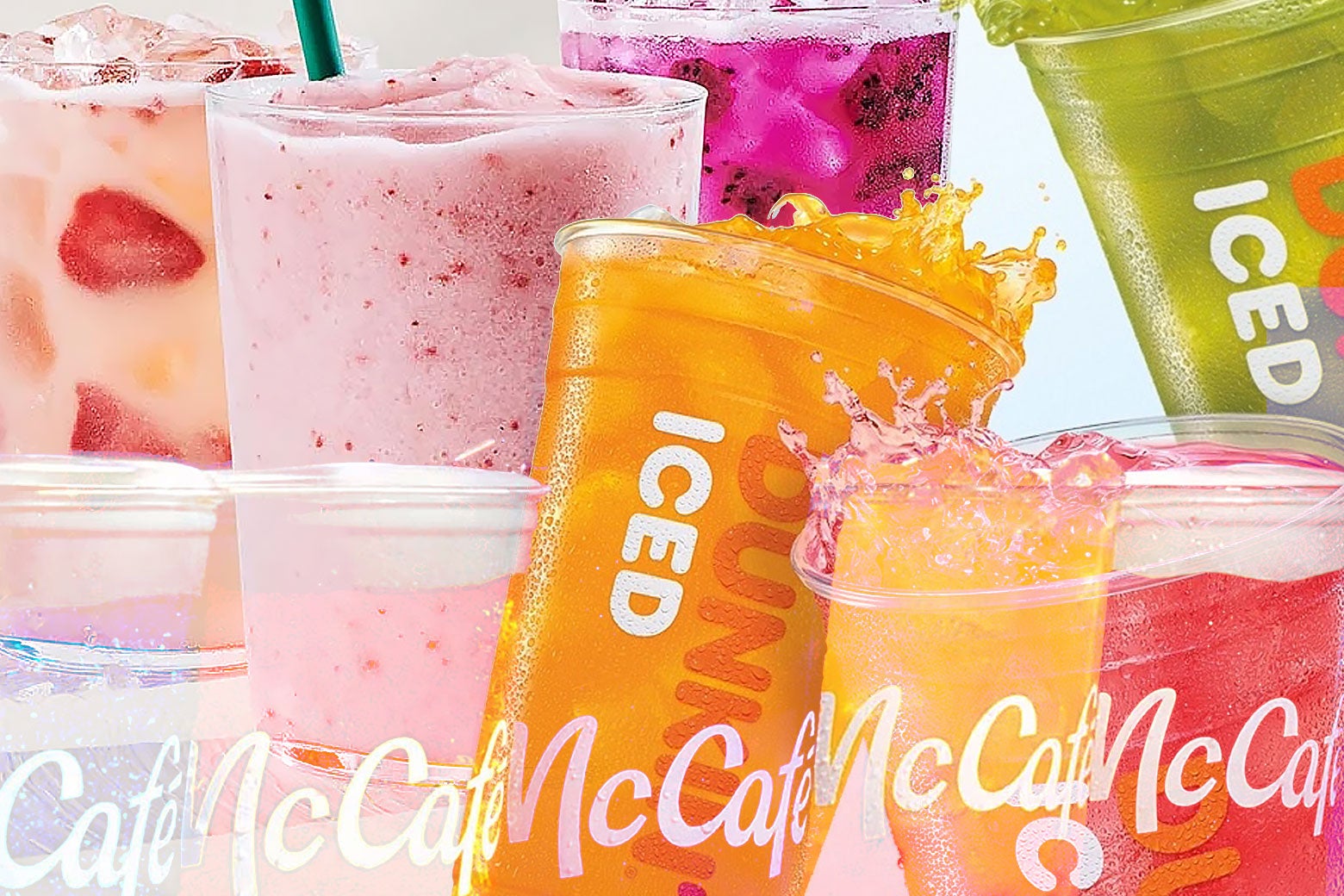
Moneybox How Refreshers Took Over the Drinks Menu America’s favorite new sweet treat is a glaring recession indicator. Photo illustration by Slate. Photos via Starbucks Coffee Company, McDonald’s and Dunkin’. Sign up for the Slatest to get the most insightful analysis, criticism, and advice out there, delivered to your inbox daily. Imagine you’re a young college graduate living in a metropolitan area in the U.S. You make less than $60,000 per year, which is considered normal for your age range, but rent is still $1,415 even though you live with a roommate. Work has also been making you stay later, ever since the company started doing layoffs, which also makes it harder for you to get your daily 10,000 steps in. When 3 in the afternoon rolls around on a particularly bad work day, you’re in desperate need of a fun sweet treat to get you out of the slump. Enter the refresher. Since Starbucks first introduced the drink category in 2012, they’ve quickly metastasized across menus, becoming the popular secret third thing for those who aren’t into the taste or price tag of coffee or matcha. Refreshers are now sold everywhere from McDonald’s to Dunkin’, the Nordstrom eBar to Panda Express. They’ve surpassed $2 billion in sales for Starbucks, as they’ve launched an ever-sprawling genre of refresher varieties: water-based, lemonade-based, coconut milk–based, chili-dusted, frozen and blended. There have been more limited-time offerings containing the word refresher in the first half of 2026 than in all of the previous years combined, and the number of refreshers hitting the market between this January and May quadrupled from the same time period last year, according to survey platform Datassential. Refreshers are kind of like pornography in that there’s no clear definition, but you know it when you see it. They usually land somewhere between a sweet tea and a lemonade, a concoction that involves several kinds of sugar-free syrup, bits of dried fruit, and sometimes a cream topping, mostly in the form of a cold foam, which is like whipped cream except made from nonfat milk. It also means that as a business strategy, refreshers can chase every single trend that comes up online with seeming ease. It’s all vibes with refreshers. Starbucks added a protein cold foam to meet the ballooning demand from wellness-pilled consumers, because for some gym bros and Pilates princesses, it’s important to make the cup of syrup you’re drinking feel like it’s doing something for you beyond simply providing joy. McDonald’s released a collaboration refresher with Red Bull, to dip a toe back into these dangerous energy-drink waters after a man died after drinking six Panera Charged Lemonades a day. They’re also always called something excruciatingly dumb. This is probably the most important characteristic of a refresher. Every refresher name, said out loud, is supposed to be a small humiliation ritual, like you’re reciting the back half of a URL slug—look at you, a grown-up, standing in public and staring at another human and letting the words “MrBeast Strawberry Açai Cannon Ball Refresher” fall out of your mouth. It’s easy to think that this is simply a child’s drink. Everyone likes to think that only tween girls are buying $8 Tropical Butterfly Lemonade Refreshers, because if something sounds ridiculous, people usually like to point at little girls as the culprit for peddling such obscenity, which is also, generally, obscene logic. It’s also untrue. A desire for something else to take the edge off—nonalcoholic, noncaffeinated drinks—is on the rise for both geriatric millennials and Gen Z consumers, as most young people dial in on the dual-pronged goals of health and affordability. When I reported on the business of Starbucks last year, analysts pointed to a major shift happening in the drinks market: concept-forward drinks are outperforming other traditional mainstays in the landscape. In a world where everyone wants to stay ahead of the truncating trend cycle, customization has become king, which makes the flavor-specificity of a refresher feel far more worth the money. Nobody wants to order mozzarella sticks anymore, they want the adventure of finding the best secret combo of mozzarella sticks dipped into various sauces in the cornucopia of a Chili’s Triple Dipper. Why have a plain drip coffee (boring, tired) when you could have a custom green tea-infused Watermelon Mango Refresher, light ice, less sugar, with extra protein cold foam (sexy, exciting)? They’re also cheap to make. It’s just syrup and nebulous amounts of whatever base. For retailers, that’s a gold mine. Gen Z spends less at quick-service restaurants than any other generation; the rising cost of living, stagnating wages, and looming desire to always be hot and cool online means that younger diners would prefer to spend more on an experience of a meal than regularly dine out at a place where the burger price is creeping up. Drinks offer a clear bridge between the desire to buy a little treat and to not spend too much in one go, the perfect recession-fueled nihilism salve. Focusing on beverages has allowed retailers to recapture audiences with an affordable luxury that’s cheaper than buying a full meal, is pretty enough to post, and brings in more consumers during off-peak hours. Axios reporter Emily Peck explained it on an episode of Slate Money earlier this year: “Fast-food restaurants are pressured right now because the cost of actual food, such as the beef, is getting more expensive, and the margins are getting tighter, but they realized instead of charging $1 or $1.99 for a soda, you can charge $5 or $6 for a Strawberry Watermelon Refresher that has freeze-dried strawberries in it.” There are other reasons why demand for refreshers has continued to rise beyond just the economic factors, to be sure. There’s been a rupture in terms of the beverage market as coffee consumption among millennials and Gen Z has declined, and as coffee has been given the same generally bad-for-you health rep as red meat—a product of yesteryear, the kind of drink you could sip while reading a newspaper in a greasy-spoon diner. In a world where influencers warn of spiked cortisol levels and disrupted circadian rhythms, plenty of consumers are turning to prebiotic sodas, sugar-free beverages, and refreshers as substitutes. To be fair, I highly doubt most refresher loyalists think they’re actually healthy, but the thing is, they feel healthier than the alternative, in the same way that the concept of “blue raspberry” feels like a real food that grows in the ground. They come with pieces of dried dragonfruit or strawberries in them (fruit mentioned), they’re often made with sugar substitutes like sucralose, and the name itself has a halo of cleanliness about it. It’s not an –ade, or a soda, mind you. It’s refreshing! It’ll refresh you! And being refreshed is healthy! Still, it’s undeniable that the outstanding number of refreshers being pushed has everything to do with a demand to meet a price-to-swag gap in the market right now—specifically, the need for a product that hits the marks of being affordable, individual swag. Everyone wants to point out recession indicators, but in a time of economic turmoil, felt most acutely by young people earning less money, every dollar counts. If you’re meeting your friends and you have to decide whether you want to get a cheeseburger meal that costs $12, which no one thinks is particularly cool, or spend $4 for a limited-edition refresher that will never come back to the menu again, it’s a fairly clear calculus. Get the refresher. Say that whole name out loud, and say it with pride. Economy Food Starbucks Drink Gen Z Restaurants
Starbucks and McDonald’s Keep Pushing These Drinks. I Have a Distressing Theory Why.
Full Article
Original Source
Read the full article at Slate →KhanList aggregates and links to publicly available news content. We do not host full articles from third-party sources. Always verify important information with original sources.