
Published Oct 18, 2026, 9:26 AM EDT Ambrose Tardive is an editor on ScreenRant's Comics team. Over the past two years, he has developed into the internet's foremost authority on The Far Side. Outside of his work for ScreenRant, Ambrose works as an Adjunct English Instructor. Sign in to your ScreenRant account Star Trek is entering an exciting new era. Unfamiliar starships, with unfamiliar crews, exploring unfamiliar parts of the galaxy, all part of the franchise's neverending quest to find the final frontier. A big part of that is doing things Trek hasn't done before, which means introducing more science fiction concepts, the kind that pop off the page in classic hard sci-fi novels, which budgetary restraints, and technological limitations, used to keep Star Trek from pulling off. But not anymore. Think back to The Original Series, which premiered 60 years ago this year. How many episodes found Kirk, Spock, McCoy, and the rest of the Enterprise crew on Earth-like planets, hiding in plain sight by dressing up in Earth-like clothes, and confronting Earth-like problems? The answer is "a lot." That was because Gene Roddenberry's show didn't have the money, the special effects, or the time to pull off a more elaborate vision of interstellar life. In spite of that, Star Trek still managed to become a pillar of modern sci-fi. Lately, Trek has been coming full circle, by embracing weirder and wilder science fiction tropes, imagery, and plotlines. That is exemplified by the first mission undertaken by the U.S.S. Endeavor, as the new series Star Trek: Zero Point launches. Their destination: a kind of planet that has never been explored, or even mentioned, in franchise canon before. Warning! Spoilers ahead for Star Trek: Zero Point #1! Star Trek Boldly Goes To A Brand New Kind Of Planet For The First Time In Franchise History An "eyeball planet." That's where Captain Musiker is taking the U.S.S. Endeavor in the first issue of IDW Publishing's new Star Trek: Zero Point comic series. Fans who watched Picard already know Musiker, who was portrayed by Michelle Hurd on screen in the TV show. She anchors the new book, which is full of debuting characters, and more crucially, expansive ideas about the future of the Trek universe. "We're attempting something that has never been done before," Musiker tells her crew before the Endeavor plunges through the icy surface of the world, identified as Merexes III in Zero Point #1. Of course, this echoes the "where no one has gone before" part of Star Trek's iconic opening monologue. The "eyeball planet" is so-called because that is what it looks like from space, to outside observers. Yet the real thrilling thing about this new type of world Trek is exploring is what lurks under the surface. The "eyeball" visual, as explained in "Exoplanetary Survey Notes," compiled by the Endeavor's Science Officer and included in Zero Point #1, is the result of Merexes III being "coated with thick ice except for a small liquid circle where the planet is closest to the sun." According to the same burst of exposition, Starfleet has surveyed, and even lightly mined, eyeball planets before, but no one has ever explored under the surface. Giving Trek a brilliant new kind of frontier to explore. The Star Trek Franchise Is Finally Warping Into The Future With IDW's Innovative Comics In Star Trek: Zero Point #1, the U.S.S. Endeavor spectacularly dives through the "iris" of Merexes III in order to find out what is below the ice. This puts a ticking clock of twelve hours on the mission, because the ship's hull is "built to protect against the vacuum" of space, rather than "tonnes of water pressure on a high gravity world." This is the kind of sci-fi location that early Trek couldn't put off, and later Star Trek rarely ventured to try. And without too much away, like the eyeball planet itself, there is more to the Endeavor's mission to Merexes III than meets the eye, greater dangers lurking beneath the surface than the crew are ready for. Whatever Zero Point's protagonists uncover, and whatever the truth of their assignment turns out to be, the introduction of "eyeball planets" to Trek lore is a turning point. This is the kind of sci-fi location that early Trek couldn't put off, and later Star Trek rarely ventured to try. But now the franchise is ready to find new frontiers to warp to, a vital upgrade that fans should be excited to engage with. Star Trek: Zero Point #1 is available now from IDW Publishing. TV Show(s) Star Trek: The Original Series, Star Trek: The Animated Series, Star Trek: The Next Generation, Star Trek: Deep Space Nine, Star Trek: Voyager, Star Trek: Enterprise, Star Trek: Discovery, Star Trek: Short Treks, Star Trek: Picard, Star Trek Lower Decks, Star Trek: Prodigy, Star Trek: Strange New Worlds, Star Trek: Starfleet Academy Video Game(s) Star Trek Online, Star Trek: Resurgence, Star Trek: Bridge Crew First Film Star Trek: The Motion Picture First TV Show Star Trek: The Original Series Cast William Shatner, Leonard Nimoy, George Takei, Nichelle Nichols, Deforest Kelley, James Doohan, Walter Koenig, Jonathan Frakes, Patrick Stewart, Michael Dorn, Marina Sirtis, Gates McFadden, Brent Spiner, LeVar Burton, Wil Wheaton, Avery Brooks, Nana Visitor, Rene Auberjonois, Alexander Siddig, Cirroc Lofton, Armin Shimerman, Colm Meaney, Terry Farrell, Kate Mulgrew, Robert Beltran, Roxann Dawson, Jeri Ryan, Robert Duncan McNeill, Robert Picardo, Ethan Phillips, Garrett Wang, Jolene Blalock, Connor Trinneer, Dominic Keating, Scott Bakula, Linda Park, John Billingsley, Anthony Montgomery, Chris Pine, Zachary Quinto, Simon Pegg, Zoe Saldana, Karl Urban, John Cho, Chris Hemsworth, Benedict Cumberbatch, Anton Yelchin, Idris Elba, Sonequa Martin-Green, Mary Wiseman, Doug Jones, Anthony Rapp, Wilson Cruz, Oyin Oladejo, Emily Coutts, Jess Bush, Christina Chong, Anson Mount, Ethan Peck, Rebecca Romijn, Michelle Yeoh Created by Gene Roddenberry
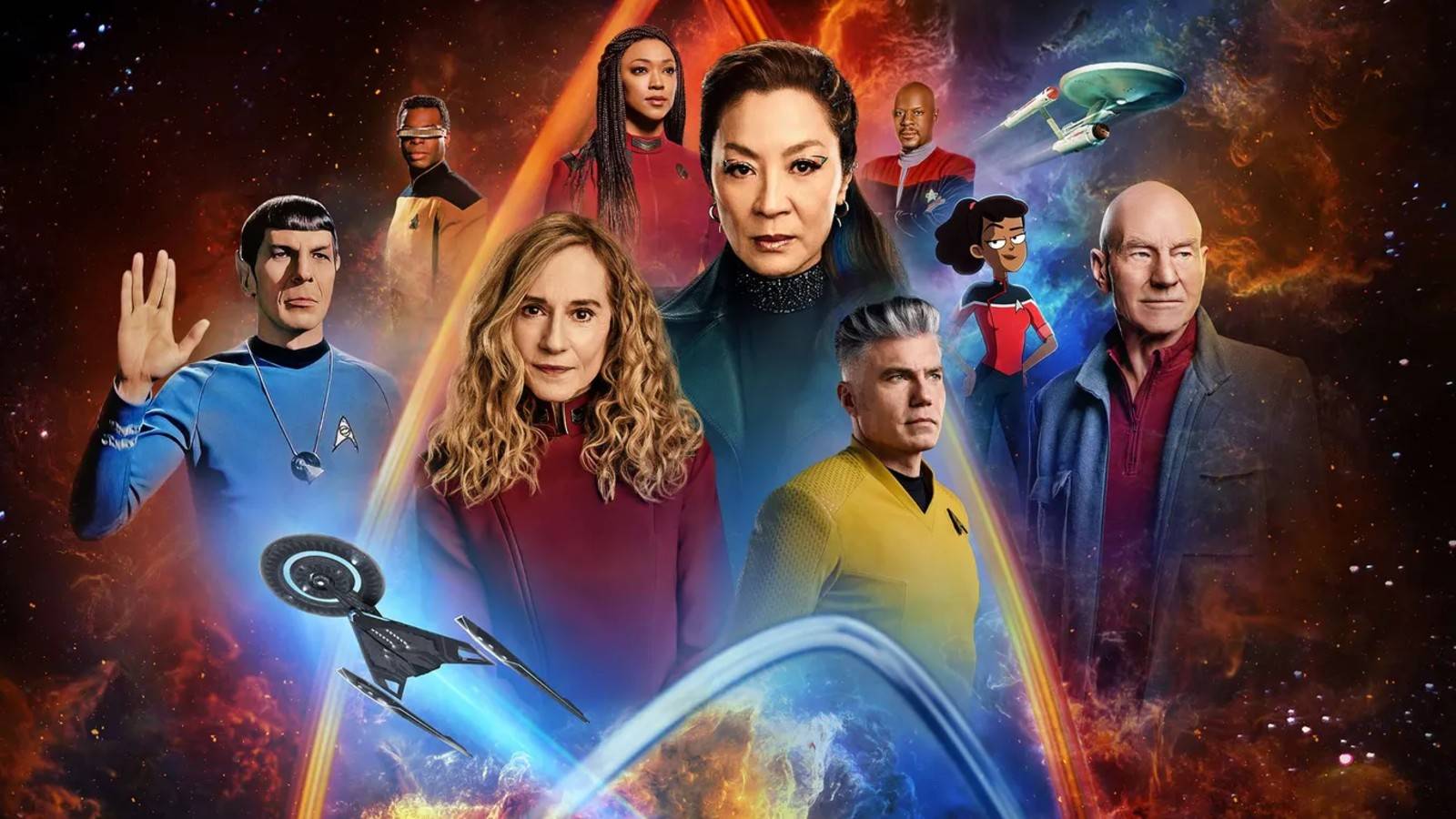
Star Trek Officially Announces The Franchise's New Frontier
Full Article
Original Source
Read the full article at Screenrant →KhanList aggregates and links to publicly available news content. We do not host full articles from third-party sources. Always verify important information with original sources.