
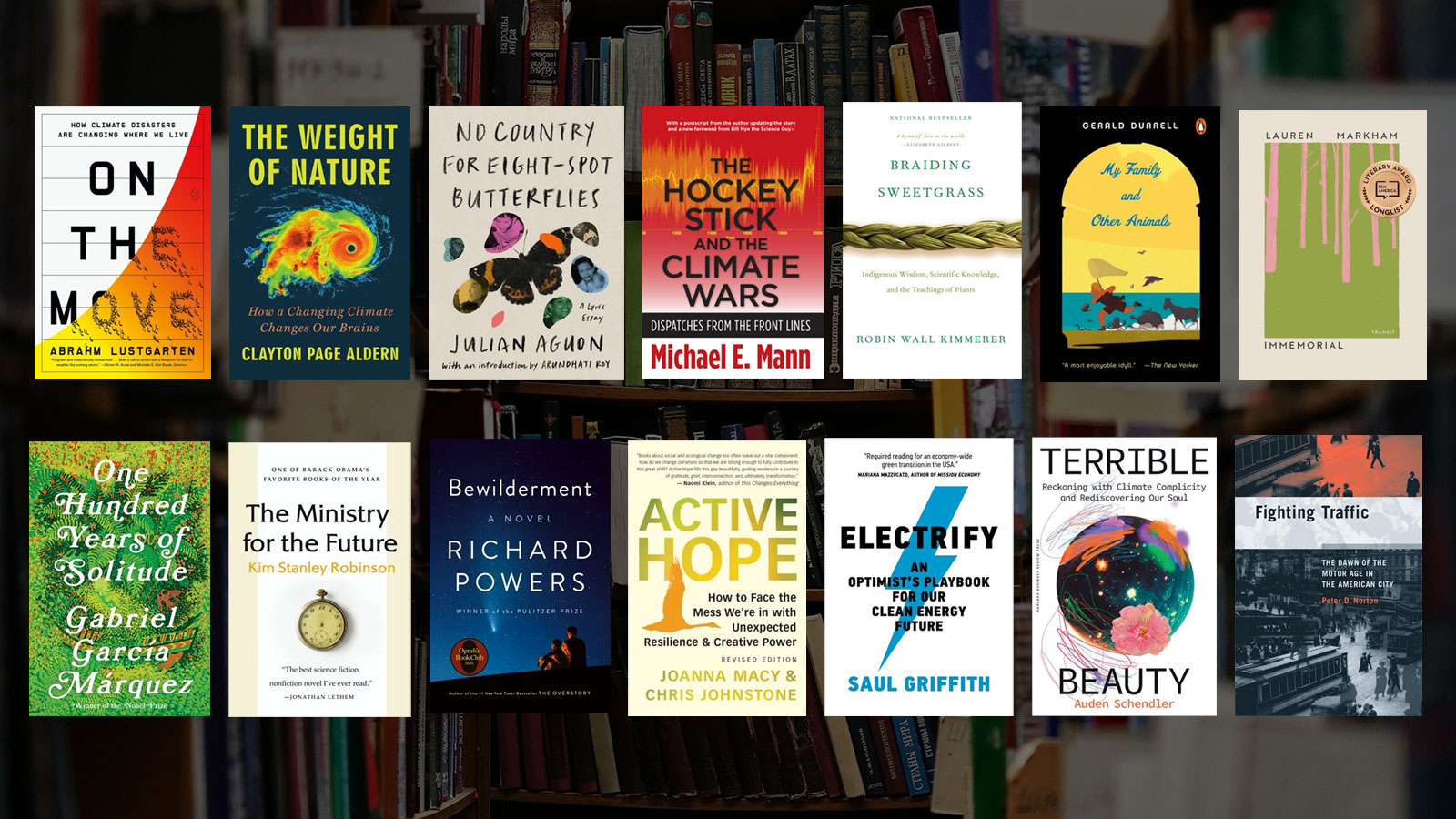
(Image credit: Olena Bohovyk / Unsplash) Want to learn more about climate change and how you can be part of the solution? Look no further than these books recommended by Yale Climate Connections journalists. These are the fiction and nonfiction titles that got us interested in climate change and showed us new ways of thinking about the problem. I hope they do the same for you. – Editor-in-Chief Sara Peach P.S. If you purchase a book through one of the links on this page, a percentage of the proceeds funds independent bookstores and our journalism. On the Move by Abrahm Lustgarten If you’re looking for a book that can help inform your personal choices on how to prepare for the future of climate change in the U.S., Lustgarten’s book is the best one I’ve seen yet. – Meteorologist Dr. Jeff Masters The Weight of Nature by Clayton Page Aldern I recommend this book because it challenges the idea that climate change is simply something happening “out there.” It shows how a changing environment can also reshape the brains and minds in ways we’ve never thought about. – Sanket Jain No Country for Eight-spot Butterflies by Julian Aguon This book is not your ordinary climate book because the author grounds the climate crisis in histories of colonialism, militarization, and Indigenous rights, ultimately revealing how frontline Pacific islands are treated as disposable sacrifice zones. – Rachel Ramirez The Hockey Stick and the Climate Wars by Michael E. Mann Climate scientist Michael E. Mann takes readers down the rabbit hole of climate denial and vividly describes the political weapons wielded by its fossil-fuel-funded practitioners. – Books Editor Michael Svoboda Braiding Sweetgrass by Robin Wall Kimmerer While this book is not tackling climate change specifically, it presents a radically different way of regarding and relating to the natural world. Through beautiful, poetic prose and vignettes, Kimmerer proposes an entirely unique worldview that combines her identity as a member of Potawatomi Nation in the U.S. and her expertise as a trained botanist. All of it continuously inspires me to move through this delicate, beautiful planet with deep care, mindfulness, and respect for every ecosystem. – Tree Meinch My Family and Other Animals by Gerald Durrell I read Gerald Durrell’s My Family and Other Animals when I was young. His line, “Gradually the magic of the island settled over us as gently and clingingly as pollen,” captures how the book awakened my love of animals and the natural world. – Johani Ponce One Hundred Years of Solitude by Gabriel García Márquez Like many students in Latin America, I read One Hundred Years of Solitude in high school. “It rained for four years, eleven months, and two days.” That unforgettable image showed me how an environmental extreme can transform a landscape, disrupt everyday life, and become part of a community’s collective memory. – Johani Ponce The Ministry for the Future by Kim Stanley Robinson Both harrowing (especially at the start) and intriguing. Based convincingly on realistic science, this novel offers a range of challenging but hopeful possible moves in a future with enough people getting a real grip on the problem. The longest book I’ve read in years, yet I keep thinking about rereading it. – SueEllen Campbell Bewilderment by Richard Powers This book is a heartbreaking and gorgeous story on grief, parenthood, and climate anxiety. It opened my world as to what climate fiction can look like — and the role that our imaginations and hearts must play as we work toward that future we want. It was so sad but so good!!!! – Yessenia Funes Active Hope (Revised) by Joanna Macy and Chris Johnstone My eternal go-to is Active Hope: How to Face the Mess We’re in with Unexpected Resilience & Creative Power by Joanna Macy and Chris Johnstone. It continues to help me make sense of the enormous scale of the challenges we face due to climate change while also tending to emotions and pointing toward tangible action. – Sam Harrington Electrify by Saul Griffith Saul Griffith showed me how I can zero out my house’s carbon footprint by gradually replacing dirty appliances with cleaner versions. I followed his plan, and today I live in a comfortable, affordable, fossil-fuel-free house powered by the sun. This book shows how to make that lifestyle possible for everyone. – Sara Peach Terrible Beauty by Auden Schendler This book rejects the common premise of “corporate carbon neutrality” and replaces it with more pointed – and more effective – strategies. My favorite section talks about “asymmetric warfare,” which is how small companies and groups can have outsized impacts if they choose to wield their influence for maximum effect. It’s an informal, refreshing, and powerful read. – Karin Kirk Fighting Traffic by Peter D. Norton Not a climate book per se, but an incredibly illuminating history of how cars came to dominate American cities, making transportation the nation’s largest source of emissions. – Sarah Wesseler Immemorial by Lauren Markham It’s a beautiful essay on seeking language to make sense of our changing surroundings due to the climate crisis and to grasp the moments that show us that it is possible to change for the better. – Luis Alexis Rodríguez-Cruz Republish our articles for free, online or in print, under a Creative Commons license. Sara Peach is the editor-in-chief of Yale Climate Connections. She is an environmental journalist whose work has appeared in National Geographic, Scientific American, Environmental Health News, Grist,... More by Sara Peach
Staff picks: Our favorite climate books
Full Article
Original Source
Read the full article at Yaleclimateconnections →KhanList aggregates and links to publicly available news content. We do not host full articles from third-party sources. Always verify important information with original sources.