
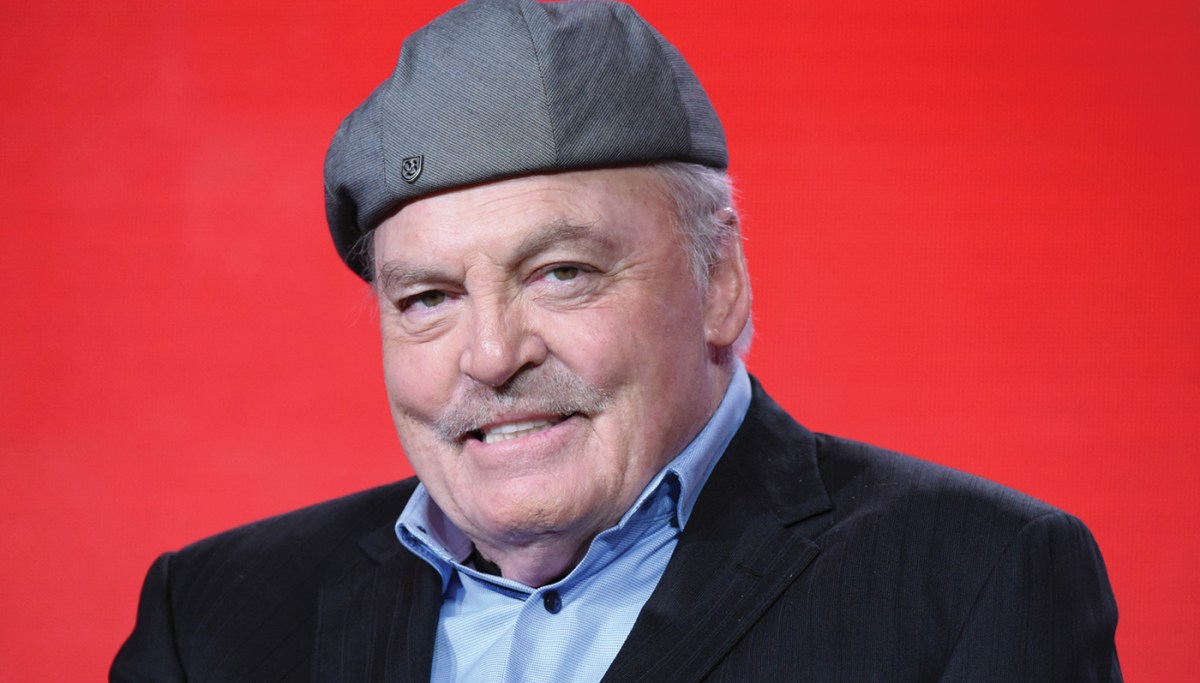
The actor who could make you believe he was both the Prince of Denmark and the toughest private eye in New York also possessed the voice that could convince you a cartoon brewery owner was the most important man in Springfield. Stacy Keach, who died Nov. 10 at the age of 85, spent more than six decades demonstrating that taking a wide variety of roles — from the classical stage to the most commercial corners of film and television — is not a compromise but a vocation.Born Walter Stacy Keach Jr. in Savannah, Georgia, on June 2, 1941, he arrived with a cleft lip and palate. Multiple childhood surgeries followed. The mustache that later became his trademark concealed the scars. The family settled in California, where he graduated from Van Nuys High School as class president in 1959. He then assembled credentials with the thoroughness of someone preparing for every possible assignment: dual bachelor’s degrees in English and dramatic art from the University of California, Berkeley, a master’s from the Yale School of Drama, and a Fulbright year at the London Academy of Music and Dramatic Art, where he encountered Laurence Olivier.On stage he advanced rapidly and earned the kind of notices that set high expectations. His performance in the Off-Broadway political satire MacBird! earned an Obie and a Drama Desk Award. On Broadway, his Buffalo Bill in Arthur Kopit’s Indians brought a Tony nomination. Critics ranked his Hamlet at the New York Shakespeare Festival among the finest of his generation, with one comparing him to John Barrymore. He played Falstaff, Richard III, and, later in his career, a blistering King Lear at the Goodman Theatre in Chicago that drew strong reviews for its modern ferocity. He returned to classical roles across decades, including a touring production of Frost/Nixon. Theater, he observed, “pays the soul, but it doesn’t pay the rent.” Stacy Keach in Pasadena, Calif., in 2016. (Richard Shotwell/Invision/AP) Film and television paid the rent, and he treated both with the same seriousness he brought to Shakespeare. Early screen work included The Heart Is a Lonely Hunter and John Huston’s Fat City, in which his portrayal of a washed-up boxer named Billy Tully drew strong notice for its weary authenticity. He co-wrote, co-produced, and co-starred with his brother James in The Long Riders, playing Frank James opposite the Carradine and Quaid brothers as the other outlaws. He played a determined narcotics officer opposite Cheech and Chong in Up in Smoke and Nice Dreams, parts that showed he had no desire to remain aloof from popular fare. On television, he became Mike Hammer, Mickey Spillane’s hard-boiled detective, across movies and series that made him widely known and earned a Golden Globe nomination. He won the Golden Globe itself for portraying Ernest Hemingway in a miniseries, for which he gained 35 pounds. Later roles included the principled warden in Prison Break, the abrasive father in the sitcom Titus, a recurring presence on Blue Bloods, and the narrator of American Greed.A 1984 arrest at Heathrow for attempting to smuggle cocaine into Britain resulted in six months in Reading Prison. The interruption might have finished many careers. Keach returned and continued. In his memoir, he described the practical reality with plain candor: show business is glamorous for the tiny few stars at the top. All of the rest, including the vast majority of other actors, have a work-life that’s not too different from the rest of us. Keach, in that way, was very much like one of us. He took the work where and when he could, and was almost always grateful for it. His life as a working actor led to a filmography that eventually surpassed 180 screen credits (for comparison’s sake, his contemporary Al Pacino has only 78), running from Shakespeare to stoner comedy to westerns to prestige drama such as American History X, Nebraska, and The Bourne Legacy. The readiness to accept what was offered kept him employed across generations and kept him approachable. Viewers rarely sensed that he regarded any assignment as beneath his talent. That lack of pretension became part of his appeal. Audiences recognized an actor who simply wanted to work.PATRICK STEWART, 1940-2026That same voice later found a natural setting on The Simpsons. My personal favorites of his performances were his guest appearances as Howard K. Duff VIII, the commanding owner of the Duff Brewery, across several episodes. Hearing him, you recognized a perfect fit for the show’s particular mixture of theatricality and absurdity. He could have been a regular cast member, another Hank Azaria-type who could voice a whole constellation of zany characters. Had he pursued it, he could have built a second career as one of the great voice actors.Keach wrote that in most cases he enjoyed the role he was playing and learned something about himself in the process. Big stars get to be choosy, he said. The rest of us get out there and hustle. Keach hustled for six decades. The rest of us —we who enjoy movies, TV, theater, and The Simpsons—were the beneficiaries.Daniel Ross Goodman (@DanRossGoodman) is a Washington Examiner contributing writer and teaches theology and religious studies at St. John’s University. His latest book, Dante’s Guide to Life: How The Divine Comedy Can Change Our Fortunes, Our World, and Ourselves, was published this fall.
Stacy Keach, 1941-2026
Full Article
Original Source
Read the full article at Washingtonexaminer →KhanList aggregates and links to publicly available news content. We do not host full articles from third-party sources. Always verify important information with original sources.