
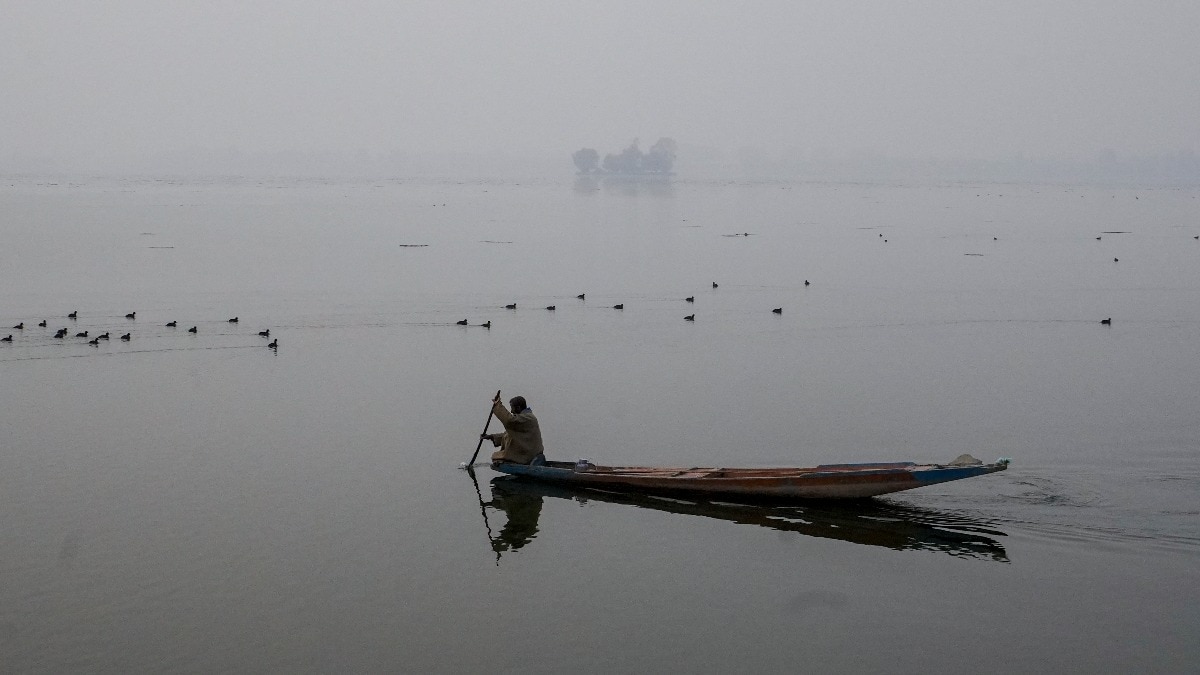
Srinagar, known for its lakes, mountains and relatively clean Himalayan air, is witnessing a prolonged spell of severe air pollution as winter sets in.The city’s Air Quality Index (AQI) stood at 487 at 10:30 am on November 27, making it the ninth most polluted city in the world, as per data from AQI.in.The situation has been particularly concerning over the past week. A vendor rows a boat laden with flowers across the Dal Lake on a cold day, in Srinagar. (Photo: PTI) The AQI in Kashmir's capital climbed to 626 around 10:30 pm on November 26, its highest reading in both the preceding 24 hours and the past seven days. Furthermore, the city’s AQI has remained above 400 since November 21, with even its lowest reading during this period touching 433. Most see this development as bizarre, as Srinagar has never been remotely near the pollution conversation, but is now facing pollution worse than India's largest cities.Naturally, the obvious question arises about what's behind it. WHY IS SRINAGAR SO POLLUTED?Located in the Kashmir Valley and surrounded by mountains, Srinagar can experience limited air movement under certain meteorological conditions.When winds are weak, pollutants released by vehicles, household heating and other sources can remain trapped close to the ground.A major factor behind winter pollution is temperature inversion, a phenomenon that prevents the normal movement of air.During cold nights, the ground loses heat rapidly, cooling the air closest to the surface. When a layer of warmer air settles above it, it acts like a lid, restricting vertical movement and trapping pollutants near the ground. A man rides a bicycle as a vendor burns trash on a cold morning in Srinagar. (Photo: AP) A scientific study also found that low temperatures, weak winds and a shallow atmospheric mixing layer aggravate particulate pollution in Srinagar, particularly between November and January.VEHICLES AND HEATING ADD TO POLLUTIONWeather conditions explain why pollution accumulates, but local emissions determine how much pollution enters the atmosphere.The Central Pollution Control Board’s (CPCB) action plan for Srinagar identifies vehicular emissions as a major contributor to the city’s pollution. Mountains are covered with fog early morning in Kashmir. (Photo: AP) Road dust, construction activities, traffic congestion, diesel generators and the burning of biomass and municipal waste also add to the problem.Winter heating further compounds the situation. As temperatures fall, households increasingly depend on fuel-burning heating arrangements, releasing particulate matter into the air.The absence of rain or snowfall can make matters worse.Precipitation helps remove suspended particles from the atmosphere. Without it, and with weak winds limiting dispersion, pollutants can continue accumulating close to the ground.Srinagar’s worsening air quality is therefore the result of local emissions meeting unfavourable atmospheric conditions, turning the valley’s geographical setting into a disadvantage.And it's yet another instance that illustrates that air pollution is increasingly becoming a national problem.- Ends
Srinagar becomes world's 9th most polluted city as AQI hits 487. What's happening?
Full Article
Original Source
Read the full article at Indiatoday →KhanList aggregates and links to publicly available news content. We do not host full articles from third-party sources. Always verify important information with original sources.