
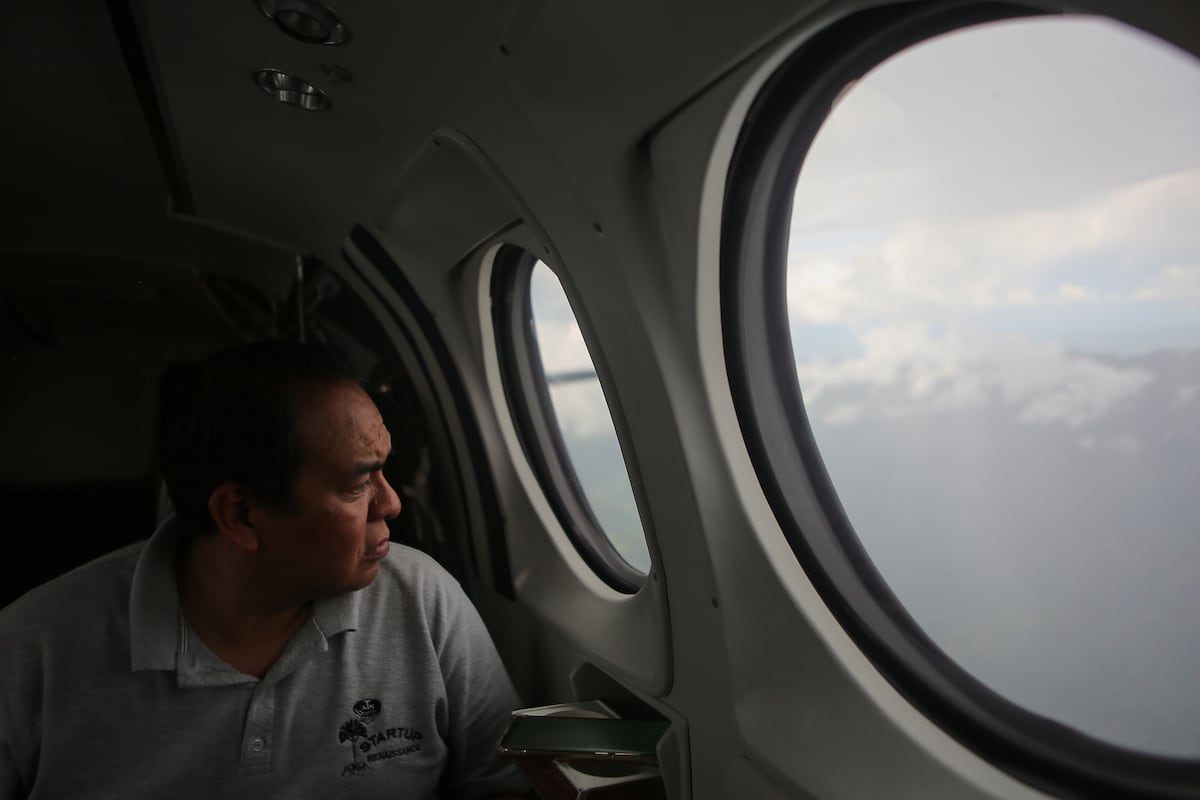
The rivers near the capital look brown from an altitude of 3,600 meters. It rained lightly in Honduras a week ago, and some of the murky water is returning to the Humaya river, one of many parched streams that 20 years ago did not show such arid scenes. Aboard the King Air C90, Víctor Torres, a Mexican pilot and member of Startup Renaissance, enlarges a patch of dark clouds near Comayagua on the screen and receives a clear instruction from the meteorologist on the ground: a dart-in-a-bullseye emoji. “Hold on,” he warns.Juan Carlos Diaz quickly opens two valves on a tank containing 1,000 liters of silver iodide and another one with air, and writes the exact coordinates in his notebook. The liquid begins to spray from the tail of the aircraft. The pilots start the camera; they know the turbulence is starting. The small plane spends two minutes crossing back and forth, as if trying to envelop the cloud. “Save 10%. It has to reach the south,” Torres shouts from the cockpit. Thirteen minutes later, thousands of droplets streak the windows. The crew smile in triumph. “My daughter thinks I’m like a superhero and that I make it rain,” he says with a laugh. “I’ve explained a thousand times that what we do is science, but I let her believe whatever she wants.”Cloud seeding, or cloud stimulation, has been practiced for about 70 years. The technique mimics the natural process by which rain forms but seeks to amplify its intensity. The silver iodide particles released by these retired military personnel act as condensation nuclei that, depending on humidity, temperature, motion and water vapor, reach the point of precipitation immediately or a few minutes later. The problem, both explain, is that without developing clouds — such as cumulonimbus or congestus cumulus — there would be nothing to do. “They are our raw material. On a summer day with bright sun, no science will work,” Torres concludes.The tool, as they describe informally, “squeezes” the water the cloud holds “and a little more.” While both predict a 40% to 60% increase in rainfall as a result of their interventions, international bodies are more cautious. Spain’s State Meteorological Agency (Aemet) estimates the impact of such flights at 5–10% more rain, while the U.S. Government Accountability Office (GAO) estimates between 0% and 20%. The World Meteorological Organization (WMO), however, does not provide a percentage and stresses that this remains an active area of scientific research that is difficult to replicate in other territories.“Each project must be designed, executed and evaluated rigorously, with independent reviews and careful analysis of the expected benefits,” says Rodney Martínez, the WMO representative for North America, Central America and the Caribbean. So far, no environmental or human health damage from the use of silver iodide is known, but possible unintended effects on water impact or other ecological harms, such as uncontrolled flooding, cannot yet be ruled out, he says.There are two points on which the entire scientific community agrees: that it can produce nearly immediate precipitation under very specific environmental conditions, and that it will never be enough to reverse a drought like the one Honduras faces today. Much less in the times of the El Niño phenomenon, which has disrupted climate patterns in the country. Although some neighborhoods have been flooded by heavy rains— according to Tegucigalpa’s mayor, 80% of what fell last year fell in the last month — others have gone months pleading with the sky for any shower. By excess or by lack of water, Honduras has 5.6 million people, practically half its population, under some type of alert, including 103 municipalities in the red category.In the Dry Corridor, a strip with a long history of water scarcity that also crosses Guatemala, El Salvador and Nicaragua, thousands of farming families have stopped putting three meals a day on their table because they have not harvested anything for 11 months. Since August, the City of Tegucigalpa has been forced to ration water. Each citizen receives water — if they’re lucky — every nine days and only for about three or four hours. When EL PAÍS visited Honduras, it was every 14 days. Although it is not the first time Hondurans collect rainwater, the scenes are becoming more common: buckets, bottles and pots stacked in yards and pipes connecting roofs to sinks in case the sky gives any respite.The worst outburst of El Niño“It’s a bandage for a fracture, we know,” Torres says from his copilot’s seat. “It’s our small contribution to everything happening in the country. I’d rather do that than do nothing.” According to the WMO, the El Niño phenomenon will continue to intensify over the coming months and could peak in December, becoming one of the most intense episodes on record. There is more than a 75% probability that, between October and December, it will reach a magnitude greater than any episode observed since 1950.Days after shutting off the taps in the capital, the Secretariat of Agriculture and Livestock (SAG) contracted the services of Mexican company Startup Renaissance, which has already operated in Chile and Mexico under similar situations, and rented a small plane for the job. In total, it has cost $700,000, a figure they are considering increasing. Moisés Abraham Molina Guillén, Honduras’ secretary of state for SAG, insists this is one of multiple measures the government is carrying out, such as drilling wells “at full speed” or distributing seeds exclusively to farmers in territories “where the rainfall forecast is adequate.” The official called the seeding results “very laudable” and told EL PAÍS that “where 20 millimeters were forecast, we recorded 80 and 100.”This initiative, which aims to benefit the 2.3 million hectares affected in the country, has been as applauded as it has been criticized. For sugar producers — who contributed one-sixth of the investment — the stimulation is a relief for their battered crops. Citizens more skeptical of the government raise an eyebrow when recent rains are linked to the state effort. Still, everyone crosses their fingers that it works. Today, a small plane that once transported celebrities is the hope of a whole country ranked among those most exposed to El Niño, according to CEPAL.‘I don’t want luxuries. Just water and food’Seconds after the first drops fall, she jumps to her feet. She turns over the pots she had on the floor, grabs empty paint buckets, soda bottles — “everything works” — and rushes out to the terrace of her rundown house. Then she stops short. She just remembered that her grandson installed a pipe system that collects rainwater more easily. Suyapa Alvarenga, 71, has spent her life sharpening her ear to detect a downpour and to begin a handmade, constant ritual.Although now somewhat more mechanized, she stands by the blue barrel and waits patiently for it to fill. She looks at the container like a slot machine dispensing coins. “I don’t want luxuries. Just water and food. With that you’re richer than rich,” she declares. Doña Suyapa does not know what it is to turn on a tap and have water. She says rationing is not new in a neighborhood like the one where she was raised: Nueva Suyapa. In this working-class community of 5,000 people, residents have for decades bought water or received state water once or twice a week. Climate change and El Niño have stretched those periods to the point of being unlivable. The last time this domestic worker washed dishes with cistern water was in August.Alvarenga’s reality was the daily life of the country’s poorest classes, those who settled informally on hillsides or in squatter neighborhoods. Today, even the better-off classes would not have water in their taps if they could not pay for private water trucks or have a full cistern system at home. Showering with a basin and reusing dirty water for the toilet is the new normal for Honduras’ middle class.This decision responds to the very low water reserves in the Los Laureles and La Concepción reservoirs, which are part of Tegucigalpa and Comayagüela’s supply system. Recently, improvements were recorded that reduced the days without water from 14 to nine. The day water arrives is a celebration. Any concave object becomes useful.José Velázquez, 38, refreshes Facebook constantly. He does it to update the page where the Water Board posts water turns sector by sector. His turn was supposed to come on Friday; he didn’t go to work and spent the day turning his tap back and forth with the same desperation with which he checks the social network. Not until Tuesday could he indulge in that small luxury, which he admits he’s embarrassed to share. “I took a long shower,” he admits. “I needed to feel some normality; it had been a long time since I allowed myself that privilege.” Washing the car is considered wasteful and condemned by neighbors. “It’s absurd to live like this. We’re experts at economizing, but how much worse is this going to get?” he asks.Gather buckets and clean them. Stay home when the water finally arrives, don’t forget to buy bleach for rainwater. Make sure the children don’t pull from the cistern, don’t go on holiday in case a downpour falls... Velázquez admits he’s exhausted. Solving things that should be basic has become his second job. His first, driving for Uber, does not even earn him the minimum wage. Even so, he manages to stretch it far enough to feed his three children and his pregnant wifeFor months he hadn’t asked himself the question again: What if I go to the United States? Precarity is forcing him to imagine that idea again. “Life is getting increasingly complicated,” he says from his living room. The man lets out one sigh after another. “Before, people left because of gangs, because they couldn’t find work. But we’ll end up leaving because of this crazy climate,” he predicts.Sign up for our weekly newsletter to get more English-language news coverage from EL PAÍS USA Edition
Squeezing the clouds: Aboard the small plane making it rain in drought-stricken Honduras
Full Article
Original Source
Read the full article at English →KhanList aggregates and links to publicly available news content. We do not host full articles from third-party sources. Always verify important information with original sources.