
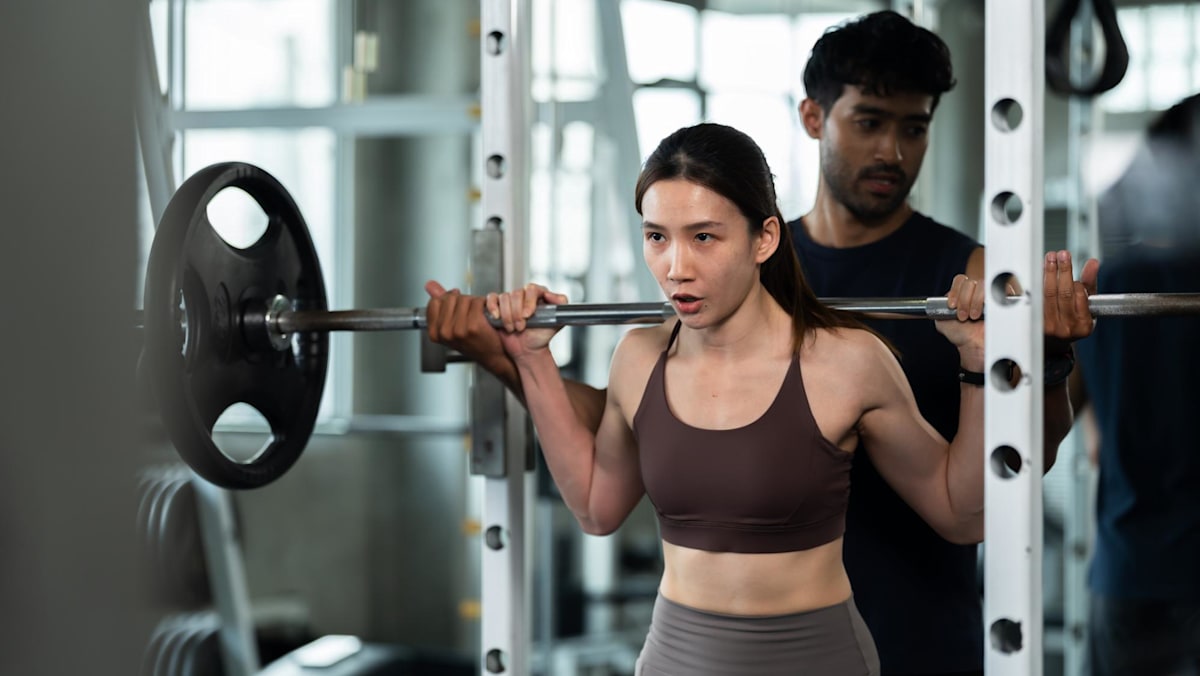
They say when life gives you lemons, make lemonade. And looking at what female athletes have accomplished throughout sports history, women have been squeezing hard – despite sometimes having to make do with equipment and exercises not designed for their proportions.You needn’t have studied biology to notice that women generally have narrower shoulders, wider hips and lower physical strength than men – all of which affect their performance.What’s less apparent is that women also tend to have a higher proportion of slow-twitch muscle fibres than fast-twitch ones, said Dr Ong Joo Haw, a sports physician from Mount Elizabeth Hospital.Both types of muscle fibres are important. Slow-twitch muscle fibres provide continuous, fatigue-resistant energy for endurance activities such as cycling or brisk walking. Fast-twitch muscle fibres are what power short, explosive bursts of speed and strength. (Photo: iStock/pixdeluxe) The rub is, women tend to prefer endurance-type exercises, which explains why you often see them dominating the treadmills and rowing machines in the gym. That’s where they might have missed the opportunity to make lemonade, or work on their fast-twitch muscle fibres – important with age as sarcopenia, age-related muscle loss, hits fast-twitch muscles harder and faster than their slow-twitch cousins.In strength training, fast-twitch muscle fibres “only get properly challenged through lower-rep, high-intensity training”, said Dr Luqman Haris, Catalyst Performance’s co-founder, who also heads the gym’s Training System & Education.Think of exercise like driving a car; when cruising at an even speed, it is kept moving by the slow-twitch fibres. To activate the fast-twitch muscle fibres, you'll have to shift to a higher gear, that is, work harder with heavier weights. Think under eight reps to failure or explosive movements, said Dr Luqman, to make sure the fast-twitch fibres are getting challenged, too.The good news is, while women “have lower absolute and relative strength”, added Dr Ong, “they can tolerate higher training volumes with shorter inter-set rest periods”. So, while the average male gym-goer is still panting from his set, she is already picking up the dumbbells.WHY YOUR KNEES HURT MORE – AND WHY YOU STRUGGLE WITH PUSH-UPSMore not-so-good news. Women are known to have laxer ligaments than men – especially at certain points of their monthly cycles, said Dr Ong. If you’re wondering when, it’s during the luteal phase just before the period begins when hormones such as oestrogen and progesterone peak.Flexibility may sound great for yoga but not so for the ligaments and joints. Ligaments are like seatbelts for the joints. When loose, the ligaments can’t stop the joints from moving beyond their normal ranges – and that places extra stress on the cartilage and tendons. In the knee, for example, an excessively loose anterior cruciate ligament (ACL) would allow the shinbone to slide more easily during a squat, putting direct stress on the ACL, said Dr Ong.Anatomical differences may also pose unique challenges to women that men don’t have to contend with. Take push-ups, for example. Many women lack the upper body strength to push their bodies off the floor – or do they? A trending “hack” on social media (see post below) is changing that notion; the carry angle may play a role. The carry angle is “where the forearm and upper arm connect at the elbow, relative to the pelvis”, explained Professor Adam Taylor, a professor of anatomy at Lancaster University. In men, that angle is around 10 degrees but in women, it is about 15 degrees to allow their arms to swing without hitting the pelvis when they walk, he wrote in The Conversation.“The carry angle doesn’t just impact how the bones of the upper limb connect to each other and to the torso. It also affects the direction in which the muscles contract,” wrote Prof Taylor. “By having the hands slightly further apart and turning them slightly outwards, it allows a woman’s muscles and bones to follow their more natural movement patterns.”That being said, you'll still need some degree of upper-body strength to perform the tweaked push-up.FROZEN SHOULDER AND MENOPAUSEMiddle age and menopause add another layer of challenge to women trying to stay on their fitness journeys. The two can collide to create frozen shoulder or adhesive capsulitis in the 40s and 50s, said Dr Ong.It is a source of pain, stiffness and a severely limited range of motion in the shoulder joint with many patients being unable to raise their arms above their heads. “Frozen shoulder is a frequently seen shoulder issue in women,” said Dr Ong.According to a 2025 article, declining oestrogen levels may play a key role. The hormone has anti-inflammatory effects and prevents tissue thickening. When oestrogen levels drop during perimenopause and menopause, this protection weakens and contributes to the shoulder capsule stiffening.Although hormonal imbalances are thought to be a cause, diabetes, thyroid disorders and parkinsonism (a group of movement symptoms similar to those seen in Parkinson's disease) are other common risk factors, said Dr Ong. “Frozen shoulder often runs its course between one and two years.”Mobility exercises can help to manage it, said Dr Ong, including active, passive or assisted exercises like pendulum swings, wall walks, doorway stretches and towel-assisted stretches.You can even continue strength training with limited shoulder mobility. In fact, strengthening exercises are important, said Dr Ong. (Photo: iStock/Pony Wang) As movements that raise the arms above the shoulder level often create pain, perform upper-body exercises within the pain-free range of motion, he said. “This will usually mean keeping the elbows below the level of the shoulder for most movements.”Include exercises with external and internal shoulder rotations. “For example, replace overhead presses with high incline presses, or isolate the side and rear deltoids with lateral raises and reverse flys,” he advised.LOVE A GOOD SQUAT? GET IT RIGHTWhether it’s done with a dumbbell, barbell or just your bodyweight, the squat is a common exercise favoured by many women in the gym. And why not? Squats recruit the largest and most powerful muscles in the body – the quadriceps, hamstrings, glutes and calves – for a bigger calorie burn and for building that shapely rear that women yearn for.But if, of late, you’ve been experiencing knee and/or back pain, or it feels like you’re running out of steam each time you push out a rep, there may be a few things to take note of, according to Dr Luqman. Dr Luqman Haris, co-founder and head of Training System & Education at Catalyst Performance. (Photo: CNA/Khoo Bee Khim) Knee valgusDo your knees point or collapse inwards as you squat? That’s known as knee valgus, which is a misaligned movement pattern. Simply having wider hips can contribute to knee valgus. Women’s hips create a bigger quadriceps angle (Q angle), which measures the pulling direction of your thigh muscles on your kneecap, explained Dr Luqman. The bigger the angle, the bigger the pull, which can then destabilise the knee and encourage the lower leg to drift inward. And voila, knee pain over time. Wider hips create a bigger Q angle, which increases the knees' likelihood to cave in. (Video: CNA/Khoo Bee Khim and Jasper Loh, model: Elly Morgan) “As you squat, the knees should track in line with the second and third toes rather than collapsing inward,” said Dr Luqman. “A simple fix is to point your toes around 10 to 15 degrees outwards and find a comfortable stance that is not too wide, typically slightly wider than hip width.” Consciously push your knees outward as you lower and rise, he advised.“If the knees keep caving in, especially when the weight gets heavy, the long-term fix is to strengthen the glute medius (the fan-shaped muscle that keeps the pelvis level when you walk or stand on one leg), which helps to reduce this tendency,” he said. Track that your knees are aligned with the second and third toes as you squat. (Video: CNA/Khoo Bee Khim and Jasper Loh, model: Elly Morgan) Lack of control on the descentAim to take about two to three seconds to lower yourself, said Dr Luqman. “A controlled descent allows the muscles, and not momentum, to manage the load, increase joint stability, reduce injury risk and improve strength gains over time.” Don't collapse or allow excessive movement in your torso as you lower your body into a squat. (Video: CNA/Khoo Bee Khim and Jasper Loh, model: Elly Morgan) A controlled descent utilises muscles, not momentum, to execute the squat. (Video: CNA/Khoo Bee Khim and Jasper Loh, model: Elly Morgan) Overarching the back“An excessive arch in the lower back during a squat can place unwanted strain on the spine,” said Dr Luqman.Instead, brace your core as if preparing for a light punch to the abdomen, and keep your rib cage stacked over your hips rather than flared upward. “This keeps the spine in a safer, more neutral position throughout the movement.” Overarching the lower back can strain it. (Video: CNA/Khoo Bee Khim and Jasper Loh, model: Elly Morgan) Keep your core braced and stack your rib cage over your hips as you come down. (Video: CNA/Khoo Bee Khim and Jasper Loh, model: Elly Morgan) Bracing techniqueMany people make the mistake of puffing out the abdomen when taking a deep breath in, said Dr Luqman.Rather, imagine filling up a belt around your entire midsection. “Once you feel that pressure build around your belly, sides, and lower back, tighten your core as if bracing for a punch, and hold that breath throughout the entire rep,” he said. “Only release your breath once you're back at the top of the squat.”A useful way to check that you’re bracing correctly, he advised, is to place both hands around your waist. “You should feel your hands being pushed outward on all sides as you breathe in, not just at the front.” Don't simply stick out your chest and puff out your abdomen. (Video: CNA/Khoo Bee Khim and Jasper Loh, model: Elly Morgan) You should feel all sides being filled with air, not just the front. (Video: CNA/Khoo Bee Khim and Jasper Loh, model: Elly Morgan) Bar positionIf you’re using a barbell, “many women unconsciously rest it too high, either directly on the neck or cervical spine, rather than lower down across the meaty part of the upper back”, said Dr Luqman. “The barbell should rest across the traps and rear shoulders, not on the neck itself,” he said.“A quick fix is to pull the shoulder blades back and down before unracking the barbell,” suggested Dr Luqman. “This creates more muscle padding for the bar to sit on and immediately reduces discomfort.” Rest the barbell across the traps and rear shoulders (right), not on the neck. (Photos: CNA/Khoo Bee Khim and Jasper Loh, model: Elly Morgan) CNA Women is a section on CNA Lifestyle that seeks to inform, empower and inspire the modern woman. If you have women-related news, issues and ideas to share with us, email CNAWomen [at] mediacorp.com.sg.
Squats, push-ups and strength training: Why women may need to exercise differently from men
Full Article
Original Source
Read the full article at Cnalifestyle →KhanList aggregates and links to publicly available news content. We do not host full articles from third-party sources. Always verify important information with original sources.