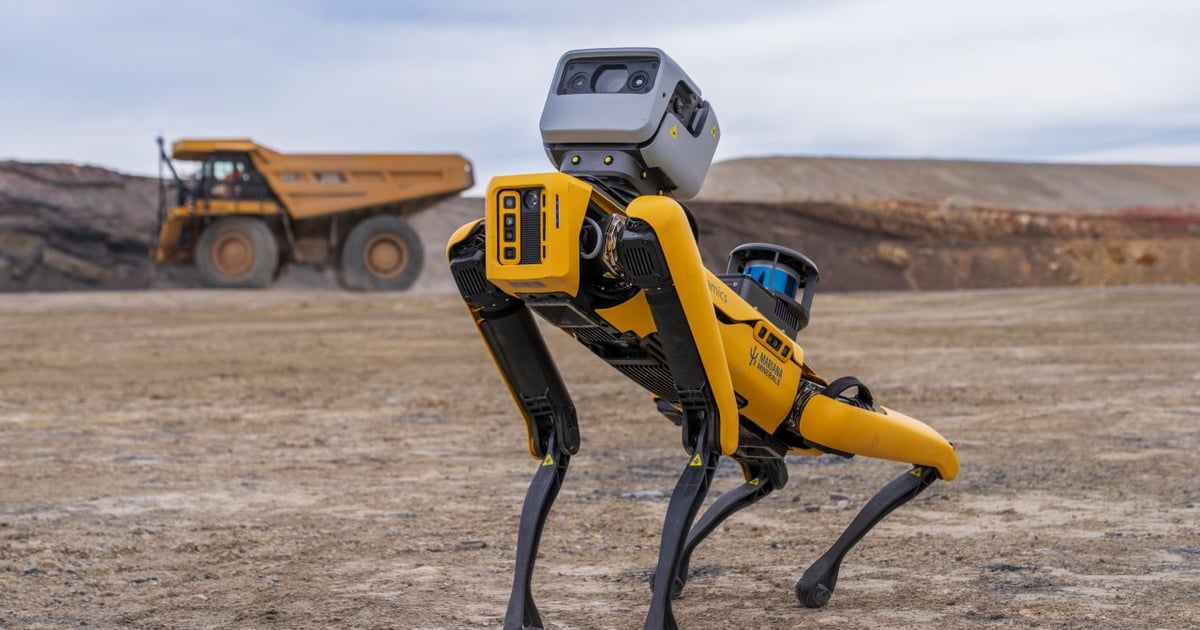
Boston Dynamics' quadruped robot, Spot, has been deployed at Mariana Minerals' Copper One facility near Moab, Utah, in a move the operator says brings it closer to running the world's first autonomous mine.Mariana Minerals is using Spot to automate routine inspection tasks, collecting data through its onboard sensors, including thermal imaging, cameras and acoustic capabilities.The deployment is also expected to lay the foundation for more predictive operations as the miner looks to bring more embodied AI into its processes. Mariana already uses automated drills to do the digging and giant robotic haul trucks to move ore for processing, with an AI-enabled platform called MarianaOS that tracks and directs the entire operation.Spot comes into play for the typically time-consuming, manual site inspection task. Mariana Minerals said automating these tasks enables employees to focus on more complex maintenance and optimization work.Related:DeepSeek Invests in Unitree to Develop AI Brain for Humanoid Bots"The way we're thinking about Spot is: ow do you free up people to do more value-accretive tasks?" said Juan Lozano, co-founder and CTO of Mariana Minerals. ”It [allows] our team to focus on work where they can add more value.""We got excited about the combination of the platform's flexibility and its advanced sensing capabilities,” he added.Why Inspections Are the Starting PointCopper One previously relied on human operators walking the plant for their inspections. The sheer scale of that task -- with the site spanning 10,000 acres -- combined with its repetitive nature, made it a natural target for automation, Lozano said."If you're running a good refinery, 99% of the time an inspection confirms that everything is operating as expected,” he said. “You are, by definition, looking for something that you don't expect to find. That can make it challenging to maintain the same level of operational discipline every single time, particularly when inspections are repeated multiple times a day."That's where Spot's multi-sensor approach comes in, combining thermal imaging, cameras and acoustic sensing to detect equipment wear, vibration and temperature changes that could indicate a maintenance problem.Marco Da Silva, vice president and general manager at Waltham, Mass.-based Boston Dynamics, said the deployment reflects a broader trend in mining robotics, but with a twist."There has been a lot of interest in mobile robotics in mining, often focused on inspecting mine faces or tailings dams," he said, referring to engineered structures that hold mining waste. "This deployment is interesting because it applies Spot's core inspection capabilities, looking at motors, pumps and using thermal and visual inspections in a way that is applicable across many industries."Related:Google DeepMind Releases Gemini 2 Humanoid ModelOnce Spot's success in inspecting the copper refinery is proven, Da Silva said, Boston Dynamics can start looking at layering additional applications onto the robot dog.Building Toward Predictive MaintenanceBeyond immediate labor savings, Mariana sees the deployment as laying the groundwork for smarter, more predictive operations.Currently when Spot flags an anomaly, the alert still goes to a person to assess. The goal, Lozano said, is to achieve automatic alerting so that an identified problem is automatically matched to the fix it has historically required, without human intervention.On top of that, Mariana wants to correlate Spot's data with everything else it already knows about the site to build a more complete operational picture."The first level of autonomy is taking a monotonous task and allowing the human who was doing it to focus on something else," Lozano said. "The thing we're really excited about is building that data set and using it to take more predictive and preventative actions rather than being reactive."Related:Chinese Startups Dominate Humanoid Robotics Patent RankingsGetting there, however, requires trust. For Mariana Minerals, Lozano said the focus is on reducing false positives and ensuring alerts are as accurate as possible before adding more predictive capabilities. Da Silva said the same is true on Boston Dynamics' end."The immediate focus is helping customers build trust in the automated alerts the robot is producing and developing systems where those thresholds can be identified automatically," Da Silva said. "There's still a roadmap ahead in terms of expanding the value Spot can deliver out of the box, but further automation of the inspection process will help deployments happen faster and deliver value sooner."Looking ahead, Lozano also said Mariana is considering Spot for tasks on construction sites -- particularly for large and integrated locations such as chemical refineries or mineral processing facilities."These facilities require a lot of infrastructure -- wiring, piping, cabling," he said. "So using vision, thermal and acoustic sensor systems to continuously walk the site and live update your 3D understanding of what is happening on-site and how it is happening is super important."Da Silva said Boston Dynamics sees applications well beyond mining. Because Spot is already walking a site, he said, it can potentially double as a data-gathering tool for other stakeholders, flagging safety hazards for an environmental, health and safety team the way a security guard would, for instance, separate from manipulation tasks suited to a robotic arm or maintenance work that a bipedal robot might eventually handle."We want to continue working with partners like this who have their eye on the future of how to manage remote, dangerous, and sometimes dull sites," he said.About the AuthorContributing WriterScarlett Evans is a freelance writer with a focus on emerging technologies and the minerals industry. Previously, she served as assistant editor at IoT World Today, where she specialized in robotics and smart city technologies. Scarlett also has a background in the mining and resources sector, with experience at Mine Australia, Mine Technology and Power Technology. She joined Informa in April 2022 before transitioning to freelance work.
Spot Robot From Boston Dynamics Deployed at Utah Copper Mine
Full Article
Original Source
Read the full article at Aibusiness →KhanList aggregates and links to publicly available news content. We do not host full articles from third-party sources. Always verify important information with original sources.